

Most blockchain conversations treat data as something that exists in the moment. A transaction is published. A blob is posted. A reference is committed. After that, availability is quietly taken for granted. This works early on, when networks are small and participants are highly motivated. It becomes fragile as systems grow, attention drifts, and incentives change. Walrus is designed for that fragile phase, not the early one.
As blockchain stacks become more modular, responsibility is split. Execution handles computation. Settlement handles finality. Applications focus on user experience. Data, however, cuts across all of them and stretches across time. It has to remain accessible not just when a system is popular, but when usage declines and participation thins out. When data disappears, systems rarely fail all at once. They lose their ability to verify themselves. Trust erodes quietly. Walrus exists to stop that slow decay before it becomes visible.
Early blockchains avoided this problem by putting everything onchain. Availability was guaranteed, but at the cost of scalability. As usage grew, data was pushed offchain to keep costs manageable. In many designs, availability stopped being enforced and started being assumed. Someone would store the data. Somewhere. For now. Walrus challenges that assumption by treating data availability as an obligation rather than a side effect.
The protocol allows large data blobs to live outside execution environments while anchoring their existence and integrity cryptographically. This keeps verification intact without forcing base layers to absorb unsustainable storage costs. More importantly, it makes responsibility explicit. Data is not just accepted and forgotten. It is maintained through incentives that reward continued availability, not just initial submission.
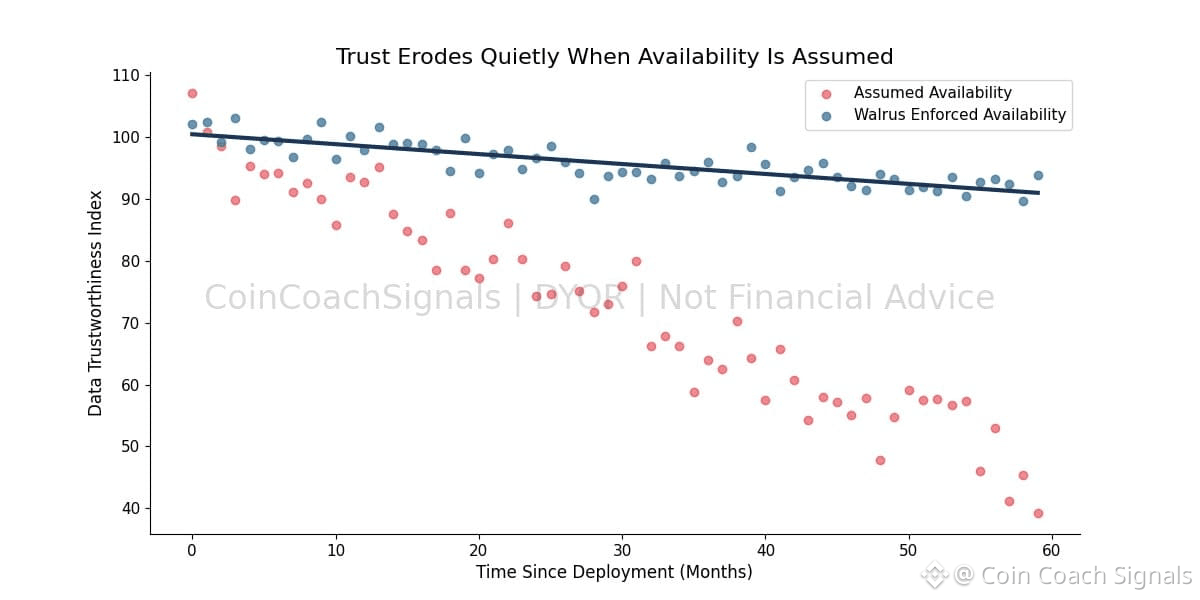
Time is the variable most systems underestimate. Data availability is rarely tested when data is fresh. It is tested months or years later, when incentives weaken and participants move on. Many systems look reliable early and degrade quietly later. Walrus is built for that delayed test. Storage providers are incentivized to stay engaged over long horizons, aligning rewards with persistence rather than momentary participation.
For rollups and Layer 2 systems, this reliability is foundational. Their security models depend on historical data for verification, dispute resolution, and state reconstruction. If that data becomes unreliable, execution correctness stops mattering. Walrus gives these systems a layer where continuity can be assumed instead of engineered through complex fallback logic. That simplification reduces risk across the entire stack.
This also reshapes how decentralization should be understood. Decentralization is often discussed in terms of execution or governance. Data availability matters just as much. A system with decentralized execution but fragile history is not resilient. Walrus strengthens decentralization by ensuring that long-term access to data does not depend on any single participant or moment in time.
Economic predictability reinforces this reliability. Infrastructure meant to support long-lived systems cannot rely on volatile or opaque pricing. Builders need to reason about availability costs over extended periods, not just deployment windows. Walrus emphasizes clearer economic structures that make long-term planning possible. Predictability matters more than short-term discounts when systems are expected to survive multiple cycles.
Neutrality is another defining trait. Walrus does not try to influence execution design, application behavior, or governance. It does not compete for users or liquidity. It provides a service that multiple ecosystems can rely on without giving up control. That neutrality reduces fragmentation and allows Walrus to integrate broadly without becoming a point of contention.
The ecosystem forming around Walrus reflects this mindset. Builders are not chasing attention or rapid iteration. They are working on rollups, archival systems, and data-heavy applications where failure cannot be undone easily. These teams care more about guarantees than features. For them, Walrus is valuable because of what does not happen. No missing history. No broken verification paths. No assumptions quietly failing over time.
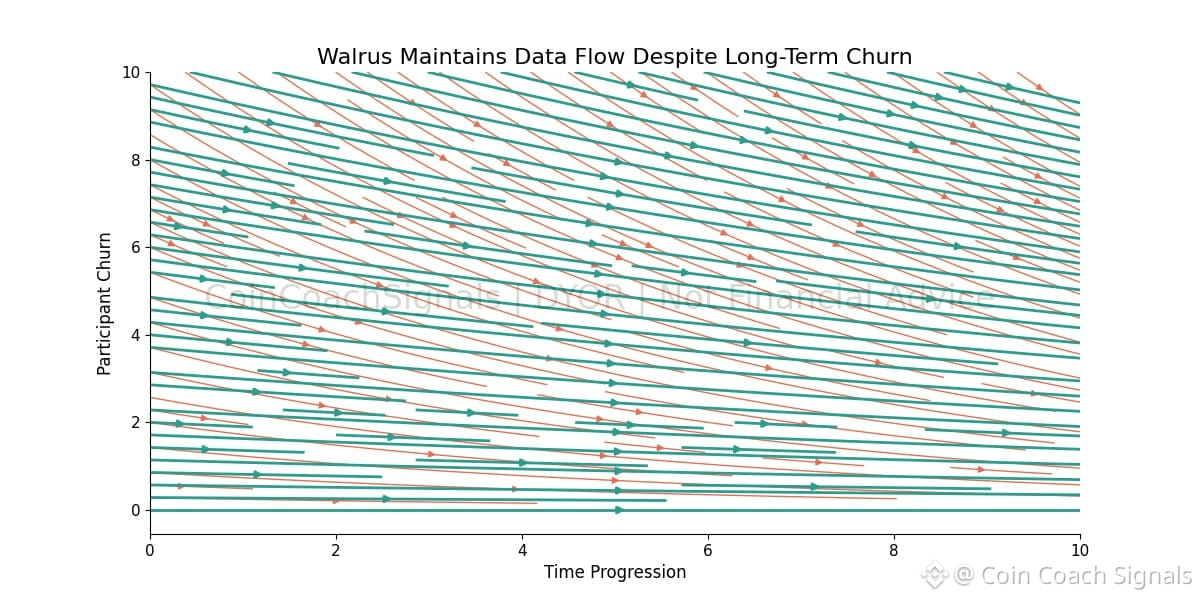
There is also a wider industry shift reinforcing this need. As blockchains handle more real value, tolerance for hidden fragility drops. Users may never talk about data availability, but they feel its absence immediately when systems fail to verify or reconstruct state. In mature environments, that kind of failure is unacceptable. Walrus is aligned with this reality by focusing on the least visible, but most consequential, layer of the stack.
Security models that assume failure rather than perfection naturally lead here. Systems designed only for ideal conditions rarely last. Walrus assumes participants will come and go, incentives will change, and attention will fade. By designing around those realities, it strengthens the foundations other layers depend on.
What ultimately defines Walrus is restraint. It does not expand beyond data availability. It does not chase execution narratives or application trends. Each design choice reinforces the same goal. Keep data accessible. Keep it verifiable. Keep it sustainable over time. That focus builds credibility slowly, but it compounds.
In complex systems, reliability is often defined by absence. No data loss. No silent degradation. No assumptions breaking years after deployment. Walrus is building for that negative space, making sure that as blockchain systems scale and modularize, their memory holds.
As the industry moves past experimentation, layers like Walrus stop being optional and start becoming foundational. End users may never see them, but entire ecosystems depend on them working quietly in the background. Walrus is building for that role. Deliberately, patiently, and with the understanding that infrastructure matters most when nobody is watching.
For educational purposes only. Not financial advice. Do your own research.
@Walrus 🦭/acc #Walrus #walrus $WAL

