

Kadcast Network has quietly become one of the more interesting parts of the Dusk ecosystem, especially as blockchain infrastructure conversations shift toward performance that actually works for financial markets. In early 2025, as institutions continue to explore onchain settlement and tokenized assets, speed and reliable communication are no longer optional features. They are requirements. Kadcast sits right in the middle of that discussion, even if most casual users never hear its name.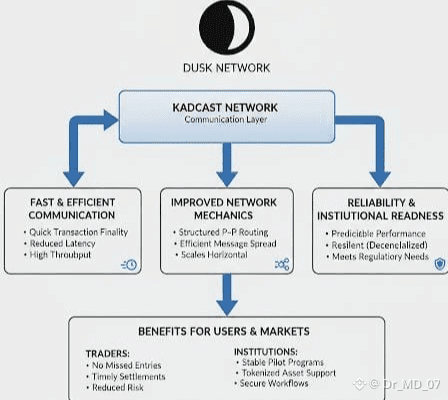
At its core, Kadcast is a communication layer. That might sound abstract, but it is easier to understand if you think of a blockchain network as a large group chat where every message must reach the right people quickly and accurately. If messages arrive late or get lost, the entire system slows down. Traditional blockchain networks often struggle here, especially under heavy load. Kadcast was designed to solve this exact issue by improving how information travels across the network.
Dusk integrates Kadcast to ensure that transactions and consensus messages spread efficiently between nodes. Instead of broadcasting messages blindly to everyone, Kadcast uses a structured peer to peer approach inspired by distributed networking research. In simple terms, each node knows exactly where to send information next, reducing delays and unnecessary data traffic. This is one of the reasons Dusk can offer fast transaction finality without compromising decentralization.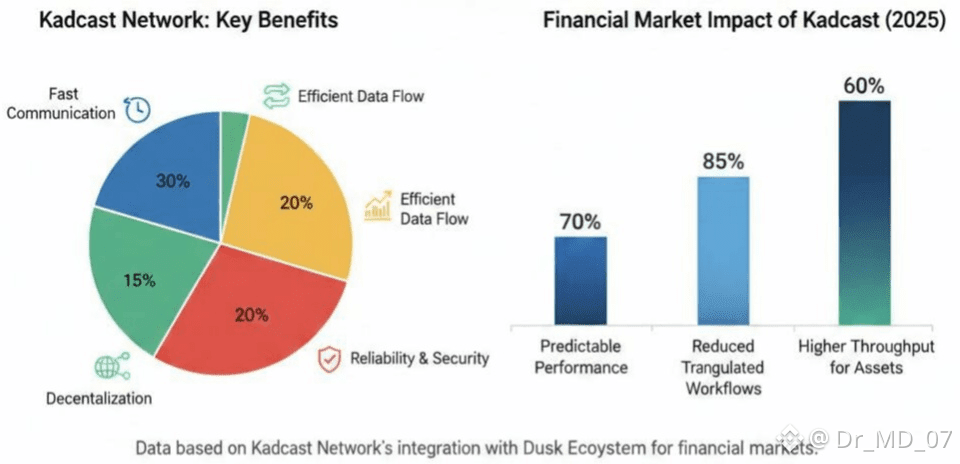
From a trader’s perspective, this matters more than most people realize. Anyone who has dealt with congested networks during high volatility knows how painful slow confirmations can be. Missed entries, delayed settlements, and uncertainty around finality all translate into risk. Dusk’s use of Kadcast addresses this problem at the infrastructure level, rather than patching it later with temporary fixes.
Kadcast is also gaining attention because it aligns well with current regulatory and institutional expectations. Financial institutions care deeply about predictable performance. In 2024 and 2025, many pilot programs around tokenized bonds, equities, and funds failed not due to lack of interest, but due to unreliable network behavior. Kadcast helps Dusk maintain low latency communication even as network activity grows, which is essential for regulated financial workflows.
What makes Kadcast particularly interesting is how it balances speed and security. Faster communication often comes at the cost of higher centralization or weaker fault tolerance. Kadcast avoids this by using efficient message routing without relying on a small set of privileged nodes. This ensures the network remains resilient even if some nodes go offline or behave unexpectedly. For a blockchain targeting regulated markets, this reliability is non negotiable.
In recent development updates throughout late 2024 and early 2025, Dusk has continued refining its network stack to support higher throughput without sacrificing privacy. Kadcast plays a supporting role here. While privacy protocols protect transaction details, Kadcast ensures the encrypted data still moves quickly across the network. This combination is one reason Dusk stands out among blockchains attempting to serve real financial use cases.
From a broader market perspective, Kadcast is trending because the industry is finally acknowledging that communication layers matter. For years, focus was placed almost entirely on smart contracts and token standards. Today, infrastructure quality is back in focus. Investors and institutions are asking harder questions about how networks behave under stress. Dusk’s decision to build on Kadcast shows a long term mindset rather than chasing short term hype.
As someone who has watched multiple market cycles, this shift feels familiar. Each cycle matures the conversation. In earlier years, flashy features attracted attention. Now, stability and predictability are earning respect. Kadcast is not a headline grabbing technology, but it is the kind of system traders and institutions appreciate once they understand its impact.
Another reason Kadcast fits well with Dusk is scalability. As more participants join the network, communication efficiency becomes harder to maintain. Kadcast is designed to scale horizontally, meaning performance does not degrade sharply as the network grows. This is particularly important for financial infrastructure that must support long term growth without repeated redesigns.
Looking ahead, Kadcast’s role may become even more visible as Dusk expands validator participation and supports more complex financial instruments. Communication demands increase as applications grow more sophisticated. Having a proven and efficient networking layer already in place gives Dusk room to evolve without introducing instability.
In practical terms, most users will never interact with Kadcast directly. They will simply notice that transactions finalize quickly, the network feels responsive, and reliability remains consistent even during periods of heavy use. That is exactly how good infrastructure should work. Invisible, dependable, and quietly effective.
Kadcast Network is a reminder that blockchain progress is not only about new features, but about better foundations. By prioritizing fast and efficient communication, Dusk positions itself closer to the expectations of real financial markets. For traders, builders, and institutions watching the space mature, that focus is becoming increasingly hard to ignore.
