
Dusk tightens when both sides believe settlement is already behind them.
The order matched. Value locked. Exposure felt mostly spent. On many stacks, this is where attention thins out. Execution happened. The rest is timing.
On Dusk, timing doesn’t finish the job.
A transfer moves into finality under a disclosure scope that held earlier. No vote. No alert. Just a boundary shifting because execution crossed into a different state context. The asset is still there. The intent didn’t change. What changed is whether the protocol still allows symmetry.

It doesn’t.
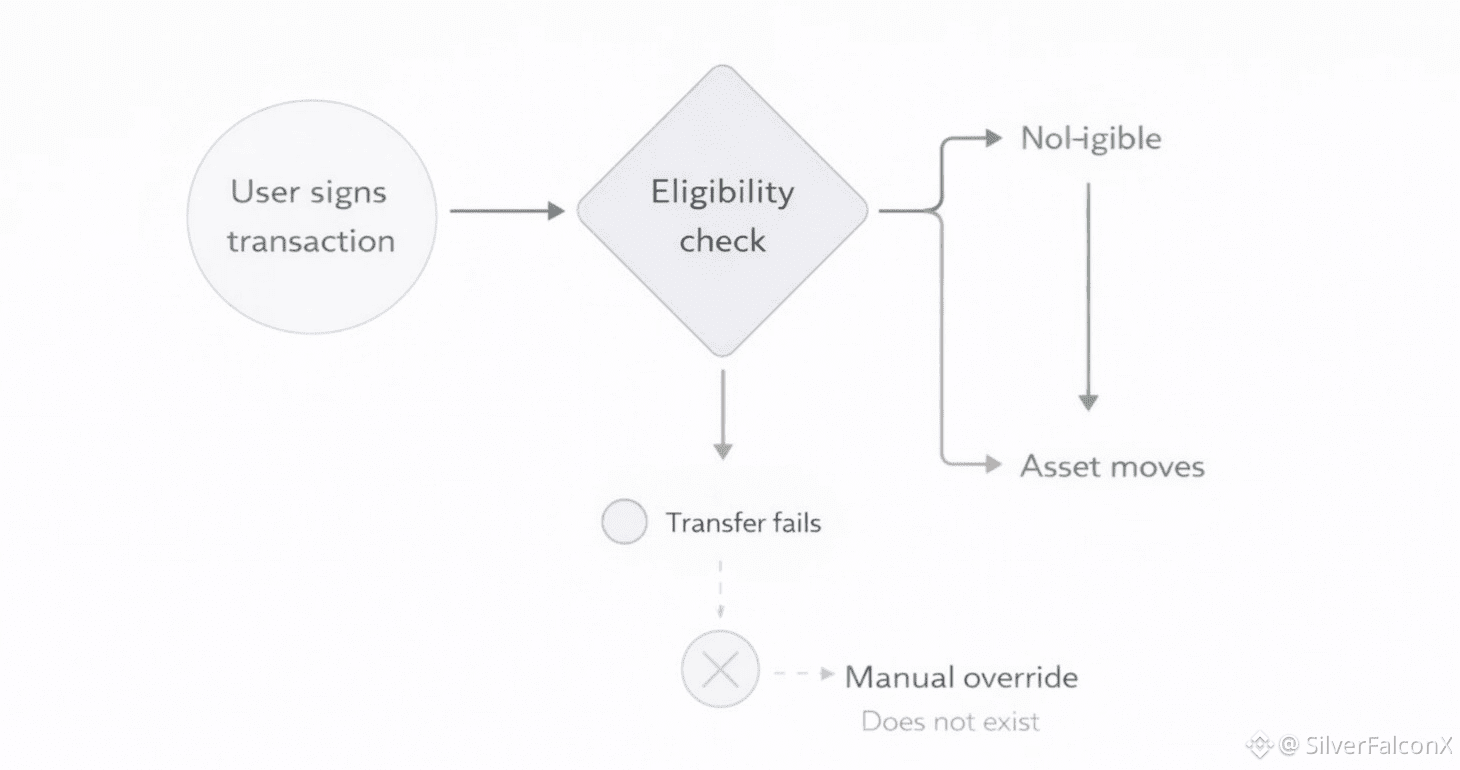
The state doesn’t advance. Not partially. Not in a way that can be patched after. Finality doesn’t land because settlement is checked as its own event, not inherited from execution. Whatever had to be true at that moment either was or wasn’t.
There’s no spectacle around it.
No revert storm. No validator drama. No fault to escalate. Capital just sits where it shouldn’t have assumed it could pass. That’s usually when people realize how much they rely on settlement being polite.
Other systems smooth this out. They let execution carry settlement along with it. If something feels off later, reconciliation absorbs the mismatch. Logs get annotated. Explanations grow. The ledger keeps its forward motion and everyone agrees the window probably didn’t matter that much.
Dusk doesn’t let settlement borrow legitimacy.
Confidential transfers don’t become legible because both parties want closure. Disclosure scope doesn’t widen because liquidity is impatient. Proof has to clear at finality, not near it. If it doesn’t, nothing completes.
Silece follows.
No mempool churn to read. No public trace to argue over. From the outside, it looks like nothing happened. From inside the system, the answer is already settled. Just not in the way anyone hoped.
This is where regulated flows usually crack.
Teams design for fast execution and assume settlement will behave like paperwork. Something that confirms what already feels done. Dusk flips that order. Execution can be quick. Settlement is where alignment is re-checked, and it doesn’t care how close you were.
The cost shows up immediately.
Liquidity thought to be committed goes idle. Delivery-versus-payment pauses because one side can’t finalize without expanding disclosure. Windows close. Counterparties revisit terms, not because risk changed, but because the system refused to pretend it hadn’t.
Systems that soften this teach a habit. Settlement becomes ceremonial. Finality becomes debatable. When disputes arrive, the argument is always about what should have counted.
Dusk doesn’t leave room for that argument.
Finality only lands when confidentiality, disclosure scope, and settlement conditions line up at the same instant. Not before. Not after.
That makes settlement slower when pressure hits.
And it means that when it does land, there’s less left to explain.
The state moved.
Or it didn’t. @Dusk
