
A small disruption is enough to expose the weak spots in any fast-finality system. Everything can appear normal at a glance—activity continues, messages flow, and the chain doesn’t “stop.” Yet the experience changes immediately for anyone trying to move real value. Decisions take longer to lock in, confidence drops, and every handoff in the pipeline starts needing a second check. It’s not the dramatic failure people prepare for. It’s the quiet kind that turns routine settlement into cautious waiting.
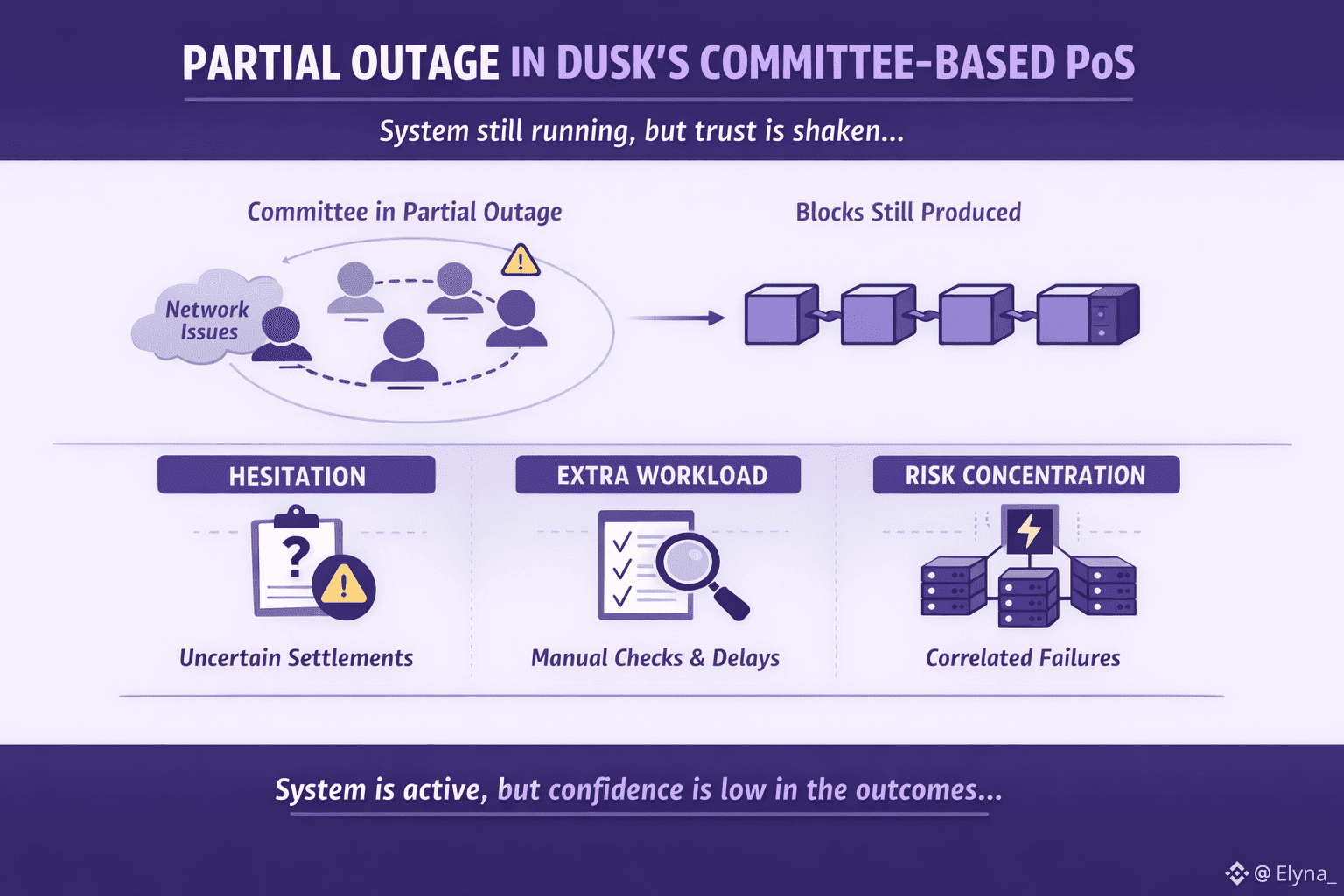
This is where Dusk’s committee-based Proof of Stake becomes a real operational story. In ideal conditions, committees are efficient. They reduce the number of participants needed to agree, so results arrive quickly and predictably. That is exactly what regulated markets want: not just speed, but clean closure. The problem is that partial failure attacks the one thing committees are meant to provide—reliable coordination.
During a partial outage, some validators may be slow, unreachable, or stuck behind network issues. They are not gone forever, but they stop behaving in sync. That alone can reshape the whole system. A committee doesn’t need everyone to respond, but it needs enough timely responses to keep the process smooth. When responses come late, the protocol might still keep moving, but the people building on top of it feel the mismatch.
The first visible impact is hesitation. Applications and users stop acting on “probable” results. A trade desk does not want to mark a position closed unless the settlement is unquestionably done. An issuer does not want to update records if there is a chance the network state will need correction or re-checking. Even when nothing is technically wrong, human operators introduce friction because the cost of being wrong is higher than the cost of being slow.
The second impact is operational workload. When finality feels less clean, teams compensate with manual safety steps: extra monitoring, repeated confirmation checks, and internal reconciliation. What should be one straight line becomes a loop. This is where time disappears. Not inside the protocol itself, but in the surrounding “trust layer” that institutions build when they can’t afford uncertainty.
The third impact is risk concentration. Committees are smaller than the full validator set, which is why they can be fast. But smaller sets also mean that correlated failures matter more. If several committee members share the same cloud provider, region, or network route, one incident can remove a meaningful portion of the group at once. That changes the security and performance profile quickly, even if the rest of the network is healthy.
Dusk’s design is built around regulated finance, so the real measure of resilience is not whether blocks keep arriving. The measure is whether settlement stays boring. Partial outages test that boringness. They reveal if the system can remain predictable when the committee is imperfect, the network is uneven, and time-sensitive users are watching the clock.
In the end, partial failure is not mainly a protocol event. It is a confidence event. The chain can still run, but the market only functions when participants can treat outcomes as finished without adding footnotes. That is the standard Dusk is aiming for—and the exact standard partial outages are designed to challenge.
