
Top officials from the European Union and the Mercosur bloc have formally signed a landmark free trade agreement in Asunción, Paraguay, concluding 25 years of negotiations and paving the way for the EU’s largest trade accord to date.
Once approved by the European Parliament and ratified by the legislatures of Argentina, Brazil, Paraguay, and Uruguay, the agreement will significantly lower tariffs and enhance trade flows between two regions representing a combined market of around 700 million people.
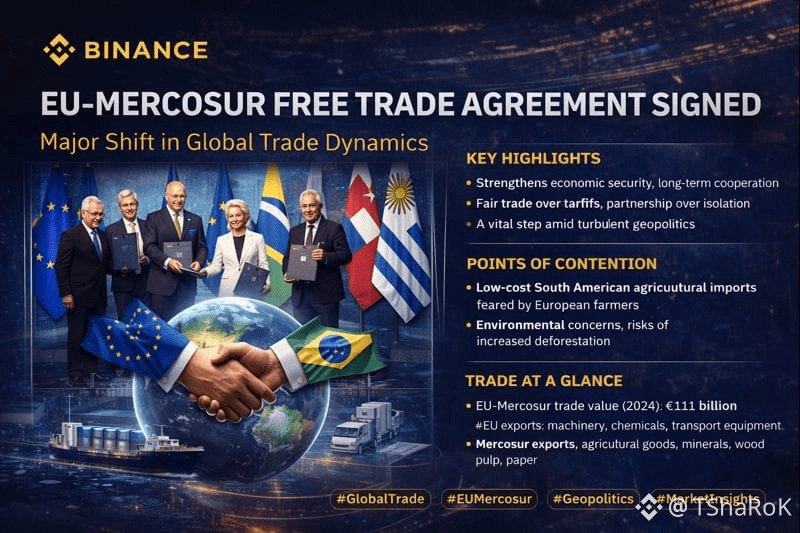
🔑 Key Highlights
The deal aims to strengthen economic security and long-term cooperation amid rising global trade tensions.
European Commission President Ursula von der Leyen described the agreement as a clear choice of “fair trade over tariffs” and partnership over isolation.
European Council President Antonio Costa emphasized that the pact helps both blocs navigate an increasingly turbulent geopolitical environment without compromising core values.
⚠️ Points of Contention
Despite broad political backing, the agreement has faced opposition from European farmers and environmental groups, who fear:
An influx of low-cost agricultural imports from South America
Potential environmental risks, including increased deforestation
📊 Trade at a Glance
EU–Mercosur trade value (2024): €111 billion
EU exports: machinery, chemicals, transport equipment
Mercosur exports: agricultural goods, minerals, wood pulp, paper
Brazil’s government described the deal as emblematic of President Luiz Inácio Lula da Silva’s broader strategy to diversify trade partnerships, alongside negotiations with the UAE, Canada, Vietnam, and India.
🌐 Market Perspective
For investors, the agreement highlights shifting global trade alliances and could have long-term implications for:
Industrial and manufacturing sectors in Europe
Agriculture, commodities, and logistics across South America
Currency and macro trends linked to cross-border trade flows
As global markets adjust to evolving trade policies and geopolitical pressures, developments like the EU–Mercosur pact are critical signals for macro-driven investment strategies.
#GlobalTrade #EUMercosur #MacroEconomics #Geopolitics #MarketInsights #TradeAgreement #BinanceSquare