
You encounter an uncomfortable obstacle the first time you attempt to create a "real" on-chain product that goes beyond token swapping: blockchains are excellent at showing that something occurred, but they are awful at recording what actually occurred. Images, videos, PDF papers, AI datasets, gaming assets, trade confirmations, identity credentials, or audit files may all be required for a single application. You've subtly reintroduced a central point of failure if the data is stored on a standard cloud server. You will always have to pay for it if you attempt to store it directly on-chain, and performance quickly deteriorates.
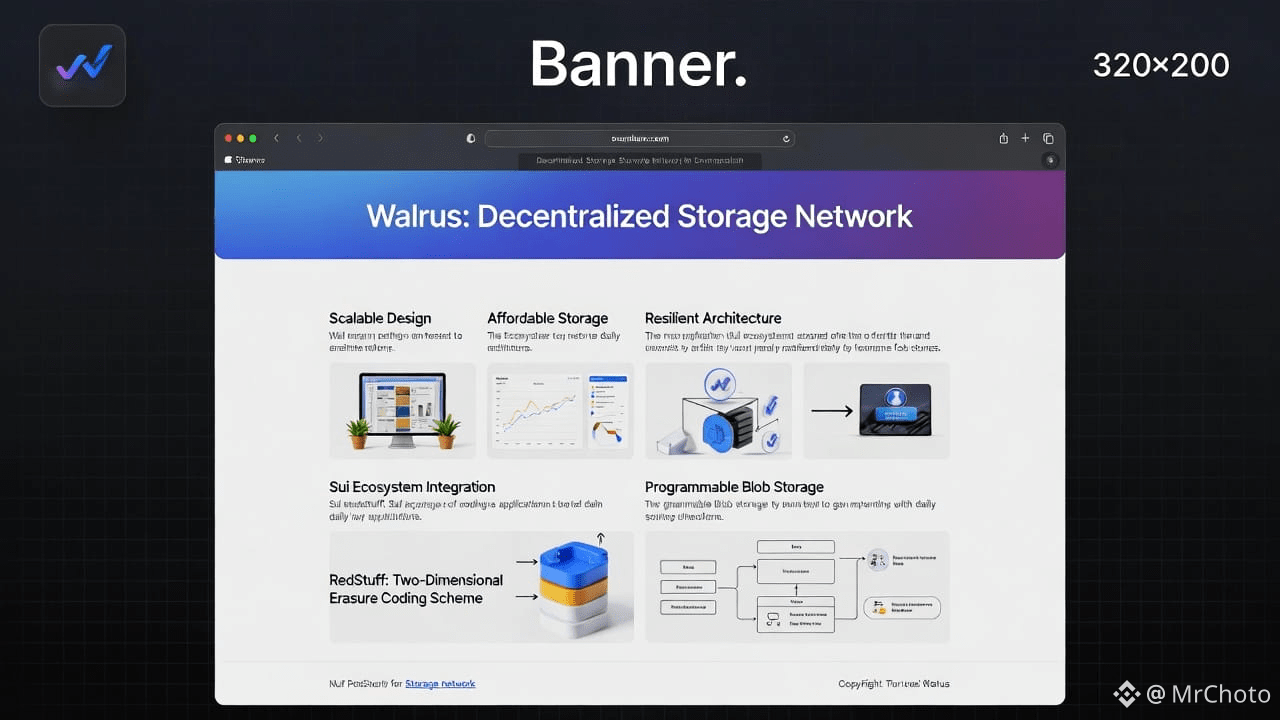
Walrus is attempting to address this issue, which is why professional builders are taking notice. Walrus isn't just another "storage coin" attempting to replicate what already exists. It is based on the idea that decentralized storage must become scalable, affordable, and resilient; otherwise, it would continue to be a specialized tool used primarily by ardent cryptocurrency enthusiasts.
Walrus is a decentralized storage network made for huge, unstructured data that don't belong on a chain, which it refers to as "blobs." To put it simply, it seeks to enable apps to treat storage as a native Web3 fundamental while storing large amounts of data safely without depending on a single provider. The project was initially created within the Sui ecosystem and used Sui as its control plane. This means that the blockchain facilitates the coordination of node participation, incentives, and the lifespan of stored data without requiring the data to be on-chain. The Walrus whitepaper and subsequent research articles outline the technical design, and on March 27, 2025, the network's mainnet was made public.
So why is this important to investors and traders? Because storage is no longer a narrative add-on. Every significant market that Web3 seeks to enter is hampered by it, including tokenized real-world assets, decentralized media, DePIN networks, AI training data, and even simple consumer apps. Additionally, "storage" is one of the only cryptocurrency industries where demand naturally increases as data continues to grow.

Walrus's approach to cost and dependability is its fundamental characteristic. In order to prevent files from disappearing, traditional decentralized storage frequently relies on full replication. That is easy, but costly. Instead, Walrus employs a unique two-dimensional erasure coding scheme known as RedStuff. The system divides a file into coded fragments, or "slivers," and distributes them among numerous storage nodes rather than repeatedly duplicating entire files. This allows the original file to be recovered even in the event that a significant chunk of the network goes down. In essence, this architecture offers a better engineering trade-off than brute-force replication by lowering overhead while maintaining durability and retrieval performance.
Walrus documentation explains this directly in cost terms: by using erasure coding, Walrus targets storage overhead around ~5x the blob size (encoded pieces stored across nodes), which is positioned as far more efficient than fully replicating everything everywhere. That number matters because decentralized storage only becomes mainstream when costs feel competitive enough for real applications. Developers will tolerate some extra cost for censorship resistance and permanence, but not a 20x penalty.
Another important part of Walrus is how it treats storage as something apps can program against, not just “upload and pray.” In older models, decentralized storage can feel like a separate world: you store data, get a hash, and hope it stays available. Walrus has been pushing the idea of programmable blob storage meaning storage actions can be governed, verified, and coordinated through on-chain logic, improving how apps manage data availability guarantees. The project’s own blog frames this as bringing programmability to data storage, which is a real shift in positioning.
Walrus's treatment of storage as something that programs may program against rather than just "upload and pray" is another crucial feature. Decentralized storage can seem like an other planet in previous models: you store data, obtain a hash, and hope it remains accessible. In order to improve how apps handle data availability assurances, Walrus has been promoting the concept of programmable blob storage, which allows storage actions to be controlled, validated, and coordinated by on-chain logic. According to the project's own blog, this represents a significant change in perspective by making data storage programmable.
Here's the realistic investor perspective: whether or not Walrus becomes infrastructure will determine its true impact, not whether or not it gains popularity. Storage networks with robust technology have already been introduced to the market, but they have not been able to gain widespread use outside of crypto-native circles. According to Walrus, the next wave of demand will come from builders who need storage that works with contemporary goods like AI agents, media platforms, and data marketplaces rather than from "people who love decentralization."
Walrus has a distinct strategic advantage in this regard because it is attempting to enhance rather than replace a blockchain. Instead of starting from scratch, Walrus may rely on an established ecosystem for coordination, governance primitives, and incentive rails by using Sui as the control plane. Because builders who are already part of that ecosystem can incorporate storage without leaving their home base, this typically accelerates adoption.
Allow me to illustrate this with a straightforward example.
Consider a small team developing a platform for tokenized research. They want analysts to submit datasets (CSV files), reports (PDFs), and possibly even AI tool training data. Ownership (who paid for what), licensing (who can access), and settlement are all handled by the on-chain component. However, it is not realistic for the material to exist on-chain. The platform is still susceptible if that content is kept on AWS because users must have complete faith in the operator, the server may be shut down, and access may be revoked. A third approach is provided by Walrus, which keeps the proofs and access coordination linked to the chain, stores the files throughout a decentralized storage network, and lessens need on a single provider.
That's a cleaner risk structure, not ideology.
It's also helpful for traders to consider Walrus from the perspective of "what becomes essential if Web3 succeeds." Storage is a must. Storage demand will increase if you think tokenized assets, consumer cryptocurrency apps, or AI-driven chain agents will develop. Walrus places itself precisely at that pressure point, offering decentralized big data reliability at prices that can sustain actual use.
The impartial conclusion is that Walrus is not inherently "better" than all of its rivals. Decentralized storage is challenging, and the industry is crowded. However, by connecting to an ecosystem (Sui) that already has builders and liquidity, Walrus is proposing a particular and credible engineering level increase in erasure coding durability, cost effectiveness, and storage programmability. Over the next two to three years, its success will be determined more by whether or not actual programs select it as their primary storage infrastructure than by hype cycles.
The impact won't appear to be a sudden pump if Walrus prevails in that struggle. It will appear as something more subdued and significant: files being kept, retrieved, and used on a daily basis until it gets monotonous. When it functions properly, real infrastructure typically looks like that.

