In early Web3 applications, storage failures are often tolerated. Data loss is inconvenient, but not catastrophic. Teams accept risk because usage is low, users are few, and systems are still experimental.
That tolerance disappears once applications reach real users.
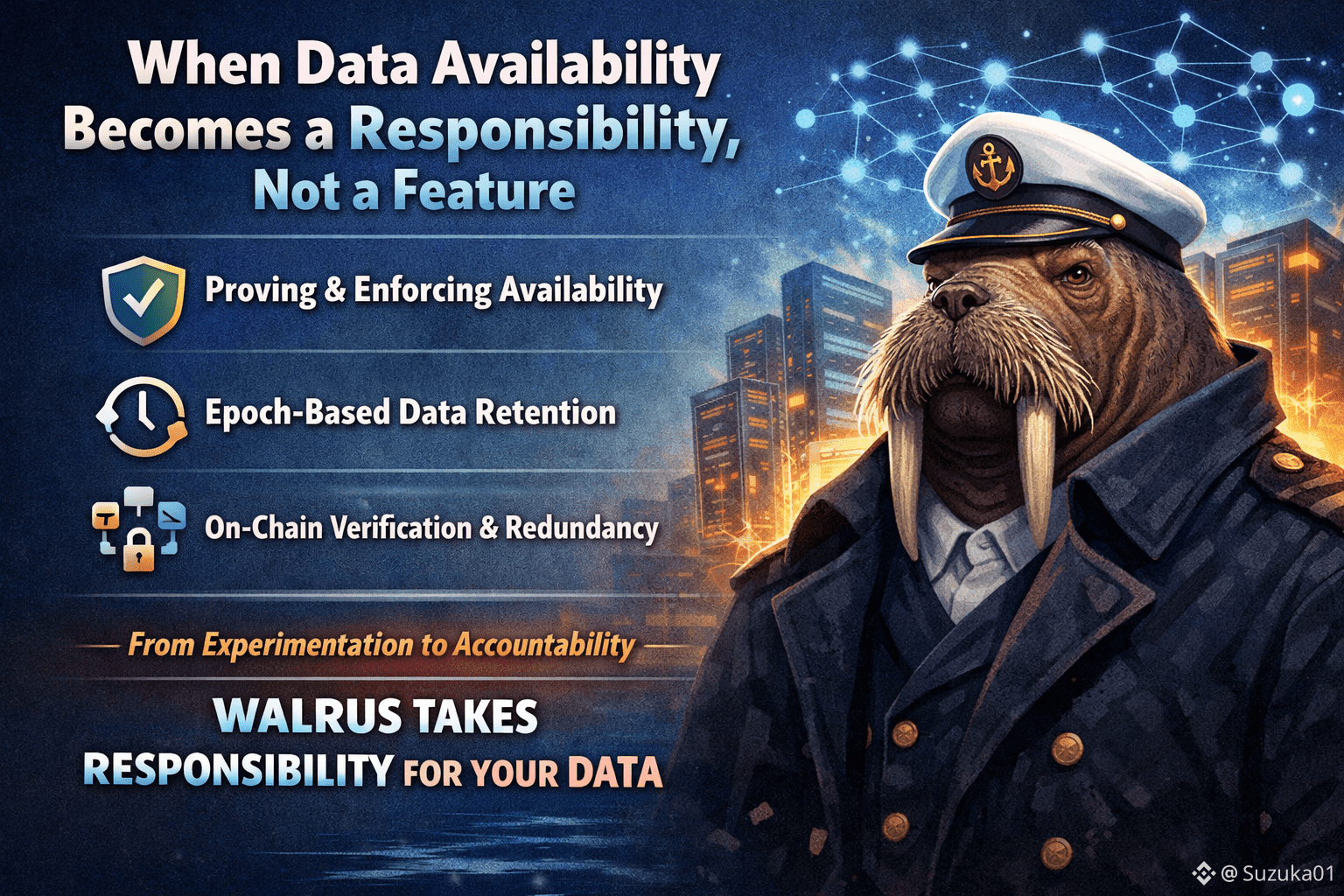
At that point, storage stops being a technical detail and becomes an uptime dependency. If data is unavailable, applications fail. If availability cannot be proven, trust breaks. Walrus exists for this exact transition.
@Walrus 🦭/acc is designed for the moment when applications can no longer afford “best-effort” data availability. Instead of assuming data will remain accessible, Walrus treats availability as something that must be continuously demonstrated and enforced.
Storage on Walrus ($Wal) is not static. Data lives through defined retention periods, managed in epochs, with rotating committees responsible for maintaining availability. Redundancy and encoding ensure that data can be reconstructed even as nodes churn or network conditions change. Applications do not rely on optimism — they rely on guarantees.
Crucially, Walrus does not fail quietly. Proofs of availability anchor storage commitments on-chain, allowing applications to verify not only that data exists, but for how long it is expected to remain available. This turns storage into accountable infrastructure rather than a fragile off-chain assumption.
As Web3 matures, many applications will discover that data availability is no longer optional. Rollups, L2s, on-chain games, and data-heavy protocols all depend on storage behaving predictably over time. Walrus is built for those systems — not during experimentation, but when failure is no longer acceptable.
Walrus does not promise storage.
It takes responsibility for it.