
In crypto, attention moves fast, but infrastructure moves the world. While traders chase short term volatility, the deepest value often forms inside the quiet systems that make everything else possible. Walrus (WAL) is positioned in that infrastructure category, not as a hype driven token, but as a working component inside a protocol designed for secure interactions, private execution, and decentralized storage built to handle real scale.
Walrus is not just another DeFi primitive. It blends privacy aware blockchain behavior with distributed data design, aiming to support applications that need more than simple token transfers. The core idea is straightforward: users and builders want onchain utility without sacrificing confidentiality, and they want storage that does not depend on centralized cloud gatekeepers. Walrus attempts to solve both, while operating on the Sui blockchain and leveraging advanced architecture like erasure coding and blob storage.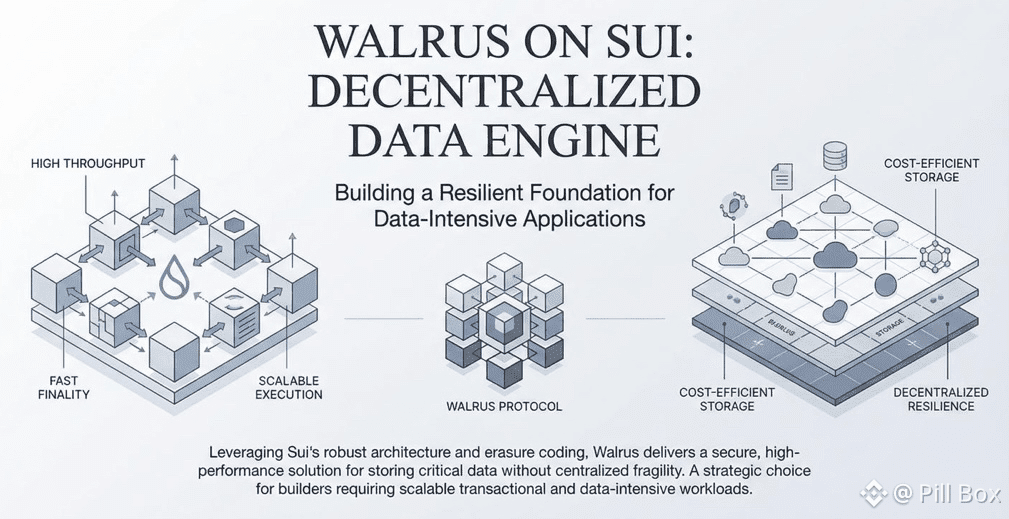
This article breaks down what Walrus actually represents, why its design choices matter, and where WAL may gain relevance as Web3 infrastructure evolves globally.
Why Walrus Exists: The Gap Between Finance and Function
Most DeFi systems today are still built like open spreadsheets. Everything is visible. Every transaction, balance movement, and strategy is easily traced. That transparency can be good for auditing, but it also creates serious limitations for adoption.
Privacy is not only about hiding. It is also about optionality, efficiency, and business viability.
Consider what happens when a serious user tries to operate on a fully transparent chain:
Competitors can track positions
Liquidators can profile behavior
Institutions cannot protect execution logic
Market makers expose strategy footprints
Enterprise partners cannot store sensitive data safely
In other words, transparency becomes friction.
Walrus approaches this by focusing on secure and private blockchain based interactions. It aims to support private transactions and broader tooling across dApps, governance, and staking. This matters because privacy is one of the few remaining “missing layers” for mainstream onchain expansion.
Walrus is essentially trying to build a system where confidentiality is a feature, not a hack.
WAL Token Utility: A Native Asset With Real Protocol Weight
A token becomes meaningful when it has non optional usage inside a working economic loop. WAL is described as the native cryptocurrency token used within the Walrus protocol. That implies it functions not just as a tradable asset, but as a mechanism for activity inside the ecosystem.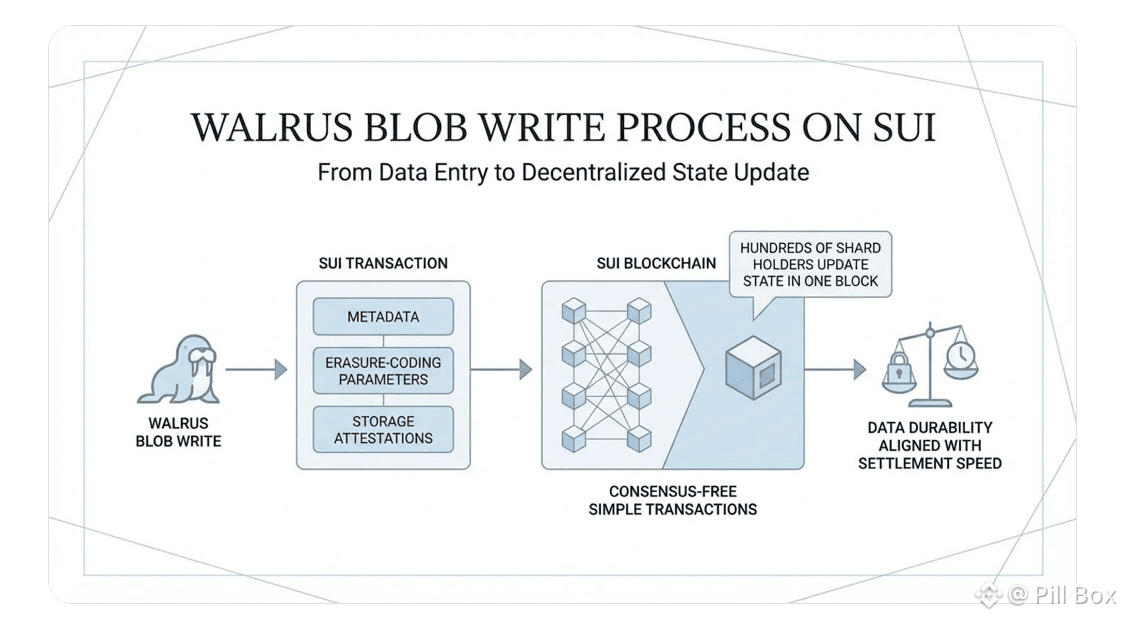
While token models vary, a native token in a protocol like this commonly supports areas such as:
Staking participation for security and incentives
Governance alignment for upgrades and parameters
Network usage fees for transactions and storage operations
Developer and user incentives for adoption and liquidity
When privacy and storage are part of the design, WAL becomes even more important because these networks must coordinate resources. Storage is not free, redundancy is not free, and decentralized persistence requires economic structure.
A protocol token is often the fuel that ensures participants behave reliably. In that sense, WAL has the potential to play a functional role rather than existing solely for speculation.
Walrus on Sui: Why the Base Layer Choice Changes the Game
The Walrus protocol operates on the Sui blockchain, and that detail should not be treated as marketing. The underlying chain determines throughput, composability style, cost structure, and developer experience. Sui has been recognized for performance oriented design and parallel execution, which is valuable when a protocol aims to handle heavy data flows and application level activity.
When a system is built for decentralized storage and private interactions, it can generate more complex workflows than basic DeFi swaps. Sui’s design can reduce bottlenecks, and that matters for a protocol trying to serve global use cases.
The chain you build on influences the ceiling you can reach.
Walrus aligns itself with a network that aims for scalability, which increases the probability that Walrus can support real world adoption rather than becoming stuck in low throughput limitations.
The Storage Layer: The Most Underrated Battle in Crypto
People talk about liquidity. People talk about narratives. Few talk about storage, but storage is quietly becoming one of the most strategic primitives in Web3.
Why?
Because the next generation of decentralized applications is not only financial. It includes:
Decentralized social and identity
Onchain gaming and digital assets
AI agents and verifiable data pipelines
Enterprise documentation and compliance records
Media storage and content delivery
All of these require reliable data persistence. Not temporary state, but true storage.
Walrus is designed to facilitate decentralized and privacy preserving data storage and transactions. That combination is important because storage without privacy can still expose user metadata, while privacy without storage still depends on centralized databases.
Walrus attempts to unify both.
Erasure Coding and Blob Storage: A Practical Blueprint for Scale
Walrus uses a combination of erasure coding and blob storage to distribute large files across a decentralized network.
This is a serious architectural choice.
Erasure coding is widely used in advanced distributed storage systems because it can provide fault tolerance more efficiently than simple replication. Instead of copying a full file multiple times, the file is split into fragments with mathematical redundancy, allowing the original data to be reconstructed even if some pieces are missing.
Blob storage refers to storing large unstructured objects, such as videos, archives, datasets, and media files. This matters because decentralized apps increasingly rely on large content objects, not only small onchain values.
Together, these choices suggest Walrus is aiming for a storage system that is:
More resilient against node failures
More cost efficient than naive duplication
Better suited for large scale file distribution
Designed for real throughput rather than hobby use
And this leads to one of Walrus’s strongest positioning angles:
Cost efficient, censorship resistant storage that can serve real applications.
Why Censorship Resistance is Not Just Politics
Censorship resistance is often framed as ideological, but the real value is operational.
A censorship resistant storage network allows applications to function without being vulnerable to:
Single provider shutdowns
Geographic limitations
Platform deplatforming
Corporate compliance pressure
Unexpected pricing changes
In a world where platforms can cut access overnight, decentralized storage becomes a stability layer. This is especially relevant for builders who want applications to be durable, global, and difficult to disrupt.
Walrus is presented as suitable for enterprises, applications, and individuals seeking alternatives to traditional cloud solutions. That framing signals a broad market target.
It is not only for crypto natives, but also for teams that want neutrality and predictable access.
Walrus as “Private DeFi Infrastructure” Instead of Another App
A key mental model shift is this:
Walrus is not primarily competing with one DeFi protocol. It is competing with the baseline expectations of onchain usability.
If Walrus successfully enables private transactions, dApp tooling, governance coordination, and scalable data storage, then the Walrus protocol becomes an enabling layer.
That puts it closer to infrastructure than application.
Infrastructure tokens have different market behavior than app tokens. They tend to gain value as:
More builders integrate the protocol
More usage fees accumulate
More network participants stake and secure
More real workflows depend on the system
This is why WAL may attract attention from builders who think beyond short term trading. If the protocol becomes a default option for private storage and transaction tools, adoption can compound.
The Global Market Case: Where Walrus Fits Outside Crypto Echo Chambers
“Global” utility is not about marketing reach. It is about whether a product survives in diverse environments.
Walrus has a design thesis that can translate well globally because it addresses broad needs:
Lower cost storage for emerging markets
Neutral data access for cross border teams
Privacy first finance for regions with surveillance risk
Alternative to centralized cloud dependency
In many parts of the world, centralized infrastructure is not only expensive, it is unstable. Data availability can be restricted, pricing can be unpredictable, and access can be revoked. A decentralized storage and transaction layer can become a competitive advantage for global teams.
Walrus positions itself as cost efficient and censorship resistant, which suggests it is built for real conditions, not just theory.
What to Watch: Signals That WAL is Becoming More Than a Token
Investors and users often focus on charts, but protocol growth shows up in different places first. If you want to track whether Walrus is strengthening, focus on signals like:
Developer integrations and tooling adoption
Growth of storage usage volume over time
Network participation metrics from validators or providers
Governance activity and proposal quality
Partnerships with dApps needing private infrastructure
Real use cases beyond speculative loops
When a protocol works, it starts being used quietly. Then demand shows up later.
The strongest crypto assets often look boring before they look obvious.
Final Perspective: WAL as a Utility Anchor in the Data Driven Web3 Era
Web3 is moving into a phase where finance alone is not enough. The next wave requires private coordination, scalable storage, and infrastructure that can support large applications without collapsing into centralized dependencies.
Walrus (WAL) represents a credible attempt to build that layer.
By operating on Sui, integrating erasure coding and blob storage, and focusing on privacy aware DeFi interactions, Walrus aims to deliver what many ecosystems still lack: a practical bridge between secure value transfer and durable decentralized data.
If Web3 becomes truly global, the networks that survive will not be the loudest. They will be the ones that quietly make everything else work.
And that is exactly where Walrus is trying to position itself.

