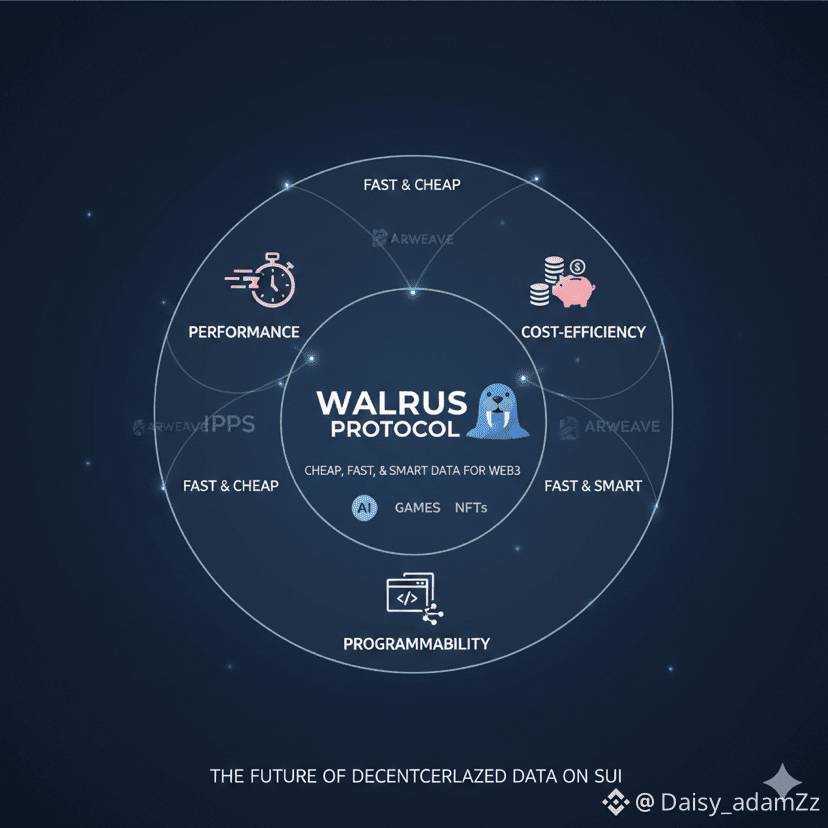
Decentralized storage has always sounded great in theory, but in reality it’s often been slow, expensive, or hard to use. Walrus Protocol is different. It focuses on making decentralized data actually practical for everyday Web3 applications, not just technically decentralized.
#Walrus is built to store large amounts of data at a low cost, retrieve it quickly, and connect it directly to smart contracts. That combination is why many people see Walrus as one of the strongest decentralized storage solutions today.
What Problem Walrus Is Solving
Most Web3 apps need more than just transactions. They need data. Big data.
IPFS is useful, but keeping data available usually requires paid pinning services. Arweave offers permanent storage, but storing large or changing data can get expensive fast. Both work, but neither feels ideal for apps that need speed, scale, and flexibility.
Walrus was designed with these problems in mind. It makes storing large files cheap and efficient, without sacrificing performance.
⸻
Built for Speed and Smooth User Experience
One thing Walrus does really well is performance. Data stored on Walrus can be accessed quickly, which is important for real applications.
For AI apps, this means faster access to datasets and model data.
For games, it means smooth gameplay without long loading times.
For NFTs, it allows rich media and dynamic content instead of simple static images.
When storage is fast, apps feel more like Web2 products — and that’s important for adoption.
⸻
Low-Cost Storage That Makes Sense
Walrus allows developers to store large amounts of data without worrying about high costs. This opens the door to building bigger and better applications.
Instead of constantly thinking about storage limits or fees, builders can focus on creating value. Cheap storage is not just a bonus — it’s what makes many Web3 use cases possible.
⸻
Works Naturally With Smart Contracts on Sui
Walrus integrates deeply with the Sui blockchain. This means smart contracts can easily reference and use data stored on Walrus without complex workarounds.
Because Sui is designed for high performance and parallel execution, Walrus fits perfectly. Together, they allow apps to handle both computation and data smoothly.
This makes development simpler and more powerful at the same time.
⸻
Perfect for AI, Games, and NFTs
The future of Web3 is data-heavy. AI needs datasets. Games need assets and state. NFTs are becoming interactive and evolving.
Walrus supports all of this. It doesn’t force developers to choose between decentralization and usability. It delivers both in a clean, simple way.
⸻
Growing Quietly but Strongly
Walrus is gaining adoption without a lot of noise. More teams are using it, more data is being stored, and the ecosystem support keeps growing.
That’s usually a good sign. The best infrastructure often grows quietly while doing real work in the background.
⸻
Final Thoughts
Walrus Protocol focuses on what really matters: performance, low cost, and easy integration with smart contracts.
By making decentralized storage fast, affordable, and programmable, Walrus is setting itself up to become a core data layer for Web3. As AI, games, and NFTs continue to grow, solutions like Walrus won’t just be helpful — they’ll be essential.