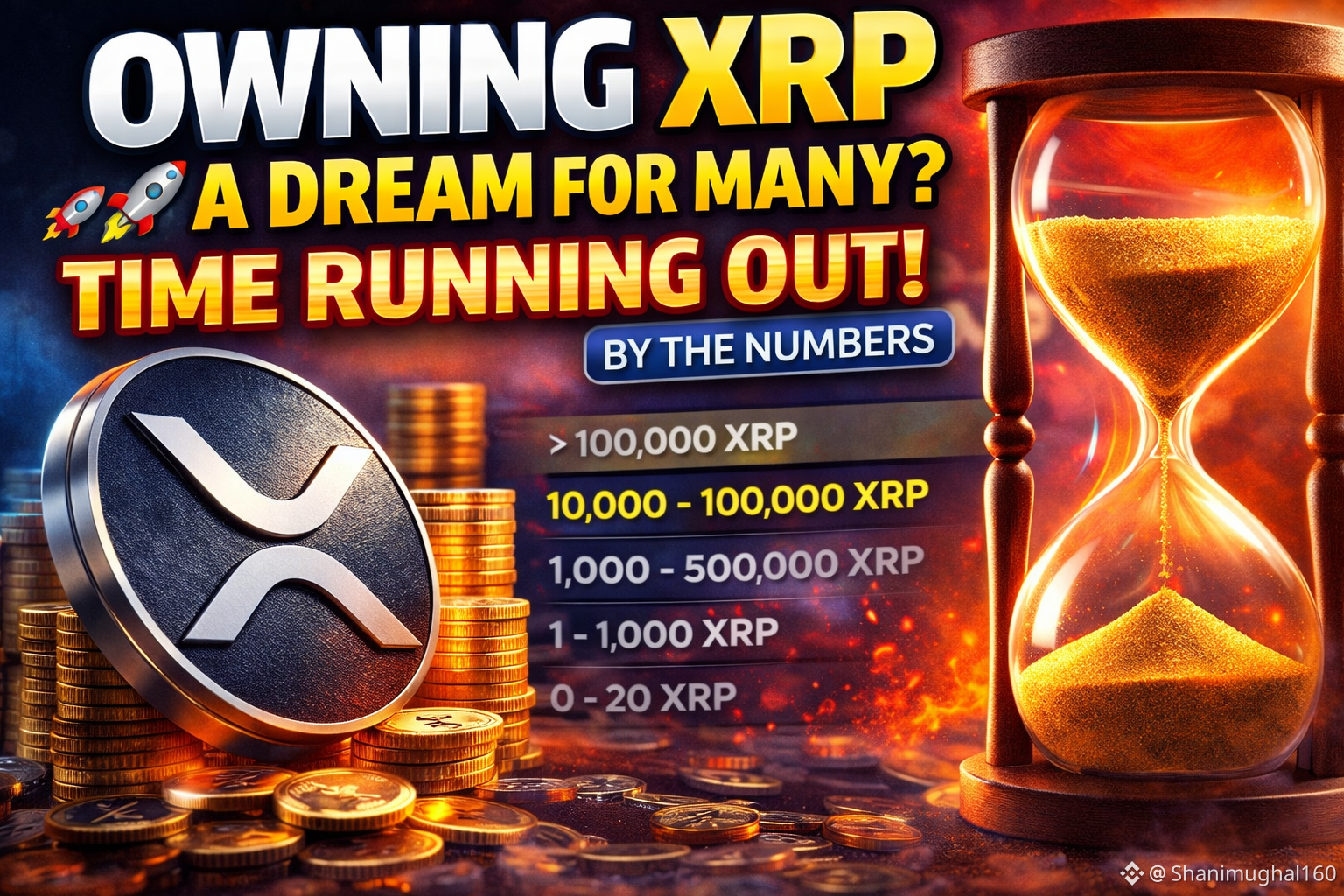
On the surface, $XRP ownership appears broadly distributed. Wallet statistics show millions of addresses holding the asset. But a closer examination reveals a very different reality.
New data shared by an XRP Ledger validator, 24HrsCrypto, challenges the idea of mass ownership and redirects attention to where meaningful XRP supply actually resides. This distinction matters because raw wallet counts can be misleading. They mask concentration and shape unrealistic expectations about future demand. When ownership is narrow, market behavior changes.
👉 What the Wallet Data Reveals
The data breaks down wallet distribution by balance size. Millions of wallets hold between 0 and 20 $XRP , while another large segment holds less than 1,000 XRP. These addresses contribute little to real ownership analysis. They often represent dust balances, inactive wallets, or test accounts.
Once these are filtered out, the ownership picture tightens rapidly. Wallets holding between 1,000 and 500,000 XRP total roughly 1.2 million accounts. According to 24HrsCrypto, these represent “meaningful XRP holders.”
He added an important perspective: even assuming one wallet equals one person, this group accounts for just 0.0135% of the global population—roughly 1 out of every 7,395 people.
The widely quoted figure of more than 4 million XRP wallets is technically correct, but it lacks context. As 24HrsCrypto explained, the “4M XRP holders” narrative is inflated by millions of wallets holding between 0 and 1,000 XRP. In reality, meaningful XRP ownership remains rare.
👉 Concentration Changes the Narrative
The distribution charts also highlight where XRP supply is concentrated. Wallets holding between 10,000 and 100,000 XRP collectively control billions of tokens. Even higher tiers hold substantially more, despite having far fewer accounts. These large holders—often referred to as whales—regularly move billions of XRP within the ecosystem.
This structure points to ownership depth rather than breadth. XRP does not behave like an asset saturated with retail holders. Instead, it trades like one still in the process of building its holder base. That distinction has major implications for price behavior and liquidity during periods of rising demand.
👉 What Comes Next for XRP?
Narrow ownership creates opportunity. New participants do not need to displace existing holders; they only need to join a relatively small group. This dynamic favors expansion phases rather than saturation.
As infrastructure matures, access improves. Custodial solutions, institutional on-ramps, and clearer regulation continue to lower barriers to entry. Each improvement expands the potential holder base without diluting existing supply concentration.
The data suggests XRP supply is already positioned. Large balances sit across defined tiers, often idle. If demand accelerates, supply does not need to be redistributed across millions of wallets—it can move through far fewer hands. This structure supports stability during accumulation phases and allows for sharp upward repricing when conviction strengthens.