

In the evolving landscape of blockchain technology, privacy and regulatory compliance are often treated as opposing forces. Public blockchains prioritize transparency, while private systems sacrifice decentralization and trust minimization. Dusk Network was designed to break this trade-off. As a purpose-built Layer-1 blockchain, Dusk introduces an architecture that delivers transaction privacy, auditability, and regulatory alignment without compromising decentralization. At the center of this model is the DUSK token, which powers security, governance, and economic incentives across the network.
Dusk’s approach starts with a clear focus on regulated financial use cases. Unlike general-purpose blockchains, Dusk is optimized for institutions that must comply with legal frameworks while protecting sensitive data. Traditional public chains expose transaction details by default, which creates friction for enterprises handling confidential assets, identities, and contracts. Dusk addresses this through advanced zero-knowledge cryptography, allowing transactions and smart contract states to remain private while still being verifiable by the network. This ensures that compliance checks can be performed when required, without revealing information to the public.
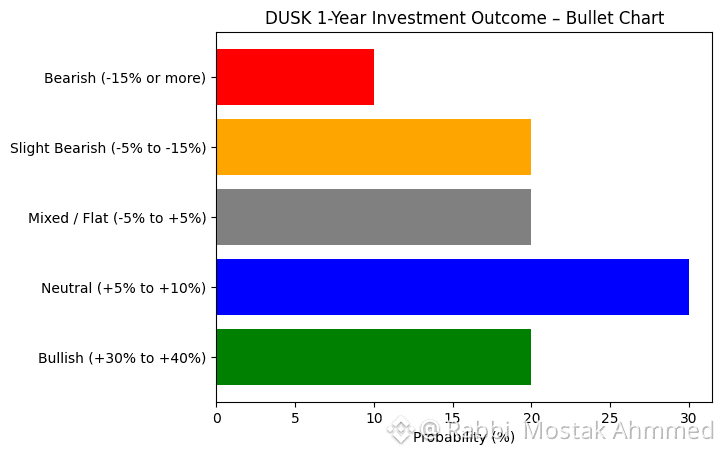
A core innovation of the Dusk Layer-1 design is its support for confidential smart contracts. These contracts can execute logic on encrypted data, enabling use cases such as private security token issuance, compliant DeFi instruments, and institutional settlement systems. Participants can prove that rules were followed without disclosing underlying values. This is a significant shift from privacy-focused chains that obscure data completely but struggle to support regulatory oversight. Dusk’s model enables selective disclosure, meaning authorized parties can access information when legally necessary, while the broader network only verifies cryptographic proofs.
Consensus on Dusk is achieved through a privacy-aware proof-of-stake mechanism. Validators stake DUSK tokens to participate in block production and network security. The staking process is designed to preserve anonymity while maintaining accountability, ensuring that validators cannot easily be targeted or censored. This strengthens decentralization and aligns economic incentives with long-term network health. For token holders, staking DUSK provides both yield opportunities and a direct role in securing the protocol.
The DUSK token plays a foundational role beyond staking. It is used to pay transaction fees, deploy and execute smart contracts, and participate in on-chain governance. Governance allows token holders to influence protocol upgrades and parameter changes, ensuring that the network evolves in line with community and institutional needs. This creates a feedback loop where adoption of privacy-preserving applications increases demand for DUSK, reinforcing the token’s utility within the ecosystem.
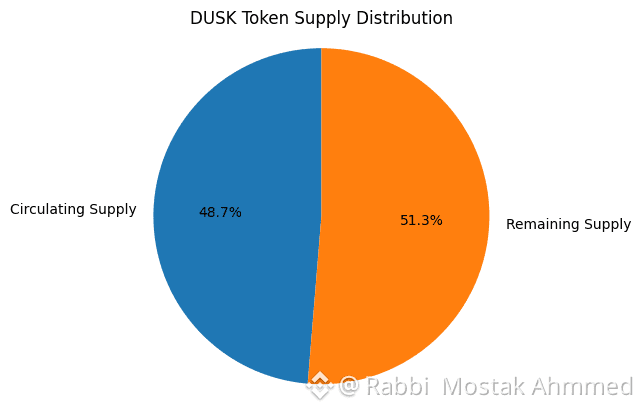
Another key aspect of the Dusk Layer-1 approach is compliance by design. Rather than treating regulation as an external constraint, Dusk embeds compliance features directly into the protocol. Identity frameworks, permissioned disclosures, and audit-friendly proofs make it possible for financial institutions to build on a public blockchain without violating legal obligations. This positions Dusk as a bridge between traditional finance and decentralized infrastructure, a role that many blockchains struggle to fulfill.
In summary, Dusk Network demonstrates that privacy and transparency do not have to be mutually exclusive. By combining zero-knowledge technology, confidential smart contracts, and a purpose-built Layer-1 architecture, Dusk delivers privacy without compromise. The DUSK token is integral to this vision, enabling security, governance, and economic alignment across the network. As demand grows for compliant, privacy-preserving blockchain solutions, Dusk stands out as a protocol designed not just for innovation, but for real-world financial adoption.
