
Dusk Foundation gets awkward when validators are present but not committing.
Committee is up, stake is there, execution is ready to close. Nothing is disputed, nothing malformed. Then a couple of attestations don’t arrive inside the window. Not enough to call it an outage. Not clear enough to call it misbehavior. Just missing signatures in the only place they actually matter.
On a lot of networks this blurs into “network conditions.” Quorum flexes, time passes, finality lands, people move on. Later, if anyone asks why it took longer, the answer is a shrug dressed up as telemetry.
Here it doesn’t blur.
DuskDS finality doesn’t materialize because the outcome looks obvious. It closes because enough accountable weight attested to it. If that weight doesn’t show up in time, the state transition stays open. Nobody gets to substitute “they would have agreed” for an attestation. Nobody gets to treat participation as implied.
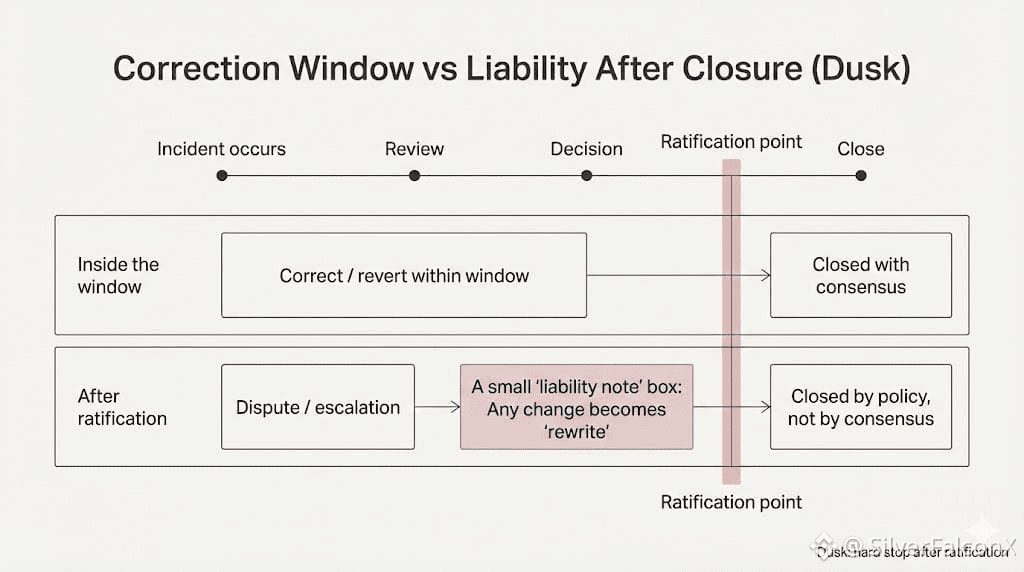
This is the operational pressure: everything looks alive and still nothing settles.
Dashboards stay green. Nodes respond. The chain keeps producing blocks. Meanwhile capital is sitting behind a transition that won’t close, and the people watching it have no satisfying story to tell the desk. “Nothing broke” starts sounding like a dodge when settlement hasn’t happened and the window is bleeding out.
Privacy makes the waiting feel worse, not better.
You don’t get public chatter to read. You don’t get a visible race to reassure anyone that momentum exists. There’s just the gap: the attestations that didn’t arrive, inside a system that treats missing commitment as a real boundary, not an inconvenience.
Then the second-order problems show up.
Downstream execution queues up behind the stuck transition. Cutoffs get threatened. People start asking who is responsible for pushing the committee to finish the job. And that’s the point Dusk forces into the open: “online” isn’t the same as “accountable.” Non-malicious isn’t the same as participating when your signature is part of finality.
The incentives get sharp without anyone raising their voice.
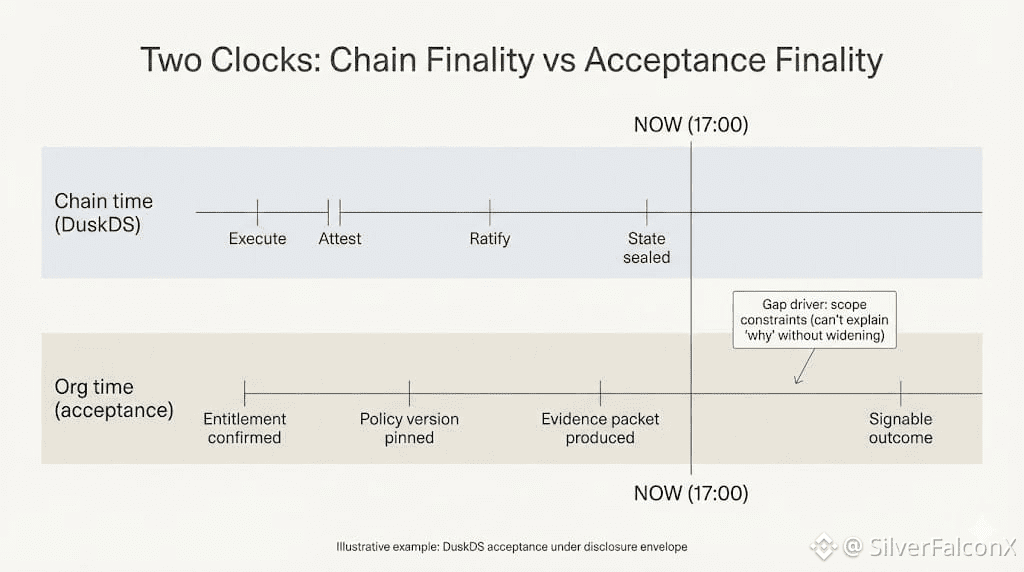
If validators can drift into silent non-participation and the network keeps smoothing it over, it becomes normal. Here it stays expensive. Finality on Dusk doesn’t arrive until the accountable parties actually commit, and until they do, operators have one ugly choice: wait, or let the window expire and deal with the consequences of re-entering the flow under a new context. #Dusk
