 In the rapidly evolving landscape of Web3, data storage remains one of the most foundational yet neglected layers. While blockchains excel at consensus and transaction integrity, they are not inherently designed to store and serve large quantities of data — especially rich media like images, audio, and video. Walrus Protocol emerges to fill this critical gap. Built as a decentralized storage solution on the Sui blockchain, Walrus aims to redefine how data is stored, accessed, and monetized in Web3, offering a truly programmable, resilient, and efficient storage network that works for users, developers, and enterprises alike.
What Is Walrus?
At its core, Walrus is a decentralized data storage network designed to efficiently store and deliver large unstructured files — commonly referred to as “blobs” — such as videos, images, and PDFs. Unlike centralized solutions (e.g., Google Drive) that risk single points of failure or other decentralized options that focus only on archival storage, Walrus combines decentralization with programmability and real-time performance.
Walrus was originally contributed by Mysten Labs, the team behind the Sui blockchain, and started its lifecycle with a public testnet launch in late 2024 before culminating in its mainnet deployment in March 2025.
How Walrus Works: Components and Architecture
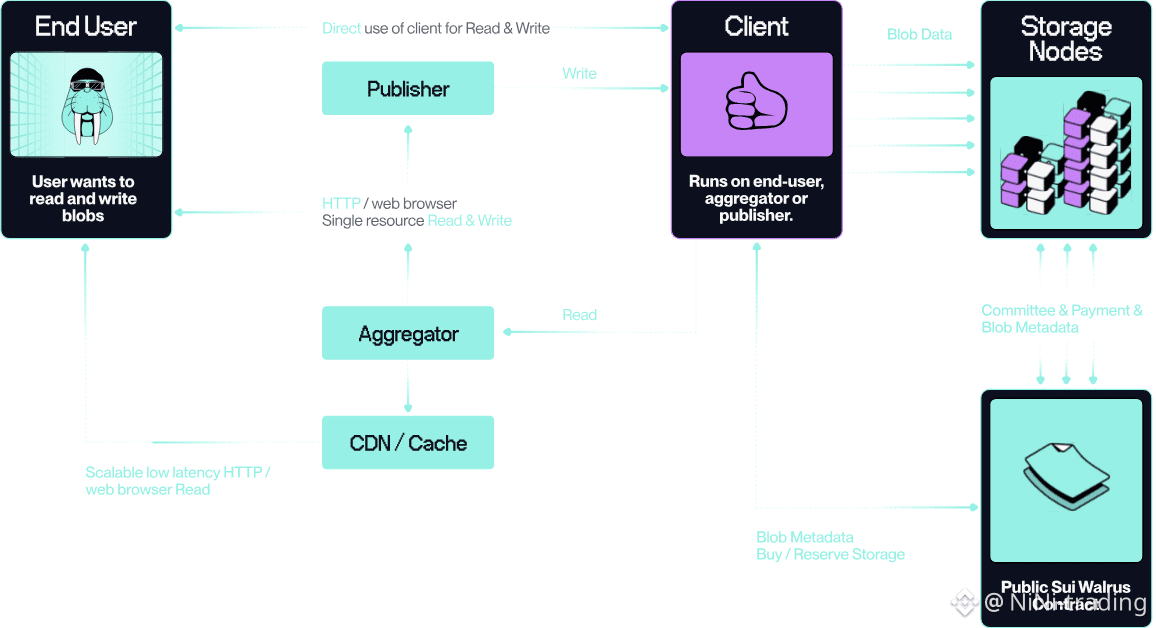
Walrus operates through a layered model with six pivotal components:
End Users: Individuals or applications that want to store or retrieve blobs.
Publisher: Responsible for writing the blob into the protocol.
Client: Acts as a bridge between end users and publishers, handling requests and forwards data accordingly.
Storage Node: The core infrastructure of Walrus; these nodes store data and serve retrieval requests. Operators generally need to stake $WAL tokens to participate.
Aggregator: Collects stored data and optimizes retrieval for end users and other systems.
CDN/Cache: Provides low-latency temporary storage to improve user experience and reduce retrieval delay.
This layered architecture enables a balance of security, performance, and scalability. Multiple storage nodes reduce dependency on any single entity, improving fault tolerance and decentralization. Meanwhile, caching layers and aggregators help avoid bottlenecks and enhance performance comparable to centralized services.
RedStuff: The Technical Breakthrough in Storage Coding
One of Walrus’s most innovative technical elements is its use of RedStuff, a two-dimensional erasure coding algorithm. This approach splits large files into smaller shards distributed across multiple nodes. Even if up to roughly two-thirds of nodes fail or lose pieces of data, the original file can still be reconstructed from the remaining shards.
Compared to traditional replication strategies that might require 10× redundancy or more, RedStuff keeps replication overhead low (around 4–5×), significantly reducing storage costs while maintaining high resilience. This design also enables fast recovery and efficient verification mechanisms, reducing the bandwidth and time needed to validate stored data.
Programmable Storage: Beyond Simple File Hosting
Perhaps one of Walrus’s most compelling innovations is programmable storage — storage that behaves as a blockchain-native, interactable resource rather than a passive repository. Every stored blob is associated with a Sui object, allowing developers to build custom logic around stored data. Applications can, for instance, delete storage programmatically when a condition is met, or rotate backups based on smart contract triggers.
This differs sharply from platforms like Arweave, where data is immutable, or Filecoin, where expiration and off-chain contracts complicate integration. In Walrus, data can be actively managed on-chain, giving developers unprecedented control and flexibility.
Tokenomics and Utility of $WAL
The native token $WAL plays a central role in governance, network security, and economic incentives:
Payments: Users pay in WAL to store and retrieve data.
Staking: Node operators stake WAL to participate in the network and earn rewards.
Governance: WAL holders can vote on protocol changes and parameter adjustments.
The total supply of WAL is 5,000,000,000 tokens, with nearly half reserved for community initiatives and ecosystem growth. Other allocations include contributors, strategic subsidies, and Mysten Labs shares.
Real-World Use Cases
Walrus’s utility stretches far beyond traditional storage:
1. NFT Metadata Storage
By storing metadata directly on Walrus, creators can ensure that NFT content — images, models, audio, and more — persists independently of centralized servers that might go offline or change content over time.
2. AI Data and Model Storage
AI applications often require vast datasets and models. Walrus allows secure, cost-effective storage of training data and model artifacts, with built-in verification and ownership proofs — critical for machine learning workflows where data authenticity is essential.
3. Data Availability for L2 Rollups
Even though Walrus started on the Sui network, its architecture supports broader data availability functions for Layer 2 rollups, reducing costs and improving accessibility for decentralized apps across different chains.
4. Digital Rights & Content Commerce
Creators can use Walrus to store content and offer controlled access via encryption keys, creating monetizable content markets where users pay for access or licenses.
Ecosystem Integrations and Adoption
Walrus has been rapidly gaining traction across the Web3 ecosystem. Significant developments include listing on major exchanges like Bitget and Crypto.com — making WAL accessible to a broader investor base and increasing liquidity.
Additionally, applications such as Akord and Tusky — aiming to provide decentralized file services similar to Web2 counterparts — leverage Walrus infrastructure, demonstrating real-world utility and integration potential.
Data as an Economic Asset
Walrus also changes how data is perceived economically. Instead of being a cost center — a necessary expense for applications — data becomes a tokenized asset that can generate value. With mechanisms like programmability and proof of availability, data ownership becomes verifiable, exchangeable, and economically meaningful.
Competitive Landscape
While decentralized storage is not new — projects like Filecoin and Arweave preceded Walrus — Walrus differentiates itself through:
Programmable storage logic.
Lower storage redundancy costs.
Blockchain-native verification and composability.
Integration with Sui’s scalable architecture.
This positions Walrus not just as a competitor but as an evolutionary step in decentralized data infrastructure.
✔ Summary: Walrus is not merely a storage solution — it’s a data platform for the next era of Web3. By combining programmable storage, resilient architecture, proof-based verification, and economic incentives via $WAL, it tackles longstanding limitations of decentralized storage and opens up new possibilities for developers and users alike.
@Walrus 🦭/acc – $WAL – #walrus