

Decentralized storage ko banana flashy kaam nahi hai. Yeh woh type ka infrastructure hai jahan ek chhoti si galti bhi applications ko quietly tod sakti hai. Files missing ho jaayein, data unavailable ho, ya recovery fail ho — toh Web3 ka decentralization claim khokhla lagne lagta hai. Walrus Protocol isi reality ko seriously leta hai, aur uska network rollout approach wahi reflect karta hai.
Walrus ka development philosophy simple hai: pehle prove karo, phir scale karo.
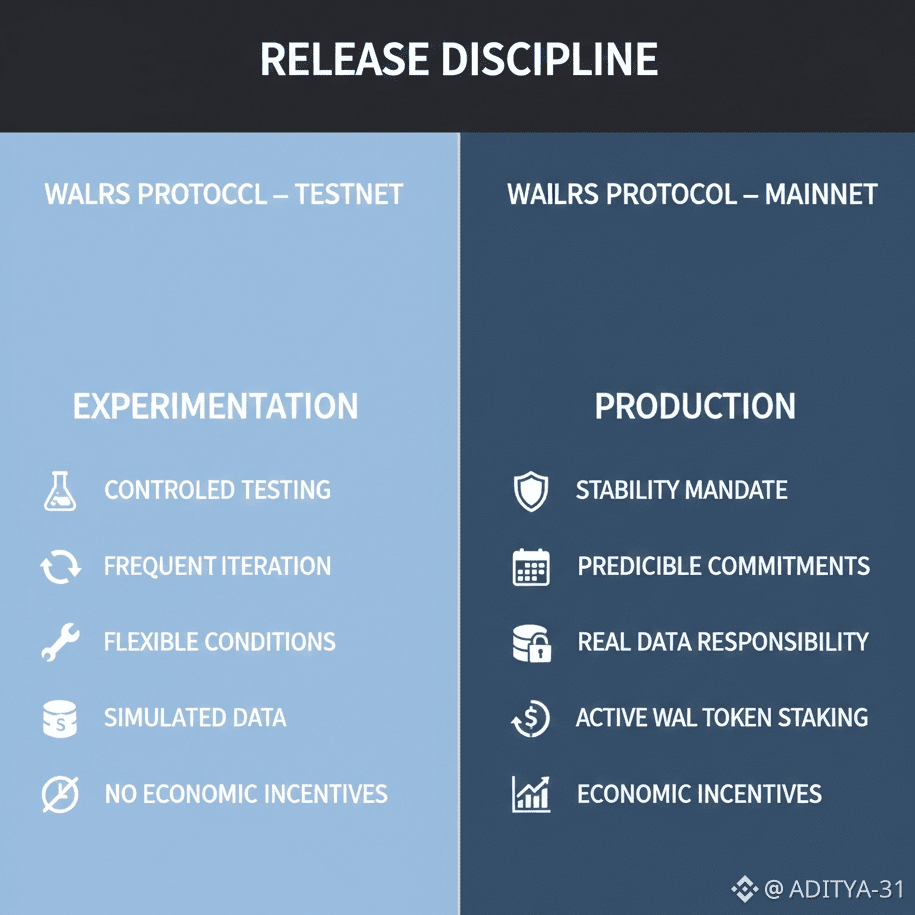
Is project me Testnet aur Mainnet sirf labels nahi hain. Dono alag-alag responsibilities serve karte hain. Testnet experimentation ke liye hai — jahan features break hote hain, assumptions test hoti hain, aur edge cases surface aate hain. Storage systems ke liye yeh stage especially important hota hai, kyunki yahan sirf transactions nahi, balki real files aur long-term data flows involve hote hain.
Testnet par developers freely experiment kar sakte hain. Wallet interactions, storage purchases, node behavior, aur performance bottlenecks — sab cheezon ko controlled environment me push kiya jaata hai. Agar kuch fail hota hai, toh cost sirf learning hoti hai, users ka data nahi.
Jab system ka behavior predictable ho jaata hai, tab hi cheezein Mainnet tak pahunchti hain.
Walrus Mainnet ka matlab sirf “live” hona nahi hai. Iska matlab hai ki ab network real storage responsibility le raha hai. Ab jo data upload hota hai, us par actual users aur applications depend karte hain. Ab $WAL token ke through real incentives aur penalties active hote hain. Yahan mistakes theoretical nahi hoti — yahan trust on the line hota hai.
Isi transition ka ek important signal tha Walrus ka Mainnet launch. Is point ke baad network sirf concept proof nahi raha. Storage nodes ne actual data serve karna start kiya, aur decentralized availability theory se nikal kar practice me aayi.
Walrus ka architecture bhi is staged thinking ko support karta hai. Data shards me distribute hota hai, epochs ke through time organize hota hai, aur commitments predictable cycles me operate karte hain. Short test cycles Testnet ko fast iteration ke liye allow karte hain, jabki longer Mainnet epochs stability aur planning space dete hain. Storage ke context me yeh balance critical hota hai.
Is approach ka direct impact ecosystem par padta hai. Developers clearly samajh paate hain ki kab experimentation safe hai aur kab production readiness expected hai. Node operators ko pata hota hai ki kab infra scale karna hai. Users ko confidence milta hai ki network sudden changes ke through unka data risk me nahi daalega.
Economic layer bhi isi discipline ko follow karti hai. Mainnet par storage payments, staking rewards, aur governance participation meaningful hote hain. Clear release phases ke bina yeh sab noise ban jaata. Walrus me incentives tab activate hote hain jab underlying system ready hota hai, na ki pehle.
Ek subtle lekin important design choice hai storage purchase duration ka control. Users unlimited future ke liye storage lock nahi kar sakte. Isse network flexibility maintain hoti hai, aur supply-demand balance predictable rehta hai. Enterprises aur builders ke liye yeh predictability planning ke liye valuable hoti hai.
Bigger picture me dekhein toh Walrus ka phased rollout ek mindset ko show karta hai. Yeh DeFi-style “ship fast, patch later” infrastructure nahi hai. Storage ke case me “later” ka matlab data loss bhi ho sakta hai. Isi liye Walrus validation ko hype se upar rakhta hai.
Jaise-jaise ecosystem mature hota jaayega, yeh staged model aur bhi important banega. Applications jab critical assets, media, ya AI datasets store karengi, tab woh un networks ko choose karengi jo measured growth dikhate hain — na ki sirf aggressive launches.
Walrus ka network journey yeh signal deta hai ki decentralized storage ko experiment nahi, responsibility samjha ja raha hai. Aur Web3 ke next phase me, yahi mindset difference create karega.

