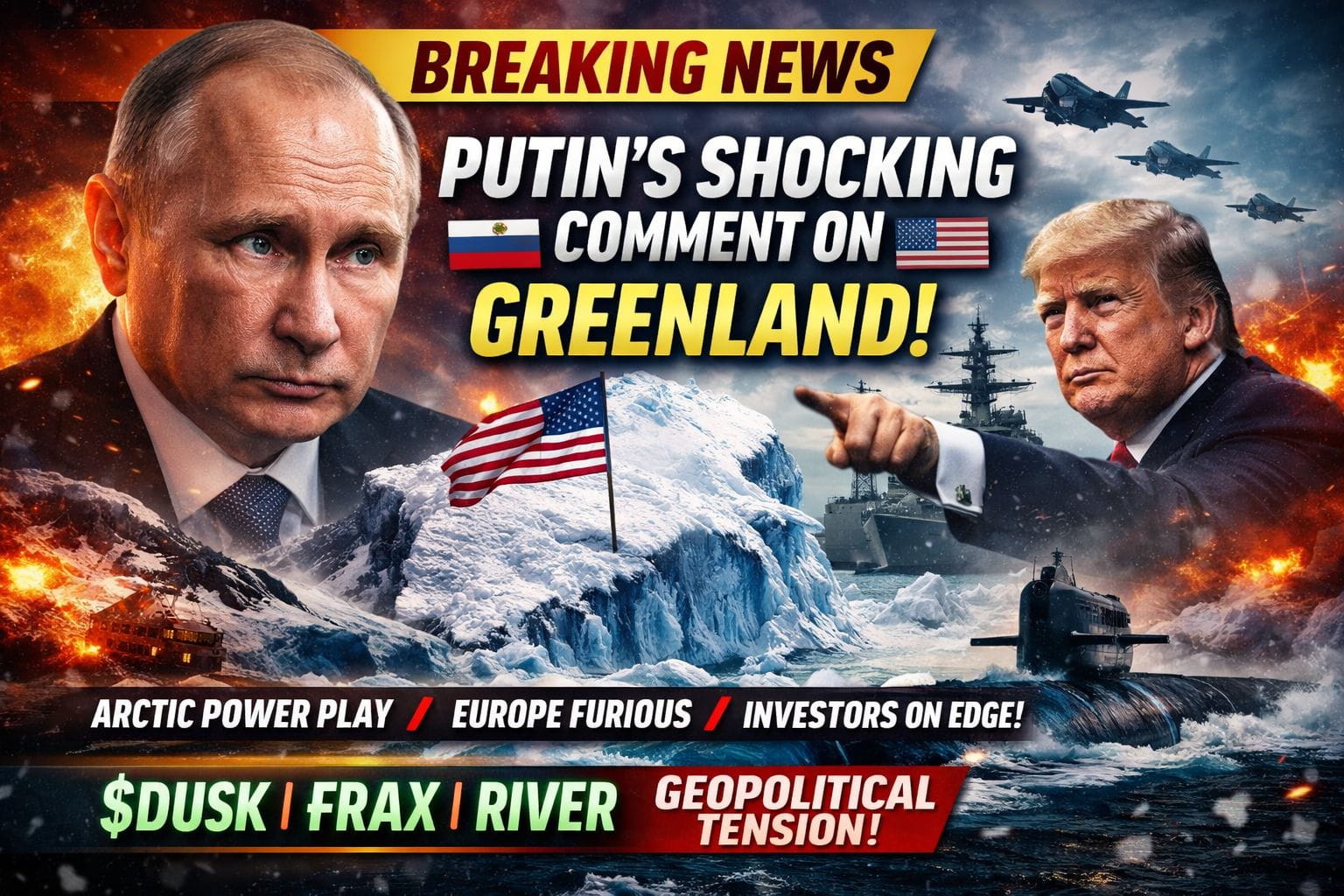
A new chapter just opened in the world’s most volatile geopolitical theatre — the Arctic.
Russian President Vladimir Putin has reportedly said he “understands the U.S. rationale” behind America’s interest in acquiring Greenland, according to Russia’s special envoy Kirill Dmitriev.
This isn’t a casual diplomatic comment — this is a strategic signal in a region where global power, military positioning, and future economic influence are all colliding at once.
🌐 Why Greenland Is a Big Deal
Greenland isn’t just an island covered in ice — it’s one of the most strategically valuable territories on Earth.
🔹 Sits at the center of Arctic geopolitics
🔹 Holds key military and missile-tracking vantage points
🔹 Controls newly emerging shipping routes as ice melts
🔹 Rich in natural resources and rare minerals
🔹 Offers significant advantages for surveillance and military infrastructure
This is why not only the U.S. but also Europe, Russia, and even China are deeply interested in the island’s future.
🇷🇺 Putin’s Comment: More Than “Understanding” — A Geopolitical Message
Putin’s calm statement comes at a time when:
👉 Washington is pushing aggressively
👉 European leaders strongly oppose any U.S. move
👉 NATO is struggling with internal tensions
👉 The Arctic is becoming the new global power battleground
So, when Putin says he “understands” the U.S. rationale, analysts see it as a carefully crafted signal, not merely politeness.
What the message implies:
🔸 “We understand your interest…”
🔸 “We also have our own strategic goals…”
🔸 “And we’re ready for the competition.”
This shifts the geopolitical narrative dramatically — and puts the Arctic at the center of global realignment.
🇺🇸 U.S. Position — Trump Pushes Harder
Meanwhile, U.S. President Donald Trump has repeatedly argued that “now is the right time” for America to act on Greenland.
He even claimed that Denmark has failed to protect Greenland from Russian influence.
This tone:
✔ Challenges international norms
✔ Pressures Danish and Greenlandic autonomy
✔ Increases tensions between the U.S. and Europe
✔ Signals a new era of U.S. geopolitical assertiveness
With this, the Arctic becomes a strategic prize — not just territory.
🇪🇺 Europe Unites Against U.S. Pressure
Trump’s tariff threats and Greenland rhetoric have forced many European nations to stand behind Denmark in defending Greenland’s sovereignty.
This unity is not just political — it represents:
🔹 A security stance
🔹 An economic alignment
🔹 A strategic effort to counter U.S. pressure
The fallout could be major:
📍 Transatlantic relations may deteriorate
📍 NATO trust could weaken
📍 EU responses may become more aggressive
Greenland has become a symbol of European resistance and strategic relevance.
📊 Investors Are Watching Closely
Whenever geopolitics intensifies, markets shift — and this case is no exception.
Many investors are already eyeing:
🔥 Crypto assets, especially narrative-driven tokens like
$DUSK $DUSK, $FRAX $FRAX, $RIVER $RIVER
🔥 Risk-on assets that benefit from global uncertainty
🔥 Strategic commodities tied to energy and rare minerals
🔥 Liquidity moves triggered by fear and speculation
Major geopolitical events often push markets in two directions:
📌 Hedging for safety
📌 Aggressive speculation in high-momentum tokens
This Greenland episode is shaping a multi-layered economic impact — far beyond politics.
🔮 Final Thought: The Arctic Is Now the World’s High-Stakes Chessboard
Greenland is no longer “just an island.”
It is:
🌍 A symbol of global power
⚔️ A battleground of great-power competition
💰 A hub of future energy and resources
🤝 A key factor in alliances and global strategy
Putin’s comment is not a soft diplomatic line — it’s a strategic warning, marking the beginning of a new phase in Arctic geopolitics.
The world is shifting.
Alliances are wobbling.
Markets are reacting.
And the next move — especially from the U.S. — could reshape global power dynamics for years to come.