
@Walrus 🦭/acc began as an engineering answer to a simple but urgent problem: blockchains and Web3 need a cost-effective, reliable way to store large binary objects datasets, media, model weights, game assets without handing all that power to a handful of cloud providers. The team behind the project built a permissionless storage network on top of the Sui stack and framed Walrus as a programmable data layer for the AI and Web3 eras, a place where blobs are first-class on-chain objects that smart contracts can reference, manage, and program against. From product pages to developer docs, that ambition is explicit: Walrus is meant to make decentralized storage cheap, fast, and directly usable by on-chain logic.
Walrus +1
Technically Walrus is different from classic decentralize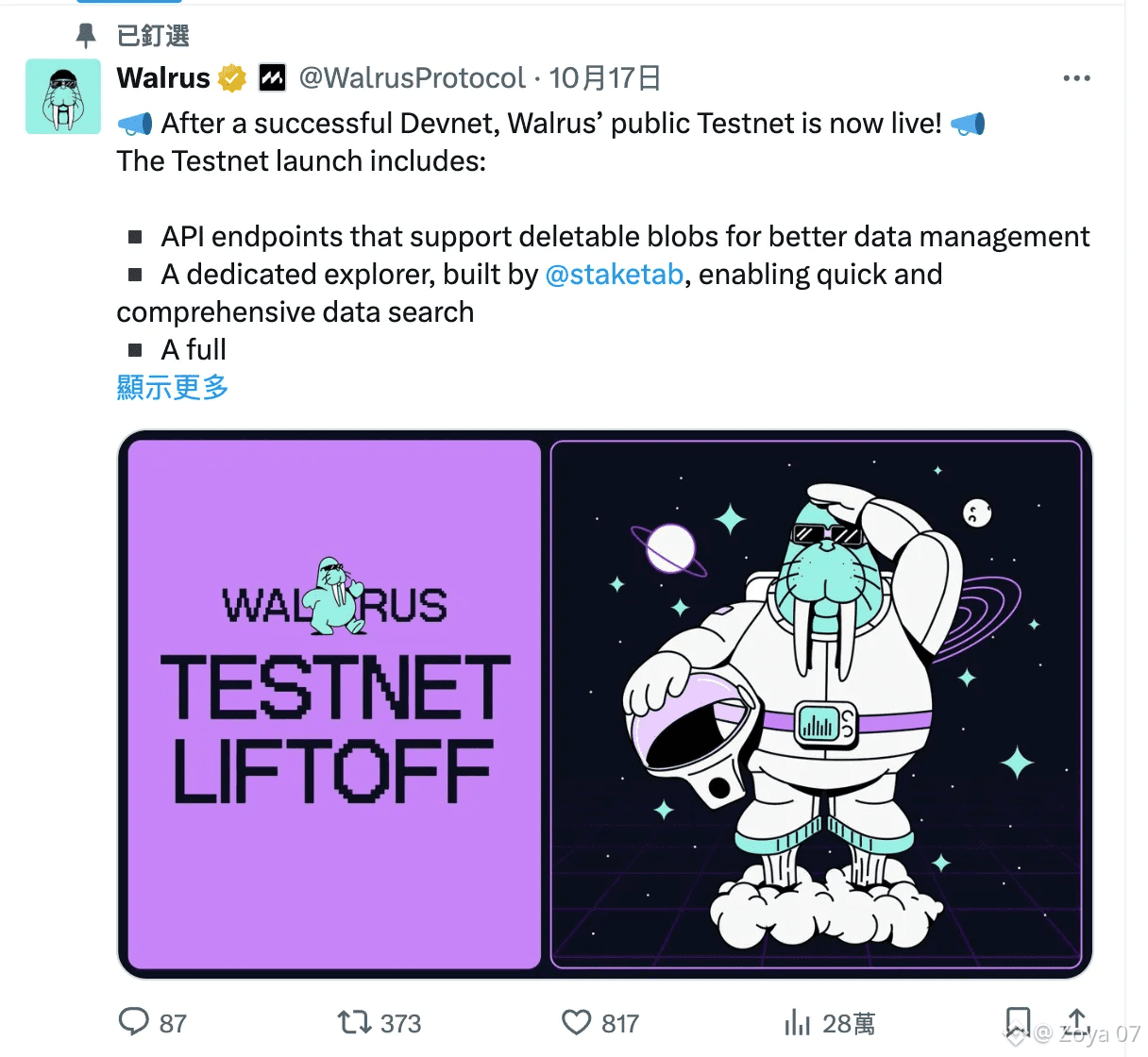 d storage projects because it treats blob storage as a systems problem and designs new coding primitives and economic layers to match. At the heart of the protocol is a two-dimensional erasure-coding scheme the team calls “RedStuff,” a matrix-based encoding that splits files into slivers and distributes them so that a relatively small replication factor roughly 4 5× in Walrus’s analysis still yields high availability and efficient recovery. That design trades a little extra encoding complexity for much lower raw storage overhead compared with full replication, and it enables a form of self-healing recovery that moves only the missing parts rather than re-transferring whole files. Those gains are what let Walrus claim large cost improvements versus naive replication approaches and make blob storage practical at Web-scale.
Walrus +1
Walrus integrates tightly with Sui’s object model and Move-based smart contracts so that stored blobs are addressable on chain and manipulable by Move logic. The control plane implemented as on-chain objects and off-chain storage node software handles node registration, epoch changes, challenges, and reconfiguration; the result is a system where the blockchain coordinates who stores which slivers and enforces long term availability through economic commitments. The project’s formal papers and implementation docs describe asynchronous challenge protocols and authenticated data structures designed to make proofs of storage practical even under network delays, an important innovation for open, permissionless storage where nodes come and go.
docs.wal.app +1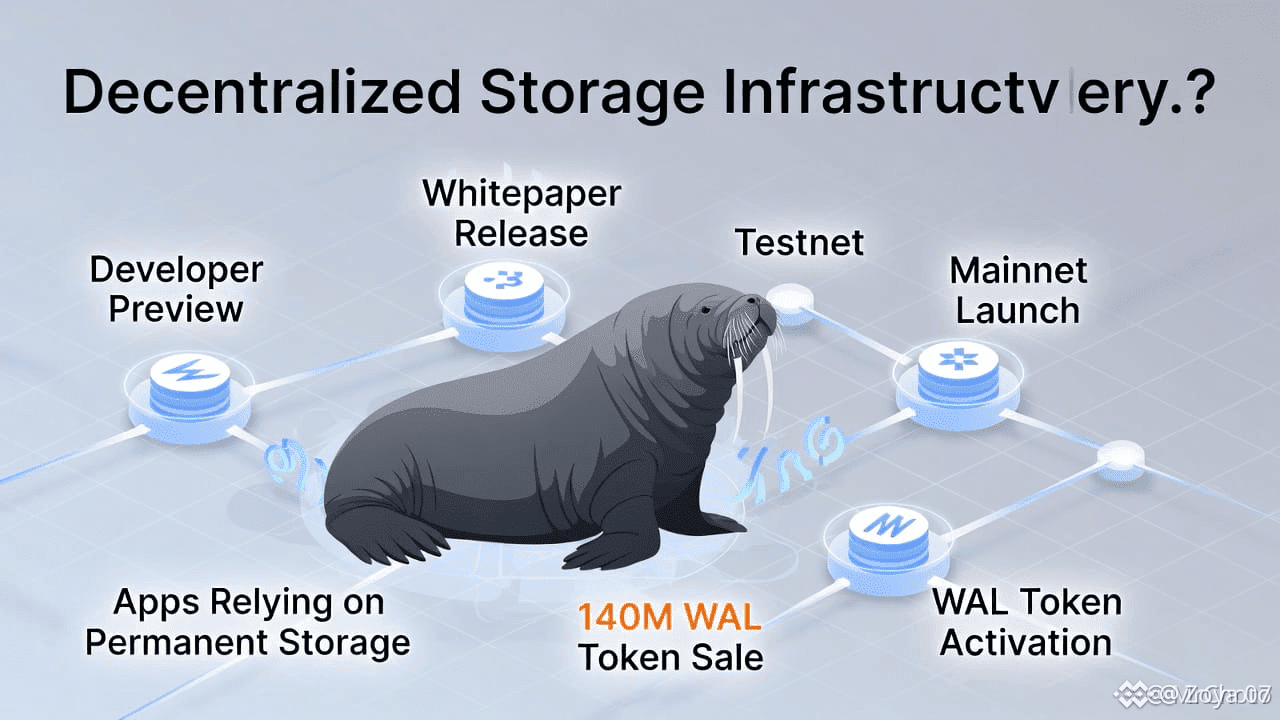
Economics and token design are where the system ties incentives to availability. Walrus uses a native token, WAL, as the unit of payment for storage, the stake that enables nodes to operate, and the governance token for protocol parameters. Users prepay for a storage lease in WAL, and payments are programmatically distributed to storage nodes and stakers across epochs; node operators stake WAL to participate and can be penalized for misbehavior or unavailability. The public whitepaper and regulatory filings released by the foundation outline these mechanisms in some detail showing planned mainnet milestones, the distribution model, and how the protocol aims to stabilize fiat-denominated storage pricing despite token volatility. Those design choices are meant to align node economics with long-term durability rather than short-term rent seeking.
storage.googleapis.com +1
From a security perspective the project blends standard Web3 practices with targeted programs for a storage network’s unique risks. Walrus has run smart-contract bug bounties and public security programs, and its academic work includes a storage-challenge protocol designed to prevent adversaries from faking availability simply by exploiting network timing. The architecture also minimizes any single operator’s ability to reconstruct whole files slivers are distributed so that no party holds enough pieces to reassemble a blob and optional client-side encryption adds another layer for sensitive data. Those features reduce some of the traditional concerns around decentralized storage while acknowledging that metadata and transaction traces on a public chain still require careful handling.
HackenProof +1
Early adoption metrics and deployment signals show a rapidly evolving network: testnet and mainnet launches were accompanied by node registrations, millions of blobs uploaded in early epochs, and integrations into the broader Sui ecosystem. The foundation and partners positioned Walrus as part of a larger push to add a verifiable data layer to Sui’s four-layer vision for on-chain AI and computational workloads, and industry coverage has compared Walrus’s cost and replication benchmarks favorably against incumbents. Those comparisons should be read as early indicators rather than proof of permanent dominance real-world durability requires time, usage, and continued economic alignment but the initial traction is notable for a storage network competing with far older projects.
storage.googleapis.com +1
Practically, Walrus’s target use cases span the visible Web3 spectrum: AI training and dataset hosting where model weights and corpora must be available and addressable; games and multimedia apps that require cheap, on-chain assets; archival node history and blockchain artifacts; and any application that benefits from programmable privacy and object-level governance. Because blobs are first-class Sui objects, developers can build automated lifecycle rules, escrowed storage payments, and on-chain verifications that tie storage state to application logic a potent combination for teams that want storage to be more than an opaque backplane.
Backpack Learn +1
No system is without trade-offs. The RedStuff design reduces replication overhead but adds encoding and recovery complexity that must be implemented correctly and tested under adversarial churn. Economic guarantees rely on robust staking, honest majority behavior from storage committees, and workable dispute resolution all of which become harder at scale and under targeted attacks. There is also the classical tension between public verifiability and privacy: while sliver distribution and optional encryption limit data exposure, metadata about storage actions and object ownership lives on chain and can reveal behavioral signals unless mitigated with additional privacy layers. Finally, comparisons to entrenched cloud providers and older decentralized networks should account for the difference between promising benchmarks and the wide, hard-won operational experience incumbents have amassed.
arXiv +1
Taken together, Walrus represents a focused bet: that a storage substrate designed from first principles for blobs, integrated with a fast, programmable chain, and backed by explicit economic incentives will be the right foundation for the next generation of AI and Web3 applications. If the team continues to deliver on reliability, security, and cost, Walrus could change the calculus for builders who today accept centralized clouds as a necessary evil. If you’d like, I can now pull the Walrus whitepaper into a concise technical summary (RedStuff math, epoch change protocol, and challenge design), extract the tokenomics and distribution tables into a single page, or turn this narrative into a one-page explainer tailored for product or compliance teams which would you prefer?
@Walrus 🦭/acc #walrus $WAL #Walrus


