
@Walrus 🦭/acc was born from a practical problem: blockchains are excellent at proving that something happened, but terrible at storing the bulky, real-world data that modern apps and AI need videos, model weights, datasets, and high-resolution media. The team behind Walrus set out to build a permissionless, highly efficient blob store that treats large binary objects as first-class, programmable on-chain assets, enabling developers to store, retrieve, price, and govern data without routing those responsibilities through centralized clouds. The project presents itself not as a generic “file coin” clone but as a data-management layer tailored for the AI era and large-scale app requirements, with developer ergonomics and predictable fiat-equivalent storage costs emphasized from day one.
walrus.xyz +1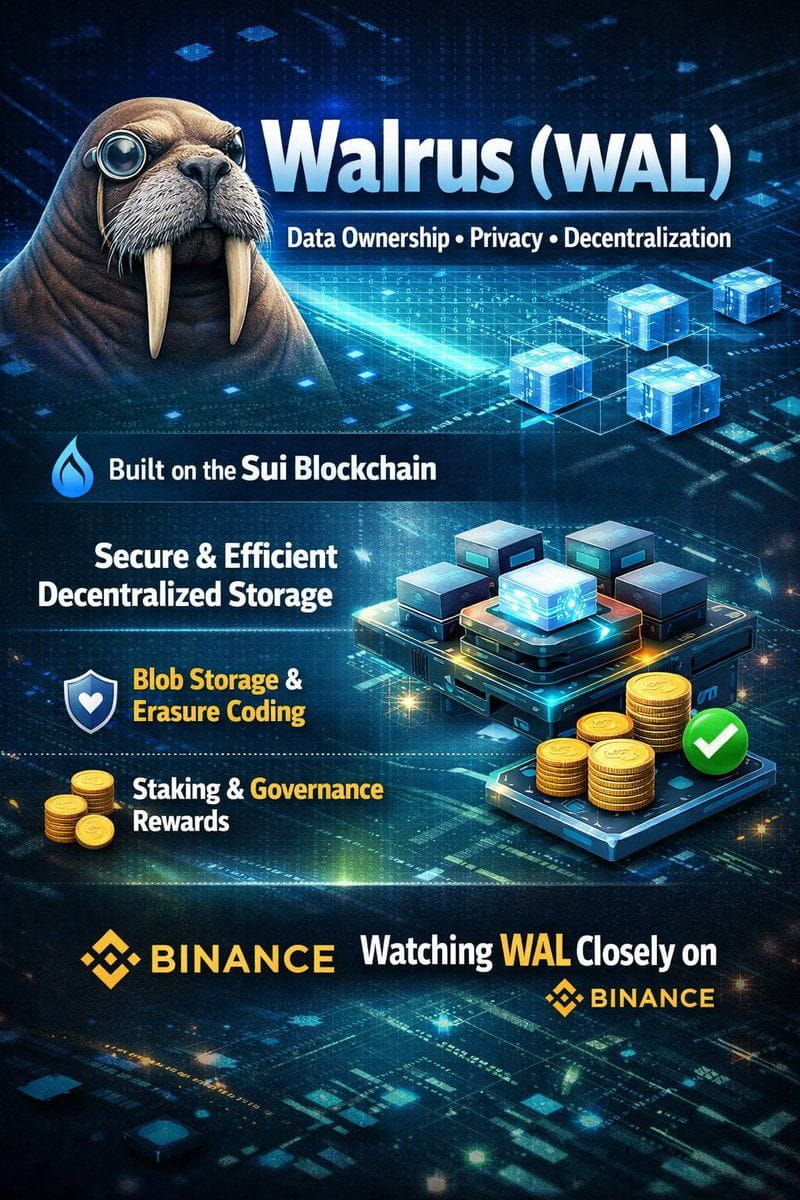
At its technical core Walrus combines two complementary ideas to hit that objective: modern erasure-coding techniques for efficient redundancy and a high-throughput blockchain Sui as the secure control plane for lifecycle, accounting, and proofs. Rather than replicating full blobs across all nodes (which is wasteful), Walrus slices data into many fragments (slivers) using a novel two-dimensional encoding scheme called Red Stuff, designed to be bandwidth efficient and “self-healing” so that lost fragments can be reconstructed by transferring only the amount of data proportional to what’s missing. This allows the network to scale to hundreds of independent storage nodes while keeping storage overhead low and availability high. At the same time, Sui smart contracts orchestrate node registration, blob registration, payments, epoch changes, and availability certificates meaning the expensive, consensus-heavy parts stay onchain while heavy data movement remains offchain and efficient. Those design choices are spelled out in the project’s technical paper and documentation.
arXiv +1
Operationally, Walrus treats a blob as an onchain object with a lifecycle: a user reserves space and pays upfront in WAL for storage for a specified duration, their blob is encoded and distributed to qualifying nodes, and the system issues periodic Proofs-of-Availability (PoA) that are anchored onchain so requesters and buyers can verify data is reachable. The WAL payment is designed to be allocated over the lifetime of the storage contract, so node operators and stakers receive compensation over time rather than in a single upfront dump; the protocol’s economics explicitly aim to smooth fiat-equivalent pricing so customers don’t get burned by token volatility when buying storage. This model makes Walrus more attractive for builders and enterprises who need predictable bills and verifiable SLAs while still gaining the censorship resistance and durability of decentralized networks.
walrus.xyz +1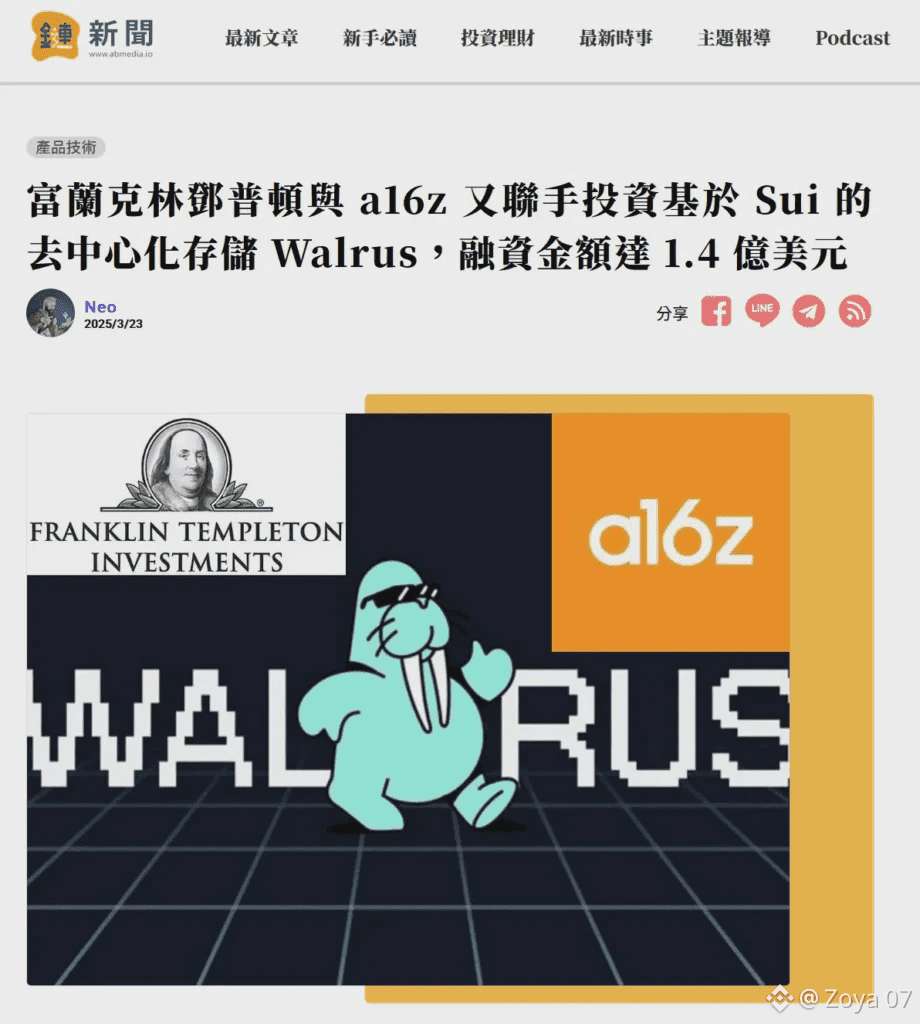
The token itself, WAL, is both the payment medium and a governance/staking instrument. Practical token details that matter for users and traders total supply, circulating supply, and market context are public: WAL has a fixed max supply in the billions with a significant portion in circulation, and it is listed across major market aggregators and exchanges where market cap, circulating supply, and 24-hour liquidity data are tracked. Those market metrics are useful for teams planning integrations or businesses estimating long-term costs, because they affect liquidity and the feasibility of hedging WAL-denominated storage against fiat. For anyone considering storing large datasets or offering storage node services, both the token mechanics (how payments are distributed over time) and the market context (liquidity and circulating supply) should be part of the decision calculus.
CoinGecko +1
Walrus’s code and tooling are openly developed and available in public repositories, letting third-party auditors, node operators, and integrators inspect implementation details, run nodes, or build tooling on top of the protocol. The project has reference clients and node software, and a growing ecosystem of developer tools, docs, and community resources intended to accelerate adoption. That openness also means engineers can study the exact PoA format, encoding pipeline, and Sui interactions if they want to run production grade infrastructure or create marketplace layers that trade on provenance and pricing. The presence of active repos and community docs makes it feasible for teams to prototype Walrus integrations faster than with closed systems.
GitHub +1
Where Walrus sits in the broader ecosystem is worth noting: it competes and complements existing decentralized storage solutions by targeting a particular niche high-throughput, low-overhead blob storage with programmable onchain metadata and market primitives suitable for AI datasets and media marketplaces. For creators, enterprises, and dApp teams, Walrus promises censorship resistance, verifiability, and programmable monetization; for node operators it promises a market for storage services with onchain accountability; and for market builders it offers primitives to price, license, and exchange datasets. The tradeoffs are the usual ones for decentralized infrastructure you inherit extra system complexity and operational responsibilities compared with handing data to an S3 bucket, but you gain transparency, composability, and resilience against single-provider failure.
walrus.xyz +1
In sum, Walrus is best understood as a purpose-built attempt to make large binary data first-class citizens in Web3: efficient erasure coding that minimizes redundancy, a modern blockchain control plane that manages lifecycle and incentives, a token model that aligns payments over time, and open-source tooling that lowers the bar for adoption. For teams building AI agents, video platforms, archival services, or data marketplaces that need verifiable availability and onchain governance, Walrus offers a distinct architecture that blends cryptography, distributed systems, and token economics. As always with infrastructure, prospective users should read the whitepaper and docs, review the open-source code, and run small pilots to validate performance and cost in their particular workloads before committing large datasets to any new network.

