
Vanar Chain (@vanar) is p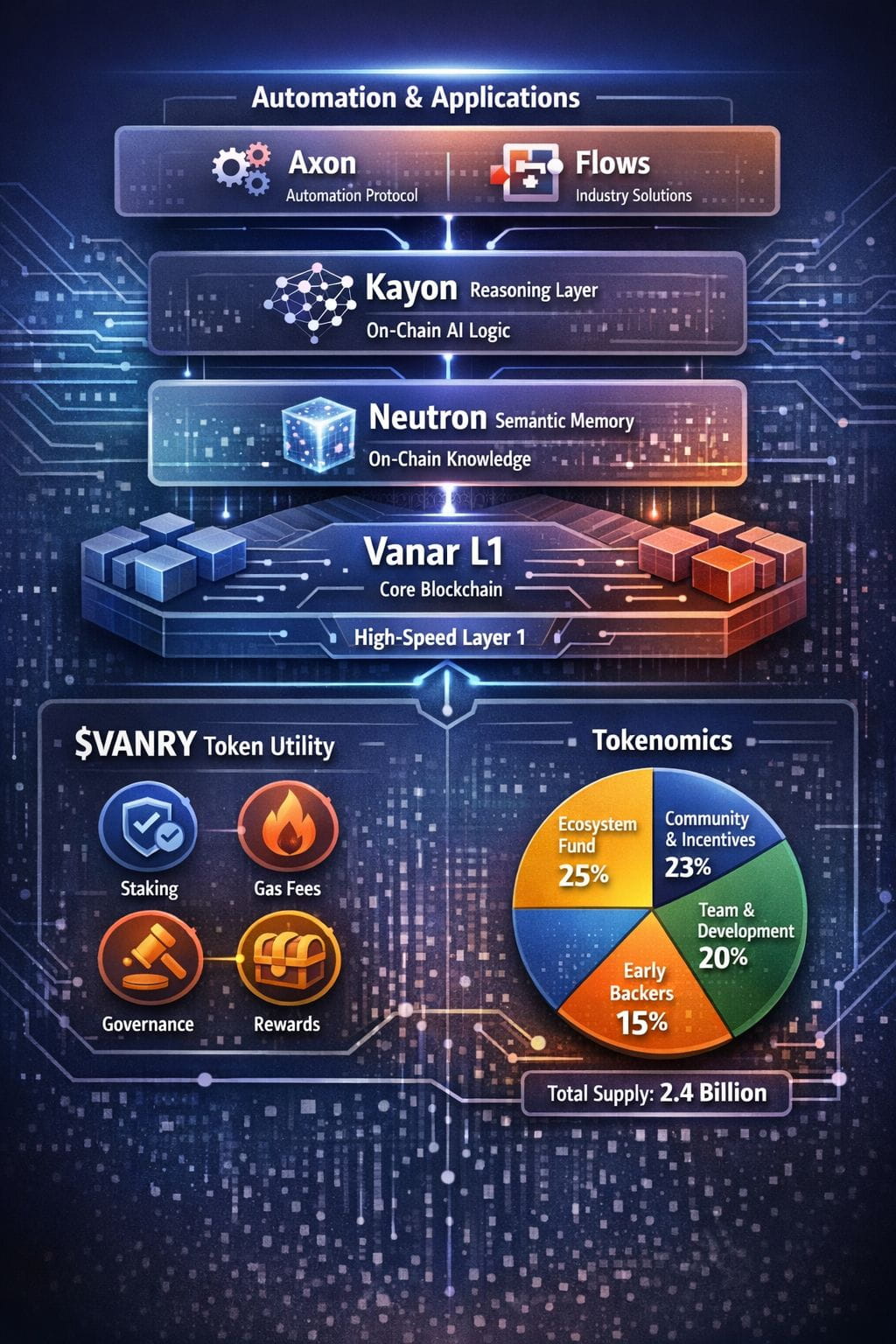 VanarchainPositioning itself as an AI-native Layer 1 built for Web3 apps that don’t just execute code, but can also “understand” data and act on it more intelligently. The core idea is simple: most blockchains are great at moving tokens and running smart contracts, but they struggle with real-world data, documents, compliance, and automation. Vanar’s approach is to make data more usable on-chain, so builders can create applications for payments, real-world assets, and consumer experiences (like gaming) without relying on fragile off-chain glue. On Vanar’s own stack description, the network is designed as a multi-layer system: a modular L1 base, a semantic memory layer (Neutron), and an on-chain reasoning layer (Kayon), with automation and “industry application” layers planned (Axon, Flows). �
vanarchain.com
What it is and why it matters:
Vanar describes itself as “AI infrastructure for Web3,” aiming to move the space from purely programmable contracts to systems that can learn, adapt, and automate decisions using structured, verifiable information. The big “why” is adoption: businesses and mainstream users care about reliability, compliance, and real services (payments, assets, identity, entertainment), not just token transfers. If a chain can store meaningful proofs (not just hashes) and trigger logic based on those proofs, it becomes much more useful for real economic activity. �
vanarchain.com +1
How it works (high level, in plain English):
Vanar’s base layer handles fast, low-cost transactions. On top of that, Neutron is presented as a semantic memory system that compresses and stores data as “Seeds” that are meant to be queryable and useful to applications, not dead files sitting somewhere off-chain. Then Kayon is framed as a reasoning engine that can query those Seeds and apply logic (for example: check a compliance condition before allowing a payment flow). This design targets a world where apps can validate and automate steps using data that is stored and provable on-chain. �
vanarchain.com
Tokenomics (and what the token does):
The token is $VANRY, and it is used for network transaction fees, staking, and smart contract operations. A published tokenomics overview states a maximum/total supply of 2.4B, with allocations including a genesis amount tied to the earlier token swap, plus pools for validator rewards, development rewards, and community incentives. Separately, major trackers report circulating supply figures in the low billions and a max supply of 2.4B, which matches the stated cap. �
Vanar documentation also explains that $VANRY exists as the native gas token, and there is an ERC-20 representation on Ethereum/Polygon for interoperability via bridging. �
assets-cms.kraken.com +2
docs.vanarchain.com
Ecosystem and adoption direction:
Vanar frequently highlights growth through integrations and consumer-facing use cases. Recent official blog updates emphasize ongoing integrations and expansion themes around entertainment, PayFi, and real-world assets, which is consistent with the “business-ready” positioning on the main stack page. �
Independent exchange/education write-ups also frame Vanar’s narrative around gaming + AI as key adoption paths (useful context, even if you treat it as third-party interpretation). �
vanarchain.com +1
OKX +1
Roadmap (what to watch next):
From Vanar’s own materials, a practical way to read the roadmap is: (1) strengthen the base chain and developer experience, (2) expand semantic storage and reasoning features so apps can do more with real data, and (3) roll out automation/application layers (Axon and Flows are listed as “coming soon”). If those layers ship with strong tooling, the chain could be more than a “fast L1” and become a full stack for payments and tokenized assets. �
vanarchain.com
Challenges and risks (realistic, not hype):
Vanar’s thesis is ambitious, and ambitious systems have real hurdles. First, “AI + on-chain data” only matters if developers actually build and users actually arrive—ecosystem traction is the ultimate test. Second, storing richer data on-chain raises questions about cost, scalability, and standards (what is stored, how it’s verified, and who maintains quality). Third, anything targeting PayFi and real-world assets faces compliance, regulation, and enterprise trust barriers. Finally, like all crypto assets, $VANRY carries volatility and liquidity risk, and project execution risk is always there if timelines slip. �
assets-cms.kraken.com
My personal takeaway: Vanar Chain’s story is less about “one more blockchain” and more about making on-chain apps smarter by default—especially for payments and real assets where data, proofs, and automation matter. If the stack (Neutron + Kayon + upcoming automation layers) becomes easy for builders and credible for businesses, it can carve out a clear lane. And if not, it risks blending into the crowded L1 field. Either way, it’s a project worth tracking closely if you’re watching the next wave of utility-focused Web3.
