
Privacy is often treated as a passing issue.
As systems develop and rules become established, privacy is usually viewed as no longer relevant.
In some regulated environments, the assumption that privacy is no longer needed can lead to industry-level structural issues. In the financial industry, the rise of shared ledgers, where transparency is inherently built into the system itself, has created a new type of transparency that creates auditability, but also exposes sensitive information about the participants, their strategies, and their relationships with each other.
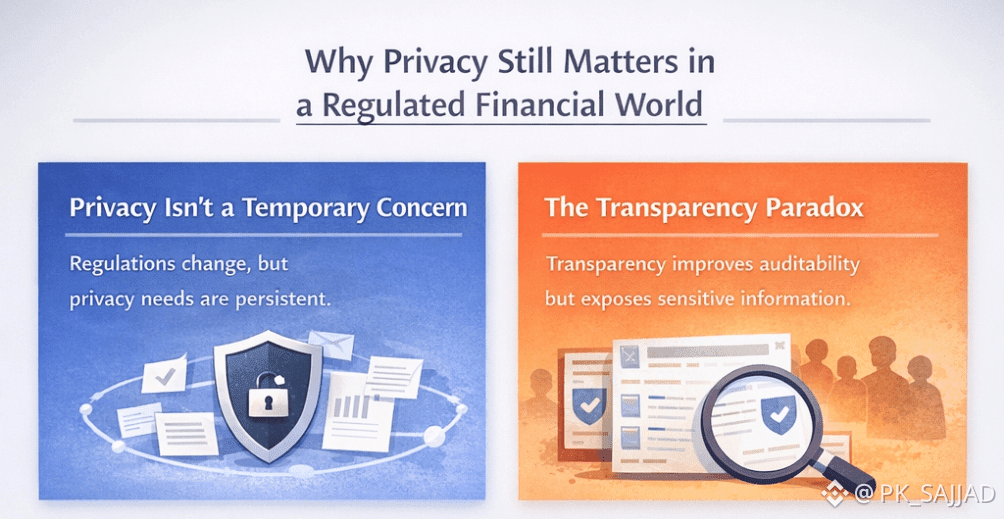
In a regulated environment, organisations that operate in that regulated environment are required to restrict certain activities to provide confidentiality to the participant. However, due to the binary nature of the majority of blockchain systems, an organisation may either have to make its data open to the public or remove it from the system altogether. This creates barriers to the adoption of the system, decreases the amount of organisations that can use the system, and forces many of the most critical or essential functions to occur in non-visible or opaque processes.
The longer a system does not have privacy-aware infrastructure, the more the absence of privacy-aware infrastructure will deteriorate the levels of compliance and the levels of trust between the regulator and the organisation.
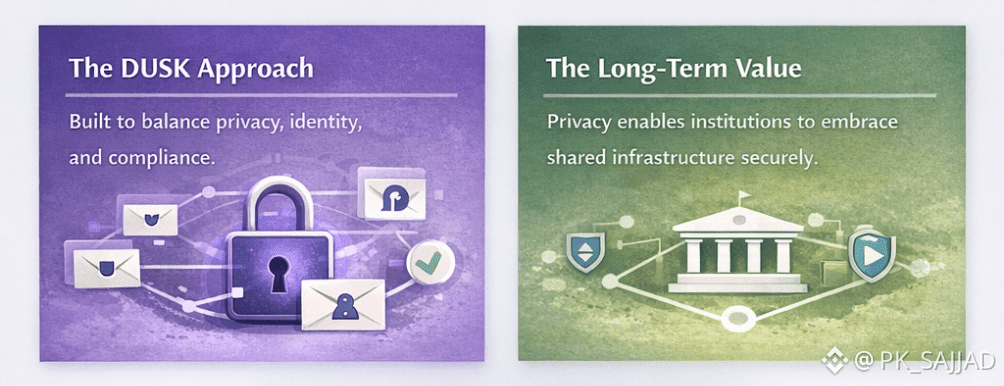
DUSK develops and treats Privacy as a Design Constraint as opposed to being an optional feature. With the development of a network-based on cryptographic techniques that provide Selective Disclosure, verification of transactions taking place can be done without having to share unnecessary details. DUSK's design is catered for by utilizing the regulated financial industry with use cases where Identity, Confidentiality and Auditability must exist in conjunction with each other. DUSK separates Transaction Validity from Data Visibility enabling compliance checks to occur without exposing the entire transaction history of users. Most of the decisions DUSK makes have to do with balancing Complexity versus Performance; DUSK has optimized its design for the long term to use in an Institutional Environment as opposed to simplicity in the short term.
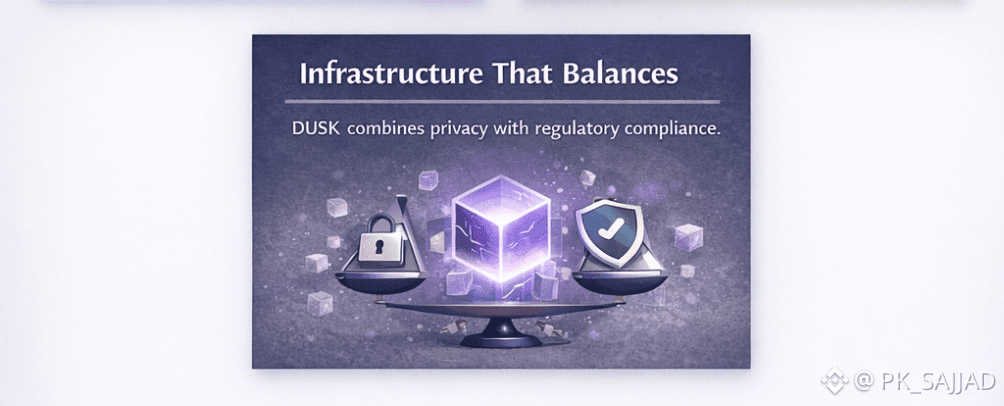
The Importance of this Approach is that financial systems are often used by more than just individuals; Institutions and Regulators and Service Providers also need infrastructure which supports Privacy while providing Oversight. For Users this approach provides reduced exposure to Data Leakage and Unintentional Profiling; and for the Overall Ecosystem, DUSK helps to create a Model that does not position Privacy and Regulation as Opposing Forces but rather as Complementary Requirements in a single unified Infrastructure.
As Financial Systems Maturation happens they usually reflect the Constraints from which they were created.
Removing Privacy at a Later Date Requires a Higher Degree of Cost and Complexity to Re-Introduce Privacy.
