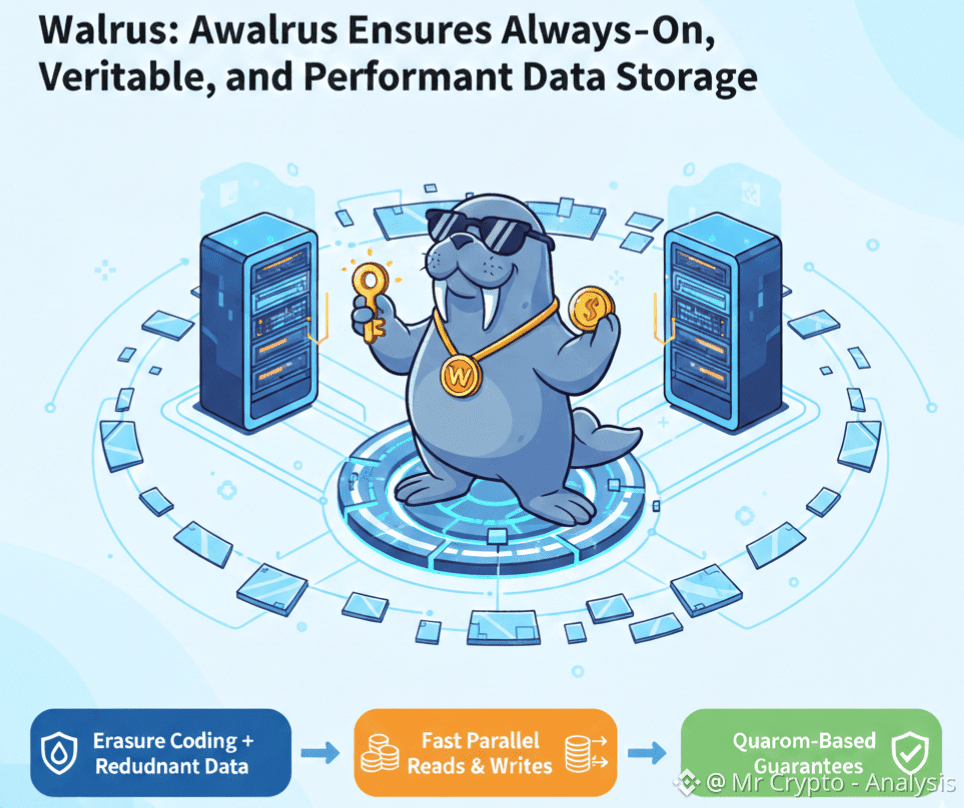
Walrus takes a fundamentally different approach to decentralized storage compared to earlier systems such as IPFS or Filecoin. Rather than treating availability and performance as optional add-ons, Walrus defines them as core protocol guarantees. The network is purpose-built as a long-term data availability and storage layer for applications that require consistency, reliability, and predictable performance over time.
Instead of storing full copies of data on a limited number of nodes, Walrus breaks each blob into encoded fragments using RedStuff, its two-dimensional erasure coding scheme. These fragments are distributed across a quorum of storage nodes, with each node holding only a small portion of the data. As long as a sufficient number of honest nodes remain online, the original data can always be reconstructed. This design eliminates the need for costly full replication while still maintaining strong fault tolerance.
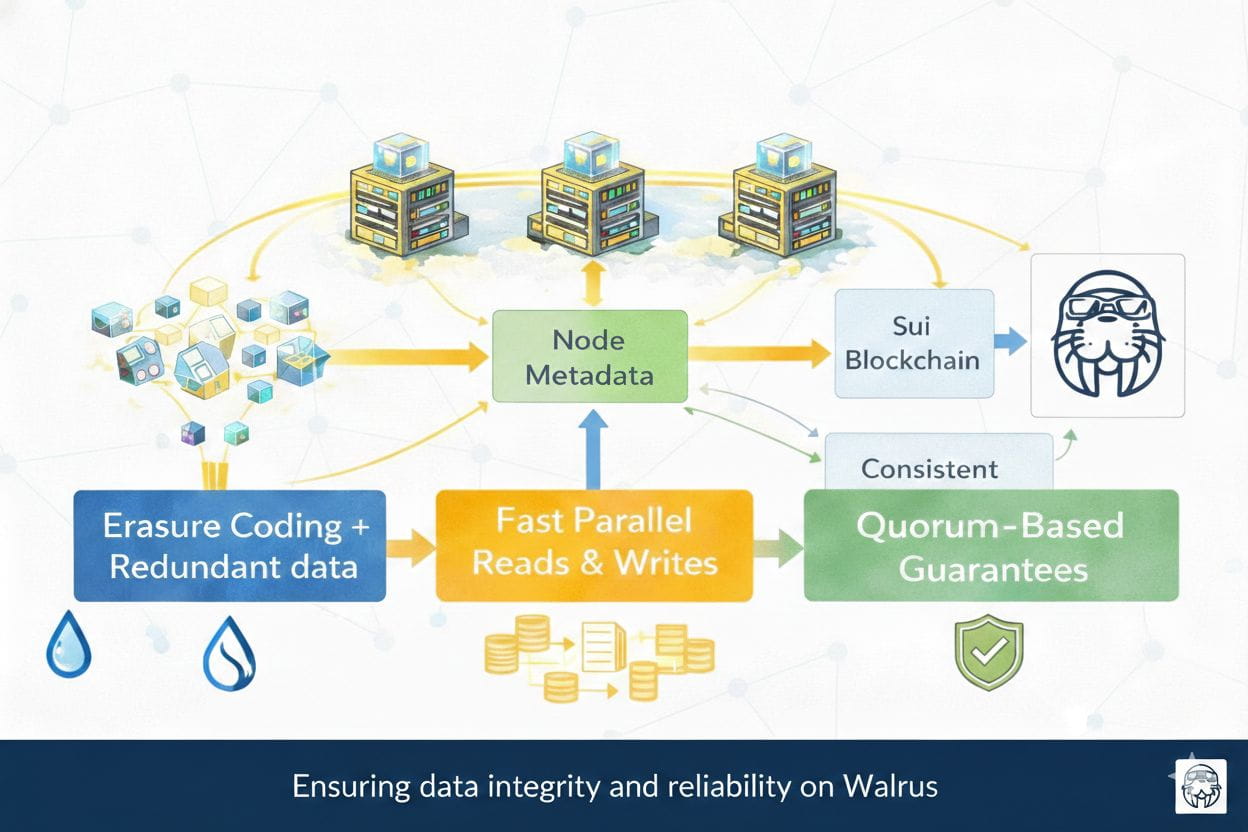
Walrus is also optimized for speed by default. Data reads are handled in parallel by multiple nodes, and reconstruction does not depend on any single node maintaining a full or “hot” copy of the data. There is no separate premium tier for faster access — performance is built directly into the protocol. This makes Walrus suitable not only for archival storage, but also for live and interactive applications that depend on stable latency.
To ensure long-term reliability, Walrus separates data availability verification from data retrieval. Storage nodes continuously demonstrate that they are holding valid data fragments through cryptographic commitments and asynchronous challenge mechanisms. These proofs are independently verified and anchored on-chain, ensuring that availability is enforced even in adversarial conditions. At the same time, users can retrieve data directly from storage nodes without waiting for global verification steps.
By combining erasure coding, quorum-based guarantees, asynchronous verification, and infrastructure-level coordination, Walrus delivers storage that is durable, verifiable, and performant at scale. Instead of charging extra for reliability or speed, Walrus treats both as essential properties of the system. This makes it a strong foundational storage layer for decentralized applications that require their data to remain accessible, consistent, and alive on the internet over the long term.