In crypto, speed matters.
Block time — the time a blockchain takes to produce a new block — directly impacts transaction finality, user experience, DeFi efficiency, and high-frequency trading. Faster block times mean quicker confirmations, smoother dApps, and real-time on-chain activity.
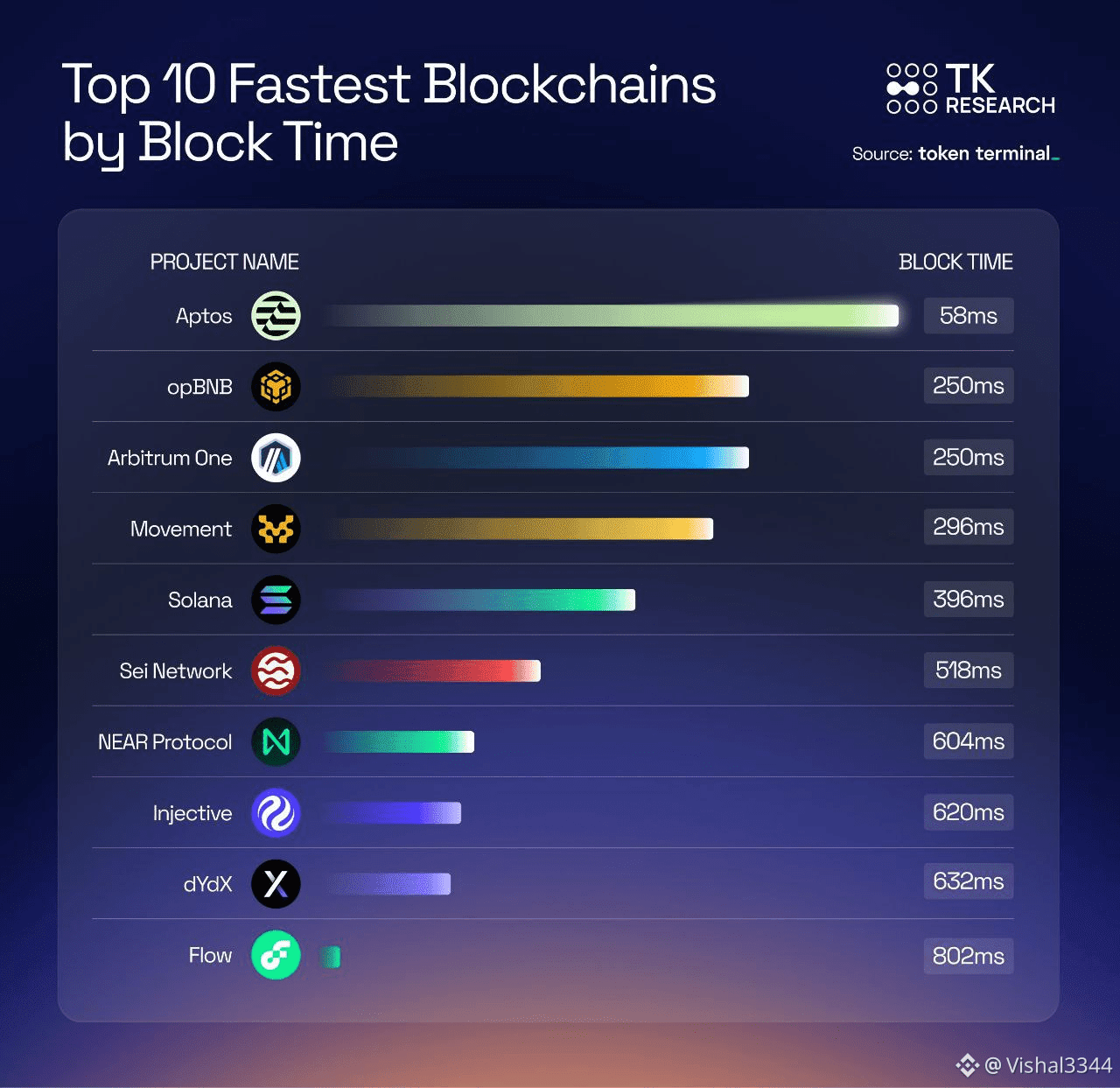
Based on recent data from Token Terminal & ecosystem benchmarks, here are the Top 10 fastest block time leaders reshaping blockchain performance 👇
$
🥇 1. Aptos — 58 ms
Aptos currently dominates the speed race.
Built with the Move programming language and parallel execution, Aptos achieves sub-100 millisecond block times, making it one of the fastest Layer-1 blockchains ever deployed.
🔹 Best for: High-performance DeFi, gaming, real-time applications
🔹 Key strength: Parallel transaction processing
🥈 2. opBNB — 250 ms
opBNB is Binance’s Layer-2 scaling solution built using Optimistic Rollups.
It offers extremely fast confirmations while staying tightly integrated with the BNB ecosystem.
🔹 Best for: Low-fee dApps, mass adoption
🔹 Key strength: Binance ecosystem support
🥉 3. Arbitrum One — 250 ms
Arbitrum One proves that Ethereum scaling doesn’t have to compromise speed.
As the leading Ethereum L2, it delivers fast block times while inheriting Ethereum’s security.
🔹 Best for: DeFi, Ethereum-native apps
🔹 Key strength: Security + speed balance
4. Movement — 296 ms
Movement combines Move-based execution with modular blockchain architecture.
It’s emerging as a serious contender in the next-gen infrastructure race.
🔹 Best for: Developers building modular chains
🔹 Key strength: Flexible execution environment
5. Solana — 396 ms
Solana remains one of the fastest monolithic Layer-1s in production.
Despite past network challenges, Solana continues to power high-volume DeFi, NFTs, and payments.
🔹 Best for: High-throughput consumer apps
🔹 Key strength: Massive TPS capability
6. Sei Network — 518 ms
Sei is optimized specifically for trading and order-book based applications.
Its speed and deterministic execution make it ideal for on-chain exchanges.
🔹 Best for: DEXs, trading platforms
🔹 Key strength: Trading-optimized consensus
7. NEAR Protocol — 604 ms
NEAR focuses on developer friendliness and sharding.
While not the fastest, it balances speed, usability, and scalability effectively.
🔹 Best for: Consumer-friendly dApps
🔹 Key strength: Nightshade sharding
8. Injective — 620 ms
Injective is purpose-built for financial applications, offering fast execution with Cosmos interoperability.
🔹 Best for: DeFi derivatives & trading
🔹 Key strength: Cosmos IBC integration
9. dYdX — 632 ms
The dYdX Chain runs on Cosmos and is optimized exclusively for professional-grade trading.
🔹 Best for: Perpetual futures trading
🔹 Key strength: App-specific blockchain design
10. Flow — 802 ms
Flow prioritizes user experience and NFTs over raw speed.
Used by major brands, it trades ultra-low latency for reliability and onboarding simplicity.
🔹 Best for: NFTs, gaming, consumer apps
🔹 Key strength: Multi-role architecture
🚀 Final Thoughts
Fast block times are no longer a luxury — they are a necessity.
As crypto moves toward real-world adoption, blockchains that combine speed, security, and stability will dominate the next cycle.
⚠️ Remember:
Speed alone doesn’t win — network reliability, decentralization, and developer adoption matter just as much.