
Walrus is not trying to be loud, flashy, or hype-driven and that’s exactly why so many serious builders are paying attention. At its heart, Walrus is about one thing that Web3 and AI desperately need but rarely get right: reliable, affordable, and truly decentralized data storage. Built on the Sui blockchain, Walrus is designed to handle massive amounts of unstructured data like AI datasets, videos, images, NFTs, and application data, without forcing users to trust a single company or server.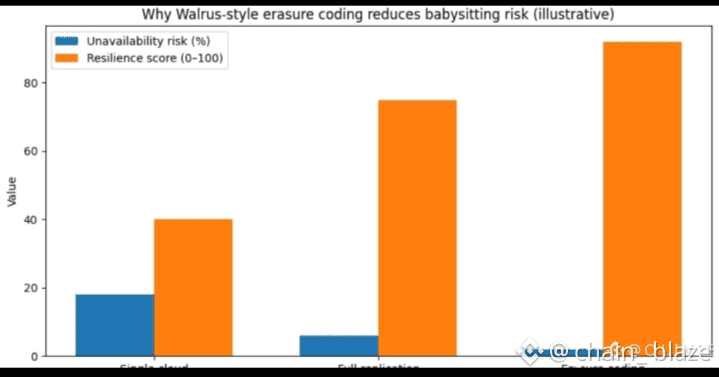
Think of Walrus as a new kind of digital warehouse. Instead of putting your data in one place and hoping it doesn’t break, get hacked, or censored, Walrus breaks your files into many small pieces and spreads them across a large network of independent nodes. Even if several of those nodes go offline, your data is still safe and accessible. This is made possible by an advanced system called erasure coding, which allows lost pieces to be rebuilt quickly and efficiently. The result is storage that is not only resilient, but also cost-effective at massive scale.
What makes Walrus especially powerful is how deeply it connects storage with smart contracts. On Walrus, stored data isn’t just passive files sitting in the background. Each storage object is linked to Sui’s programmable system, meaning apps can interact with data directly. Developers can create applications where files unlock at certain times, change based on conditions, or are shared only with specific users. This turns data into something alive something apps can reason about and control.
The WAL token sits at the center of this system. It’s used to pay for storage, secure the network, and guide the future of the protocol through governance. Node operators stake WAL to prove they’re committed to the network and are rewarded for reliably storing and serving data. Token holders can also vote on important decisions, helping shape how Walrus evolves over time. The supply is large, designed to support long-term growth, with distribution spread across ecosystem incentives, development, and community participation.
Walrus moved from theory to reality in a big way when it launched its mainnet in March 2025. Backed by major investors and years of research, the launch marked a turning point. This wasn’t a rushed release it followed extensive testing and real developer feedback. Since then, the network has been steadily growing, with teams using Walrus for AI model hosting, decentralized media storage, and Web3 applications that need fast and reliable data access.
One of the most interesting aspects of Walrus is its relationship with Sui’s economy. Storage activity on Walrus uses SUI tokens, some of which are locked or burned during operations. As storage demand grows, this could create real economic pressure on SUI’s supply, tying data usage directly to the value of the underlying blockchain. In a future where AI and data-heavy apps dominate, that connection could become extremely important.
Looking ahead, Walrus isn’t standing still. The roadmap focuses on scaling the network to handle even larger workloads, adding more advanced access controls for sensitive or time-based data, and expanding beyond Sui to connect with other blockchains. The goal is clear: become a universal data layer that any chain, app, or AI system can rely on.
Walrus doesn’t promise quick profits or overnight hype. What it offers instead is infrastructure the kind that quietly supports everything else. As Web3 matures and AI continues to explode, projects that solve real problems tend to matter the most. Walrus is betting that data, not speculation, will be the backbone of the next digital era. And if that bet is right, WAL may end up being one of the most important building blocks most people never noticed until they couldn’t live without it.

