
On Plasma( @Plasma ), the payment doesn’t wait to see who’s watching.
USDT leaves the wallet and the system doesn’t check back in with anyone. There’s no “are you sure,” no dependency sitting underneath that could quietly fail. No native token balance hovering in the background like a gatekeeper.
It just moves.
Gasless stablecoin transfers do something blunt. They remove the moment where a payment can be negotiated away by circumstance. No gas panic. No last-second top-up. No conversion step that turns intent into friction.
The chain doesn’t ask what else you’re holding.
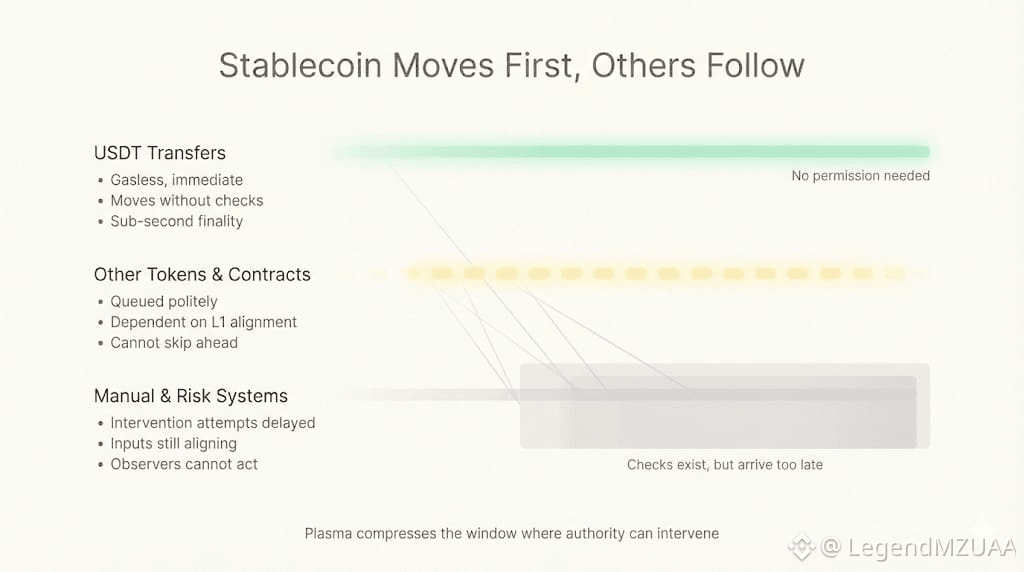
PlasmaBFT closes state fast. That’s obvious. What’s less obvious is how little time that leaves for interruption. The usual actors never arrive. Manual review is still loading. Risk systems are still lining up their inputs. By the time anyone could object, there’s nothing left to object to.
In high-adoption markets, this isn’t dramatic. It’s quiet. Almost boring.
A tap. A balance change. The merchant already looking away. Nobody explains. Nobody hedges. Nobody says “give it a second.” The transaction didn’t pause long enough to create doubt.
That’s new.
Most payment rails leave a soft space after execution. A grace period. A chance for someone upstream to say wait. Plasma compresses that space until it stops being useful. Sub-second finality isn’t about speed here. It’s about shrinking the window where authority can still matter.
Institutions feel it differently.
They don’t see a faster system. They see fewer handles. Nothing to pull on after the fact. No internal queue to lean against when something feels uncomfortable. Settlement lands already outside their reach.
Bitcoin anchoring sits behind this, uninterested and heavy. It doesn’t accelerate anything. It just makes the past stubborn. Once Plasma commits, there’s no secondary layer where the story can be edited later.
Teams adjust without talking about it.
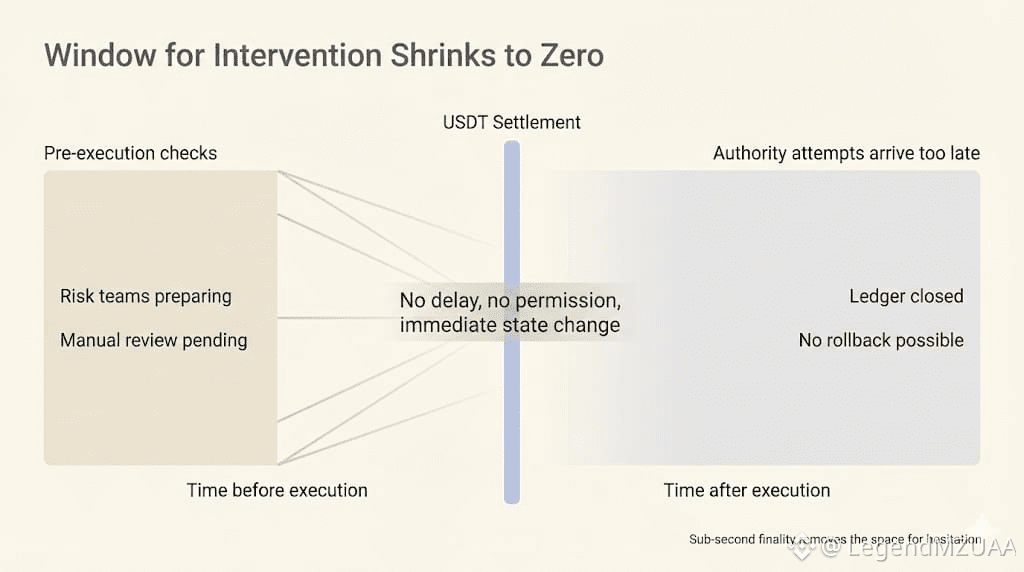
Controls move earlier. Checks happen before execution because after execution there’s nothing left to check. Plasma doesn’t block intervention, it outruns it.
The chain keeps treating stablecoins as first-class. Everything else queues politely behind them. Not because it’s fair. Because that’s the point.
On Plasma, Nothing feels like enforcement.
It feels like absence.
No one asks for permission because there’s no one left who could grant it.
The payment already happened.
The ledger already closed.
And whatever hesitation was supposed to live in that gap never found a place to stand.