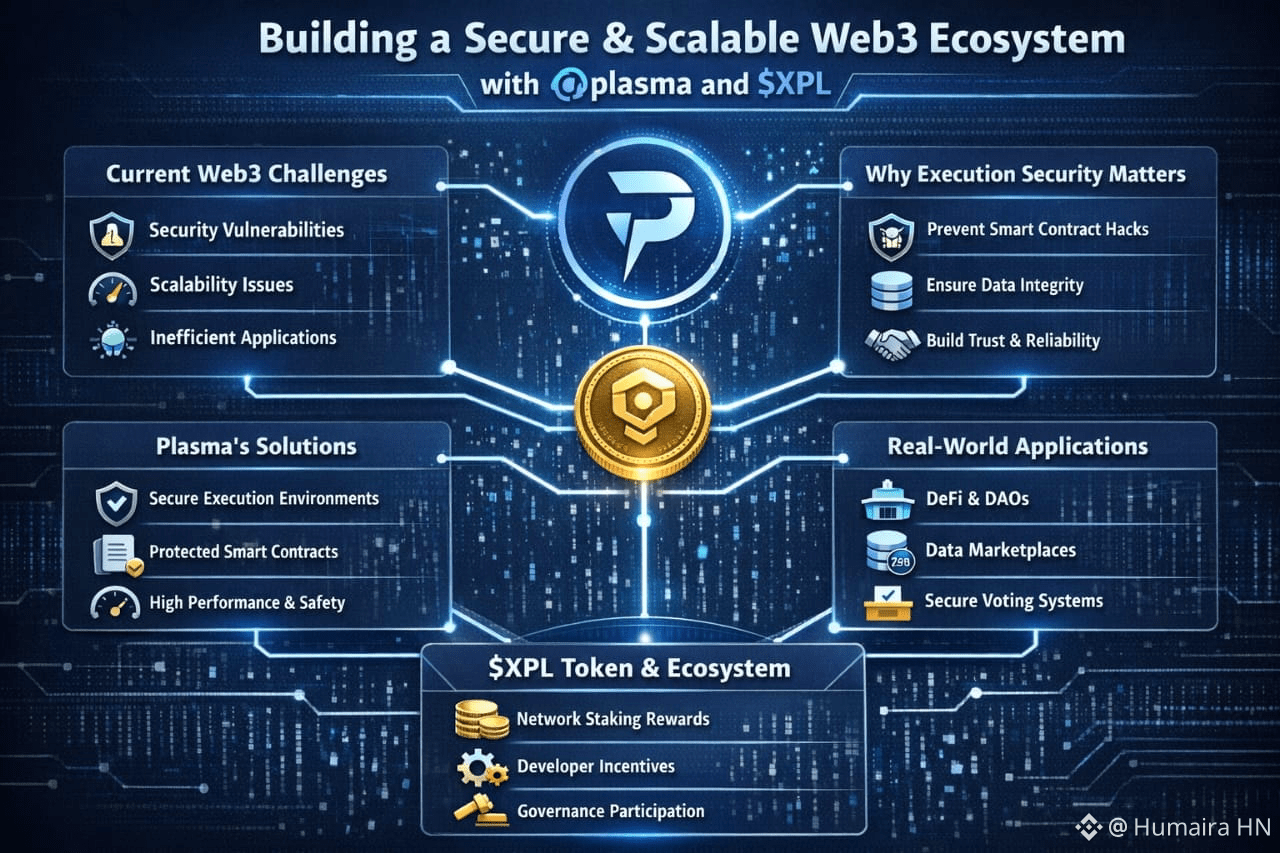
Introduction - Why Execution Security Is the Missing Layer in Web3
Over the past few years, I have been closely observing the evolution of Web3 and one lesson has become increasingly clear: the real challenge of decentralized applications is not hype or speculation, but trust, security, and reliability. As a participant in this space, I’ve seen firsthand how many promising platforms struggle to provide developers and users with environments that are genuinely safe and scalable. This is where @Plasma and its ecosystem token, $XPL , stand out. They are not just another blockchain or speculative token, they are the infrastructure underpinning a secure and scalable Web3 future.
When I first learned about Plasma, I was struck by its focus on execution security. In most public blockchains, developers face the constant tension between performance and security. While speed and scalability often dominate the narrative, execution risks, flaws in smart contracts, potential data manipulation or even insecure transaction handling are still among the top barriers to adoption. Plasma addresses this head-on by creating a platform where developers can deploy complex applications confidently, knowing that both the logic and operations are protected within a verifiable environment. This is not just a technical improvement; it is a paradigm shift for how we think about Web3 infrastructure.
The Current State of Web3
Web3 today is a mix of remarkable potential and recurring challenges. I’ve spent countless hours exploring different ecosystems, observing both success stories and setbacks. High-profile security failures have shown that decentralization alone is insufficient. A smart contract that executes incorrectly, even once, can lead to catastrophic losses, eroding trust in an entire platform. Similarly, many applications suffer from inefficiencies due to poor design, making them vulnerable to exploits or manipulation.
Scalability is another challenge. Many blockchains promise rapid transaction throughput, yet their execution layers are under optimized, creating vulnerabilities for sophisticated applications like DeFi protocols, DAOs, or data marketplaces. What this revealed to me is that Web3’s promise cannot be fully realized without robust infrastructure designed for both speed and security.
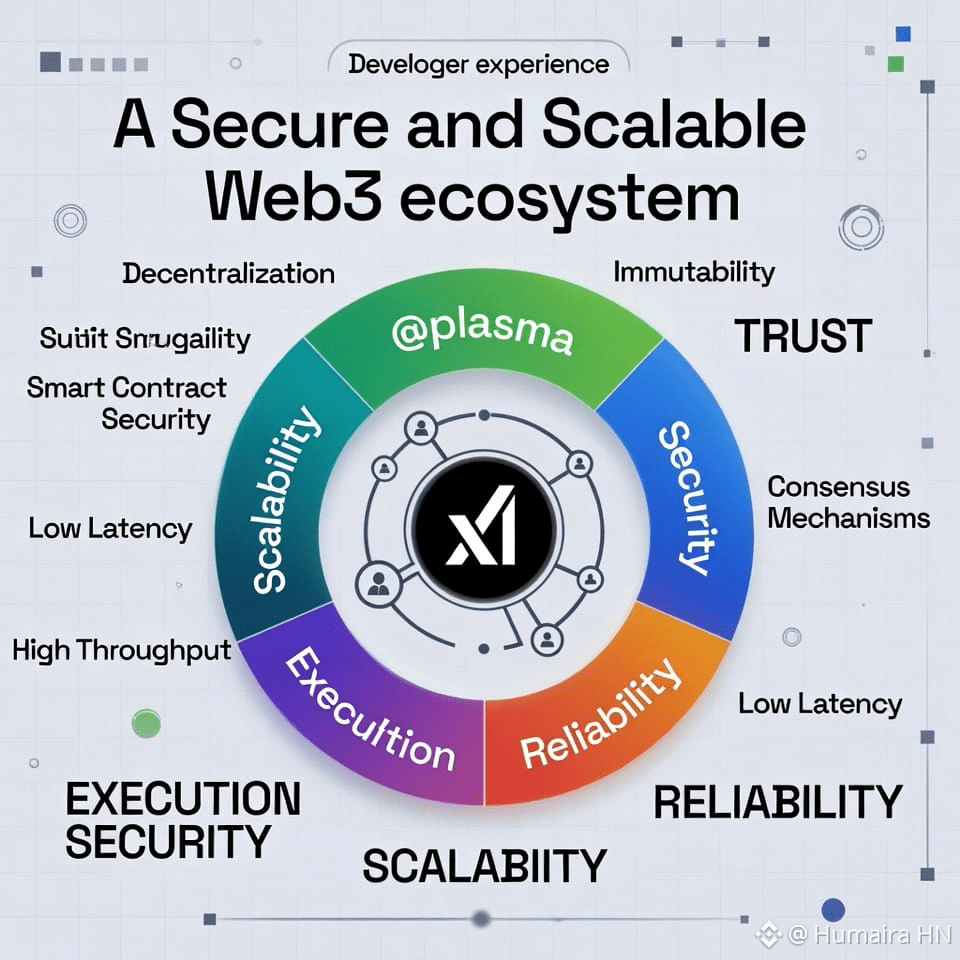
Why Execution Security Matters
As I delved deeper into blockchain development, I realized that execution security is the invisible backbone of successful applications. Smart contracts are meant to be trustless, yet every day, developers encounter the reality of vulnerabilities: coding errors, logic oversights, and operational risks. Even minor flaws can be exploited, leading to financial loss, compromised data, or broader network distrust.
For example, consider the many DeFi hacks reported over the past few years. These incidents were not failures of blockchain technology itself but rather failures in execution integrity. The lesson is clear: without a platform that prioritizes security at the execution layer, the Web3 ecosystem cannot reach maturity. This is exactly the gap Plasma aims to fill.
How Plasma Addresses These Challenges
Plasma’s approach is elegant in its simplicity and powerful in its execution. The platform provides secure execution environments where smart contracts and applications operate within well defined, protected boundaries. Unlike standard public blockchains where every transaction is processed in an open and sometimes vulnerable environment, Plasma ensures that sensitive logic remains shielded, while still preserving transparency and verifiability.
This approach has multiple benefits. Developers can innovate without fear of exposing critical code to malicious actors. Enterprises and startups can deploy complex workflows without compromising security. Even individual users benefit from knowing that the applications they interact with have built in execution integrity. In my experience, this focus on security fundamentally changes how developers approach building on a blockchain, encouraging more ambitious and responsible applications.
Real World Applications of Plasma
What excites me most about Plasma is how this secure infrastructure translates into real-world applications. In the DeFi space, for example, applications built on Plasma can execute complex financial logic safely, reducing the risk of exploit and increasing user confidence. DAO governance systems can operate with full transparency while ensuring that sensitive voting mechanisms or treasury operations remain protected.
Data marketplaces are another compelling example. The value of decentralized data depends on both accessibility and integrity. Plasma provides a platform where data providers can share information confidently, knowing that operations are secure, and consumers can rely on the accuracy of the data they receive. Each of these scenarios demonstrates the practical utility of XPL as more than a token, it is the engine driving trust and reliability across the ecosystem.
The Developer Experience on Plasma
Having explored the platform firsthand, I can attest that developer experience is a priority for Plasma. The tools, SDKs, and frameworks provided make it easier for creators to build privacy aware and scalable applications. From the initial coding stages to deployment and maintenance, Plasma offers resources that streamline development while ensuring robust security.
I remember reviewing a team’s early project deployment on Plasma, and the difference was immediately noticeable. The integration of secure execution environments reduced the testing overhead significantly, while the platform’s documentation and support network ensured that even complex logic could be deployed efficiently. For any developer aiming to create production ready Web3 applications, this level of infrastructure support is invaluable.
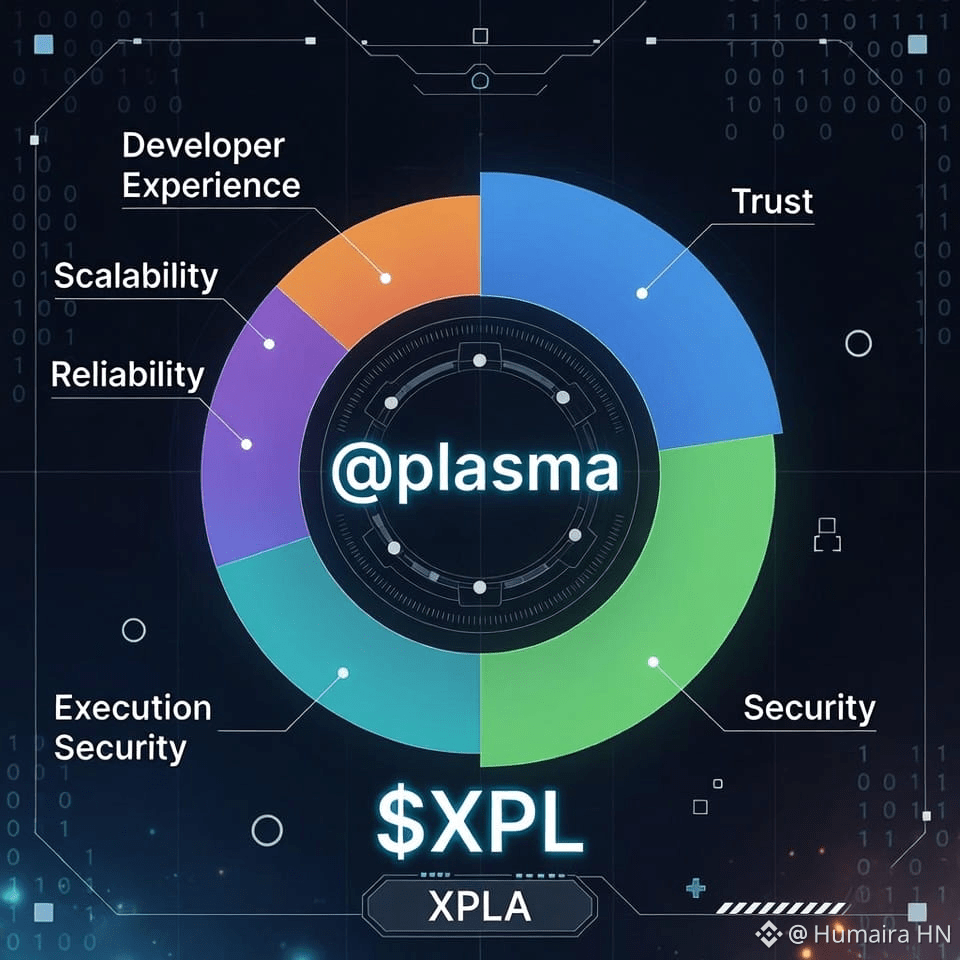
XPL Token and Ecosystem Incentives
The $XPL token is central to Plasma’s ecosystem, and I see it not merely as a medium of exchange but as a mechanism for sustaining network health and incentivizing participation. Validators securing the network are rewarded with XPL, developers benefit from its utility in deploying applications, and participants can engage in governance and staking activities that strengthen the overall ecosystem.
From my perspective, this aligns incentives effectively. XPL encourages responsible behavior, fosters long-term commitment, and creates a vibrant ecosystem where both technical and community contributions are valued. It also positions the token as a critical part of the long term sustainability of secure, decentralized applications.
Comparing Plasma with Other Platforms
Having explored Ethereum, Solana, and Polkadot, I can confidently say that Plasma occupies a unique niche. Many chains excel in scalability or community adoption but do not focus explicitly on execution security at the level Plasma does. Ethereum’s smart contracts are powerful but sometimes exposed to risks that could have been mitigated by a secure execution framework. Solana’s speed is remarkable, yet execution vulnerabilities have occasionally led to high profile network issues. Plasma complements these ecosystems by offering a layer where applications can operate securely without sacrificing performance.
The Future of Plasma and Web3
Looking forward, I see Plasma as a key enabler for the next wave of Web3 adoption. Enterprises seeking to integrate blockchain solutions will naturally gravitate towards platforms that offer secure, auditable, and reliable execution. Developers aiming for real world applications from finance to governance to data management will benefit from Plasma’s robust infrastructure and community support.
In my experience, the combination of technical rigor, developer support, and token-driven incentives creates an ecosystem that is both resilient and scalable. As adoption grows, I anticipate XPL playing a pivotal role not just in securing the network but in enabling innovation across industries.
Conclusion
Reflecting on my journey with @plasma and $XPL , the lesson is clear: the future of Web3 depends on platforms that prioritize security, trust, and developer empowerment. Plasma is not just another blockchain project, it is an infrastructure solution designed for real-world applications, long-term sustainability and scalable growth.
Every feature, update, and tool strengthens the platform’s ability to support complex applications securely. For anyone interested in the evolution of decentralized ecosystems, watching Plasma and XPL is essential. They represent not just innovation, but the foundation for a safer, more reliable, and professional Web3.