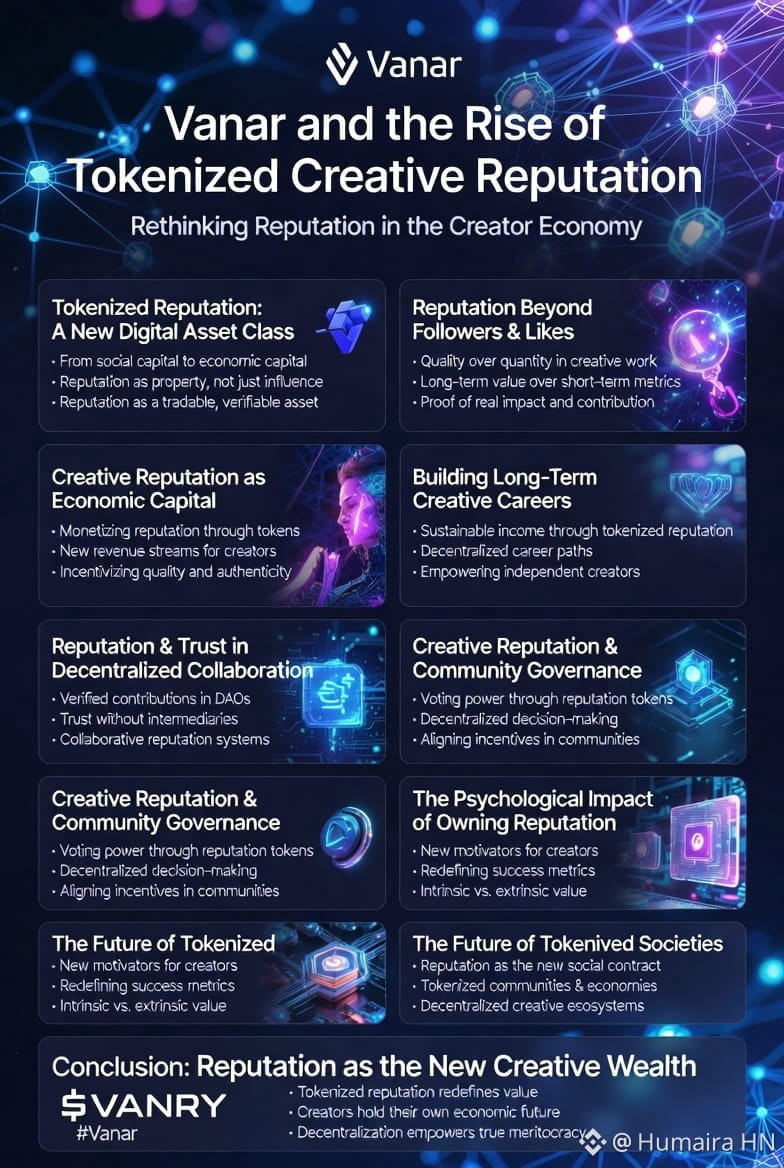
Introduction – Rethinking Reputation in the Creator Economy
In the modern digital world, reputation has become one of the most valuable assets a creator can have. Whether someone is a writer, designer, developer, educator, or content creator, their success often depends on how much trust others place in their skills and past work. However, most online reputations today are still locked inside centralized platforms that control visibility, algorithms, and access to audiences.
The problem with centralized reputation is that it is fragile and temporary. A creator can spend years building followers, reviews, and credibility on one platform, only to lose everything if the platform changes its rules, gets banned in a region, or simply disappears. This makes reputation something we rent instead of truly own, even though it represents real effort, creativity, and time.
From my perspective, this is where Vanar becomes extremely interesting. Instead of treating reputation as something external and platform owned, Vanar opens the possibility for creators to turn their reputation into a tokenized digital asset that they actually control, making $VANRY and @Vanar part of a much deeper shift in how creative value is stored and recognized.
Tokenized Reputation as a New Digital Asset Class
Tokenized reputation means that a creator’s achievements, contributions, and history can be represented on chain in a structured and verifiable way. Instead of just likes, followers, or views, reputation becomes something measurable, transparent, and portable across different ecosystems. This transforms reputation from social validation into a real digital asset.
In the Vanar ecosystem, this idea fits naturally because the network is designed for creator focused infrastructure. Reputation tokens or reputation-based credentials could reflect things like successful collaborations, completed projects, peer reviews, or community impact. These records would not depend on a single platform, but exist independently on-chain and grow over time.
When I think about this, it feels like a major upgrade to how creators build long-term careers. Instead of starting from zero every time I join a new platform or community, my creative reputation could follow me, evolve with me, and even become more valuable than individual pieces of content I produce using $VANRY.
Reputation Beyond Followers and Likes
Today, most creators are judged by surface level metrics such as follower counts, engagement rates, or viral reach. These numbers often say more about algorithms than real creative quality. A creator with fewer followers might be far more skilled and reliable than someone with millions of views, but the system does not reflect that properly.
Vanar offers a way to rethink this by enabling deeper reputation signals. Instead of popularity, reputation could be based on proof of contribution, verified collaboration, long term consistency, and real impact. This creates a more honest system where creators are valued for what they actually build, not just how loud they are.
Personally, this is something I find very motivating. It means I don’t need to chase trends or viral content to feel successful. I can focus on meaningful work, knowing that my reputation within the Vanar ecosystem grows organically and becomes a real part of my digital identity supported by VANRY.
Creative Reputation as Economic Capital
Once reputation becomes tokenized, it naturally starts functioning like economic capital. Just as financial assets open doors to opportunities, tokenized creative reputation can unlock collaborations, funding, partnerships, and community leadership roles. Reputation becomes something others can trust without needing personal connections.
In a Vanar based environment, creators with strong reputation tokens could gain priority access to projects, governance decisions, grants, or premium collaboration spaces. Instead of networking based on hype or social circles, opportunities could be distributed based on transparent creative merit.
From my experience, this feels far more fair than traditional systems. Instead of competing for attention, creators compete on contribution and reliability. Over time, my creative reputation becomes a form of economic leverage that grows alongside my skills, and VANRY becomes the fuel behind that entire reputation economy.
Building Long-Term Creative Careers
One of the biggest challenges for creators is sustainability. Many creators experience short-term success but struggle to maintain consistent income and relevance over long periods. This is because most platforms reward momentary engagement rather than long-term creative development.
Vanar’s reputation-based model supports long-term thinking. Instead of chasing daily metrics, creators can focus on building a solid reputation portfolio that reflects years of learning, experimentation, collaboration, and growth. This turns creativity into a career path rather than a temporary trend.
For me, this changes how I think about the future. I no longer see my creative work as isolated projects, but as layers of reputation stacking over time. With $VANRY, my effort today directly contributes to a long-term digital asset that represents who I am as a creator.
Reputation and Trust in Decentralized Collaboration
In decentralized environments, trust becomes one of the hardest problems to solve. When anyone can participate anonymously, it is difficult to know who is reliable, skilled, or genuinely committed to a project. This often slows down collaboration or forces teams to rely on centralized intermediaries.
Tokenized reputation on Vanar can act as a decentralized trust layer. Instead of trusting individuals blindly, collaborators can rely on on-chain reputation records that show past contributions, peer validations, and long-term activity. This allows trust to emerge organically without centralized control.
From my point of view, this is one of the most powerful aspects of the system. It means I can confidently collaborate with people I have never met, simply by observing their creative reputation. Over time, this creates a global network of trusted creators connected through $VANRY.

Creative Reputation and Community Governance
Another interesting dimension of tokenized reputation is governance. In many Web3 projects, governance power is based purely on token holdings, which favors wealth over contribution. This can lead to decisions being controlled by speculators instead of actual builders.
Vanar’s approach opens the possibility for governance based on reputation instead of only financial stake. Creators who contribute consistently could gain more influence in decision-making, shaping the future of platforms and ecosystems they actively support.
As a creator, this feels empowering. It means my voice matters because of my work, not just my wallet. Over time, $V$VANRY comes not only a financial token but a symbol of participation, contribution, and shared responsibility within the Vanar ecosystem.
The Psychological Impact of Owning Reputation
Beyond technology and economics, there is also a psychological shift. When creators truly own their reputation, they feel more motivated, confident, and independent. They are no longer at the mercy of algorithms or platform policies that can change overnight.
Vanar introduces a sense of digital self-worth that goes beyond likes and views. Reputation becomes something internal and permanent, not external and temporary. This encourages healthier creative behavior focused on quality, learning, and meaningful collaboration.
Personally, this gives me a stronger sense of identity as a creator. I feel like my work actually accumulates into something lasting, rather than disappearing into endless feeds. With VANRY, my creative journey feels more real, more stable, and more future proof.
The Future of Tokenized Creative Societies
Looking ahead, tokenized reputation could become the foundation of entire creative societies. Communities could organize around shared values, skills, and goals, with reputation acting as the social currency that defines roles, influence, and access.
Vanar has the infrastructure to support such societies by combining blockchain, creator tools, and decentralized governance. Instead of platforms owning communities, communities become self-organizing networks of creators linked through reputation and shared purpose.
When I imagine this future, I see a world where creators are no longer just users of platforms, but active architects of digital culture. With $VANRY, reputation becomes the bridge between creativity, identity, and long-term economic freedom. #Vanar
Conclusion – Reputation as the New Creative Wealth
The creator economy is slowly moving from attention-based systems toward value-based systems. Instead of being rewarded for noise, creators will be rewarded for contribution, consistency, and collaboration. Tokenized reputation represents this shift in a very powerful way.
Vanar stands out because it treats reputation not as a social metric, but as a real digital asset that creators can own, grow, and leverage across ecosystems. This changes how we think about careers, success, and digital identity.
From my personal perspective, this is one of the most exciting ideas in Web3. It makes me feel like my creativity finally has long-term value beyond temporary trends. With $VANRY and @Vanar , reputation becomes not just recognition, but real creative wealth. #vanar