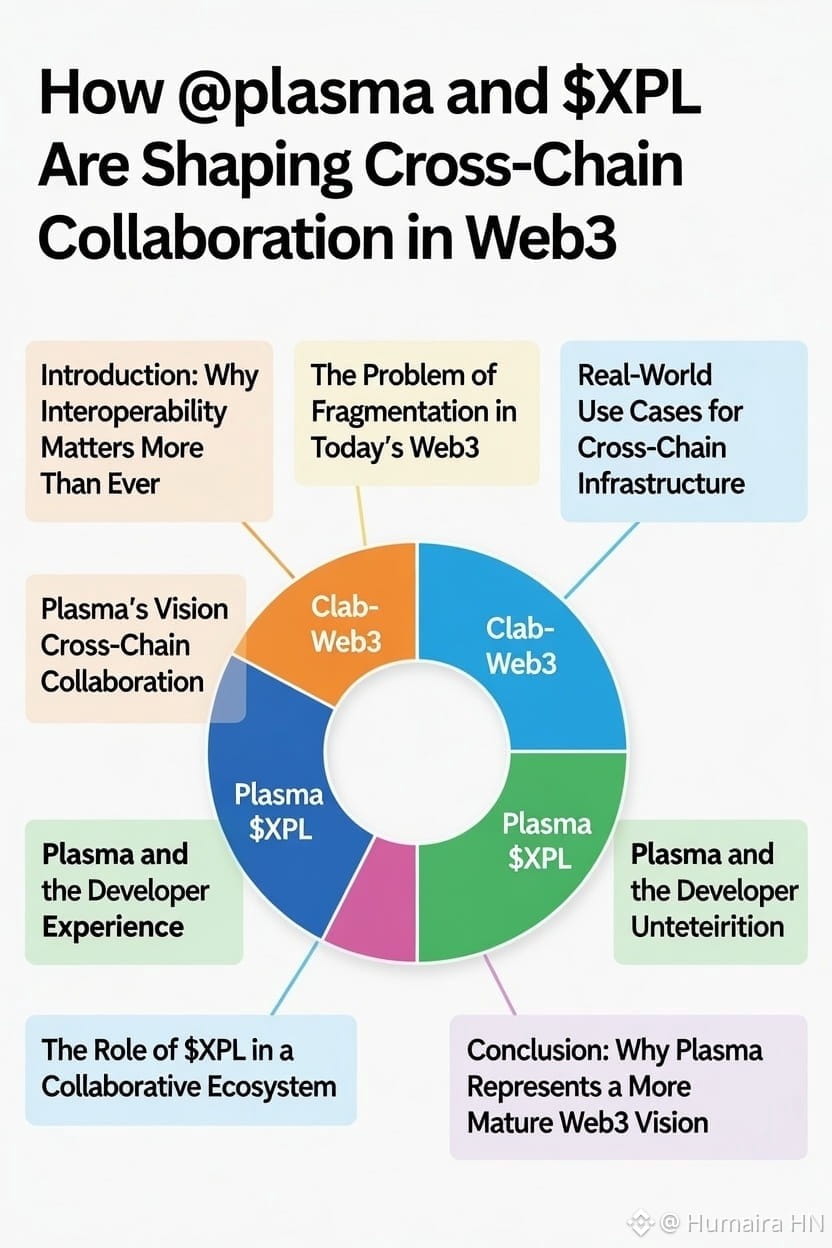
Introduction: Why Interoperability Matters More Than Ever
When I first started exploring Web3, I was fascinated by the idea of decentralization, ownership, and permissionless systems. But as I spent more time actually using different blockchains, I began to notice a serious limitation: everything felt fragmented. Each network had its own wallets, tokens, applications, and communities, but very little communication between them. Instead of one unified Web3, it felt like dozens of isolated digital islands.
This fragmentation creates real problems for both users and developers. As a user, I constantly have to bridge assets, switch networks, and learn new tools just to interact with different applications. As someone interested in the builder side of Web3, I also see how developers are forced to choose one ecosystem and ignore others, even when there are opportunities to collaborate or expand. The lack of seamless interaction across chains slows down innovation and makes Web3 less accessible for mainstream users.
That’s why I find the approach of @Plasma and $XPL especially compelling. Instead of trying to become “the only chain that matters,” Plasma is focused on something much more realistic and powerful: helping different blockchains work together. In my view, interoperability is not just a feature, it is a requirement for Web3 to become a truly global and scalable system.
The Problem of Fragmentation in Today’s Web3
One of the biggest issues I see in today’s Web3 is that value and activity are scattered across multiple ecosystems. Liquidity exists on one chain, governance tools on another, NFTs on a third, and data services somewhere else. Each of these systems works well in isolation, but together they form a complicated and inefficient user experience. This makes Web3 feel more technical and less intuitive than it should be.
From a developer’s perspective, fragmentation is even more problematic. Building a product on one blockchain often means giving up access to users and resources on other networks. Developers have to rewrite code, redeploy smart contracts and maintain multiple versions of the same application if they want to go multi chain. This increases costs, complexity and the risk of errors, which ultimately discourages experimentation.
What concerns me most is that fragmentation goes against the original spirit of Web3. The idea was to create an open, interconnected digital economy, not a collection of competing silos. If users and applications cannot move freely between networks, then decentralization loses much of its practical value. This is exactly the gap that Plasma is trying to address through cross-chain infrastructure.
Plasma’s Vision for Cross-Chain Collaboration
What I appreciate about Plasma’s vision is that it does not treat blockchains as enemies. Instead, it treats them as components of a larger system. Plasma focuses on enabling communication, coordination, and collaboration between networks, rather than forcing everything to live on a single chain. This feels much closer to how the internet itself evolved, with different systems connected through shared protocols.
Plasma aims to provide the tools and infrastructure that allow applications to operate across multiple blockchains without friction. This means developers can build products that interact with assets, users, and data from different ecosystems while maintaining a unified experience. For me, this is one of the most practical and forward thinking approaches in Web3 today.
In simple terms, Plasma is not trying to replace existing chains. It is trying to connect them. This makes Plasma highly relevant in a future where no single blockchain dominates, but many specialized networks coexist. By positioning itself as a collaboration layer, Plasma becomes an enabler of growth for the entire Web3 space, not just its own ecosystem.
Real World Use Cases for Cross Chain Infrastructure
The first area where I see massive potential for Plasma is decentralized finance. Right now, liquidity is split across different blockchains, which limits efficiency. Users often get worse rates simply because the best liquidity exists on another network. With proper cross chain infrastructure, DeFi applications can aggregate liquidity from multiple ecosystems and offer better services to everyone involved.
Another powerful use case is DAO governance. Many DAOs operate on one chain but hold assets, members, or integrations on others. This creates operational friction and security risks. Plasma’s approach makes it easier for DAOs to manage multi-chain operations in a coordinated way, allowing governance systems to become more flexible and inclusive.
Data platforms and digital identity systems also benefit from interoperability. Users should not have to recreate their identity, reputation, or data profile on every new blockchain. With Plasma, these systems can be designed to work across networks, giving users more control and continuity. To me, this is essential for Web3 to feel like a real digital society rather than a set of disconnected experiments.
The Role of XPL in a Collaborative Ecosystem
In this entire framework, $XPL plays a central role as the utility and coordination token of the Plasma ecosystem. Instead of being just a speculative asset, XPL supports network operations, incentives, and participation. Validators, developers, and users all interact with the token as part of the system’s functioning.
What I personally find important is that XPL aligns incentives across different participants. Developers are motivated to build cross-chain applications, validators are rewarded for securing the infrastructure, and users benefit from smoother interactions between ecosystems. This creates a positive feedback loop where real usage strengthens the network, rather than just price speculation.
Over time, as more applications rely on Plasma for cross-chain collaboration, the utility of XPL naturally increases. It becomes a token that represents access, coordination, and infrastructure, not just market sentiment. In my view, this is exactly how a healthy Web3 token economy should work.
Plasma and the Developer Experience
From everything I’ve seen, Plasma places strong emphasis on the developer experience. Interoperability is not useful if it is too complex to implement. Plasma aims to provide tools, frameworks, and documentation that make cross chain development practical, not just theoretical. This is crucial for real adoption.
Developers already face a steep learning curve in Web3. Adding multi-chain complexity without proper support only makes things worse. Plasma simplifies this by abstracting many of the technical challenges behind standardized systems. This allows developers to focus on product design and user experience instead of low level infrastructure problems.
In the long run, I believe platforms like Plasma will attract a new generation of builders who are less interested in “which chain is better” and more interested in “how can we connect everything.” This mindset shift is necessary if Web3 is going to move beyond niche communities and into real-world industries.
How Plasma Fits into the Future of Web3
When I look at the long term direction of Web3, I don’t see a world dominated by one blockchain. I see a network of specialized systems, each optimized for different purposes: finance, gaming, identity, data, governance, and more. In such a world, interoperability is not optional, it is fundamental.
Plasma fits perfectly into this future by acting as a coordination layer. It does not need to outperform every chain in every category. Its value comes from enabling cooperation instead of competition. This makes it resilient, because its success depends on the growth of the entire ecosystem, not just its own market share.
In my opinion, this makes Plasma strategically positioned for long-term relevance. As Web3 becomes more complex and interconnected, the demand for platforms that manage cross-chain interaction will only increase. Plasma is building for that future today.
Conclusion: Why Plasma Represents a More Mature Web3 Vision
After spending time studying different projects, I’ve come to believe that interoperability is one of the most underappreciated aspects of Web3. Everyone talks about speed, scalability, and fees, but very few talk about how systems actually work together. Yet in practice, this is what determines whether Web3 feels usable or fragmented.
What makes @Plasma and $XPL stand out to me is their focus on collaboration instead of domination. Plasma does not promise to replace the entire ecosystem. It promises to connect it, which is a far more realistic and sustainable goal. This mindset reflects a more mature understanding of how decentralized systems should evolve.


Ultimately, I see Plasma as part of a necessary shift in Web3 thinking. The future is not about building the biggest chain, but about building the best connections between chains. And in that future, platforms like Plasma will not just be useful, they will be essential.