
Vanar Chain is steadily building something different from most Layer 1 projects by focusing on usefulness instead of noise. At the center of this design sits the $VANRY token, quietly powering an ecosystem where gaming economies and automated finance operate side by side. Rather than chasing trends, Vanar tackles real issues like unreliable data handling, slow decision flows, and user friction. As I spend more time looking at how the pieces connect, it feels less like a hype driven blockchain and more like infrastructure meant to disappear into daily use while still doing heavy lifting behind the scenes.
Permanent On Chain Knowledge Through Neutron Seeds
One of the most compelling pieces of Vanar is how it treats data. Neutron Seeds turn large real world files into compact on chain objects that retain meaning and structure. On most blockchains storing something like a legal agreement or ownership record is impractical due to cost and size. Here semantic compression reduces those files hundreds of times over while keeping them readable by smart contracts.
What stands out to me is how permanent this makes information. A supply document or property record becomes a verifiable source of truth that never relies on off chain storage or fragile links. Builders can pull these Seeds directly into applications that depend on accuracy. In tokenized real estate, ownership history stays intact and provable. In games, player progress or rare items carry context across worlds without being rebuilt.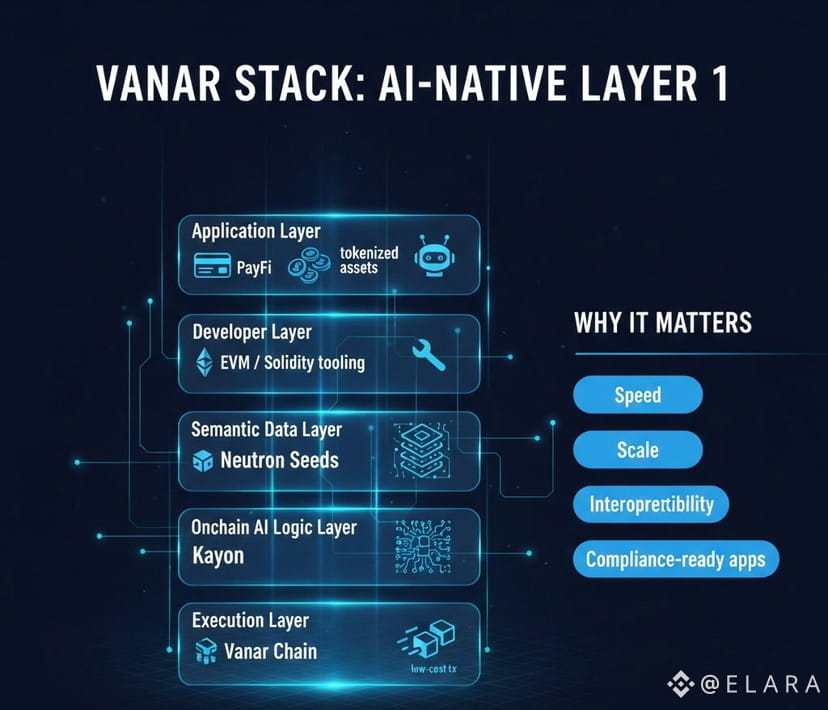
Using Neutron requires $VANRY, and heavier compression leads to token burns. That ties real usage directly to long term value. From a practical angle this solves a major weakness in Web3 where missing or corrupted data breaks trust entirely. Here the data simply stays.
Kayon Brings Reasoning Directly On Chain
Storage alone does not create intelligence. Kayon adds the missing layer by allowing applications to reason over stored data in real time. It acts as an on chain logic engine that reads Neutron Seeds, current blockchain state, and approved inputs to make decisions that can be verified later.
I like how direct this feels. A contract can be asked to check a payment against regulatory rules, flag issues, and execute automatically if everything lines up. The output is clear and auditable rather than hidden behind black box models. That matters a lot for finance and compliance heavy workflows.
In payments, Kayon is already being used to match invoices against enterprise records and reduce manual errors. In gaming, it reads player history and adapts quests or dialogue dynamically. Worlds start reacting to behavior instead of repeating scripts. All of this runs through validators chosen for reliability, keeping performance fast without sacrificing decentralization.
Developers access Kayon through simple tools that feel familiar, and premium reasoning capacity will soon require VANRY. That creates a recurring demand loop as usage scales beyond experiments into production.
Reputation Driven Consensus for Real World Reliability
Vanar does not rely purely on capital weight to secure its network. Its Proof of Reputation model selects validators based on transparency, performance history, and community trust, layered on top of delegated staking. Instead of anonymous operators, well known entities and experienced teams take responsibility for uptime and security.
From a gaming perspective this matters more than raw throughput. During live events or competitive sessions stability is everything. Sub three second finality and high gas limits keep interactions smooth even during spikes. As someone watching from the outside, it feels like Vanar is optimizing for experience first rather than theoretical benchmarks.
Stakers back these validators and earn consistent returns while participating in governance. Poor performance leads to penalties, which reinforces accountability. For enterprises settling tokenized assets, knowing who operates the network adds an extra layer of confidence that anonymous systems struggle to provide.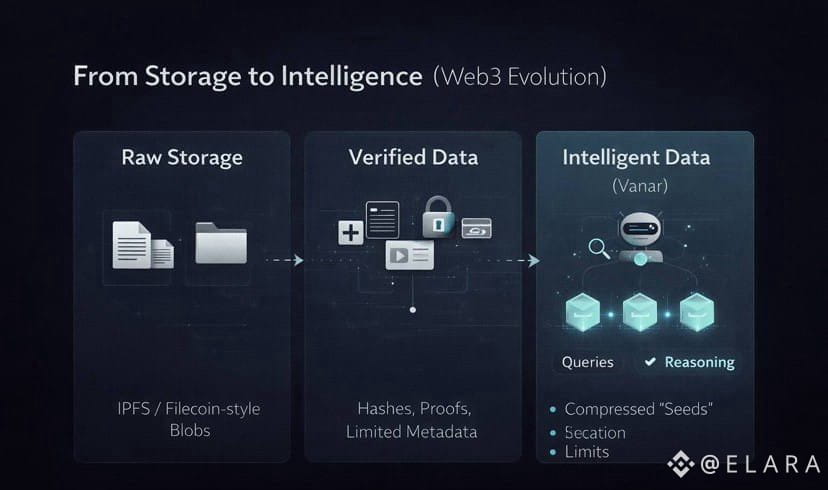
A Token Model Built for Long Term Use
The economics behind $VANRY reflect the same long term thinking. Supply is capped at 2.4 billion with slow emissions spread over decades. There are no aggressive team unlocks waiting to hit the market. Most rewards go toward validators and builders rather than insiders.
$VANRY is required for everything that happens on the network. It pays for transactions, AI reasoning, data compression, staking, and governance. Burns from intensive operations help balance emissions, especially as gaming activity and enterprise usage grow.
Staking remains simple and accessible. Delegation requires no special setup, and voting power flows naturally to those actively securing the network. Recent governance decisions show that this participation is not symbolic. Real funding and direction come directly from token holders.
Market behavior reflects early stage conditions, but what matters more to me is that demand is tied to real activity rather than narratives that fade quickly.
Designed for Global Entry Without Friction
Vanar makes onboarding easy in ways that feel intentional. Users can enter with cards across more than a hundred countries. Social wallets remove the need to understand private keys just to play a game or interact with an app. For mobile users in emerging regions, fixed low fees make participation realistic instead of theoretical.
This accessibility extends to partnerships. Wallet integrations, green infrastructure, and enterprise tooling all point toward a chain that wants to be used rather than admired from a distance. Gaming studios and fintech teams can plug in without redesigning their entire stack.
Competitive Positioning Through Balance
What separates Vanar from many alternatives is balance. It does not push everything to secondary layers or compromise experience for scalability. It keeps compatibility broad while maintaining predictable costs. Gaming brings users. AI brings automation. Finance brings sustainability.
There are still challenges ahead. Scaling reasoning workloads and navigating regulation will take careful execution. But the system is designed to evolve without rewriting its foundations.
Vanar Chain are not loud projects. They are methodical ones. By letting data persist, logic reason, and users interact without friction, they point toward a version of Web3 that feels less like an experiment and more like infrastructure. As intelligence becomes native to digital systems, it raises a quiet but important question. When technology finally gets out of the way, which platforms will people trust to hold their stories, assets, and decisions for the long run?