

@Dusk An “auditor-ready” blockchain is a slightly odd phrase, because auditors don’t really want novelty. They want boring things: clear evidence trails, consistent rules, and the ability to reproduce the story of what happened without asking ten different people for screenshots. What’s changing lately is that crypto is being pulled into the same accountability routines that traditional finance has lived with for decades. In Europe, MiCA is now less a talking point and more a set of deadlines, and supervisors have been explicit about what they expect from firms that aren’t authorized: don’t keep operating in the gray—prepare orderly wind-downs where transitional periods have ended. When oversight gets real, the question stops being “is this innovative?” and becomes “can we defend this in an audit?”
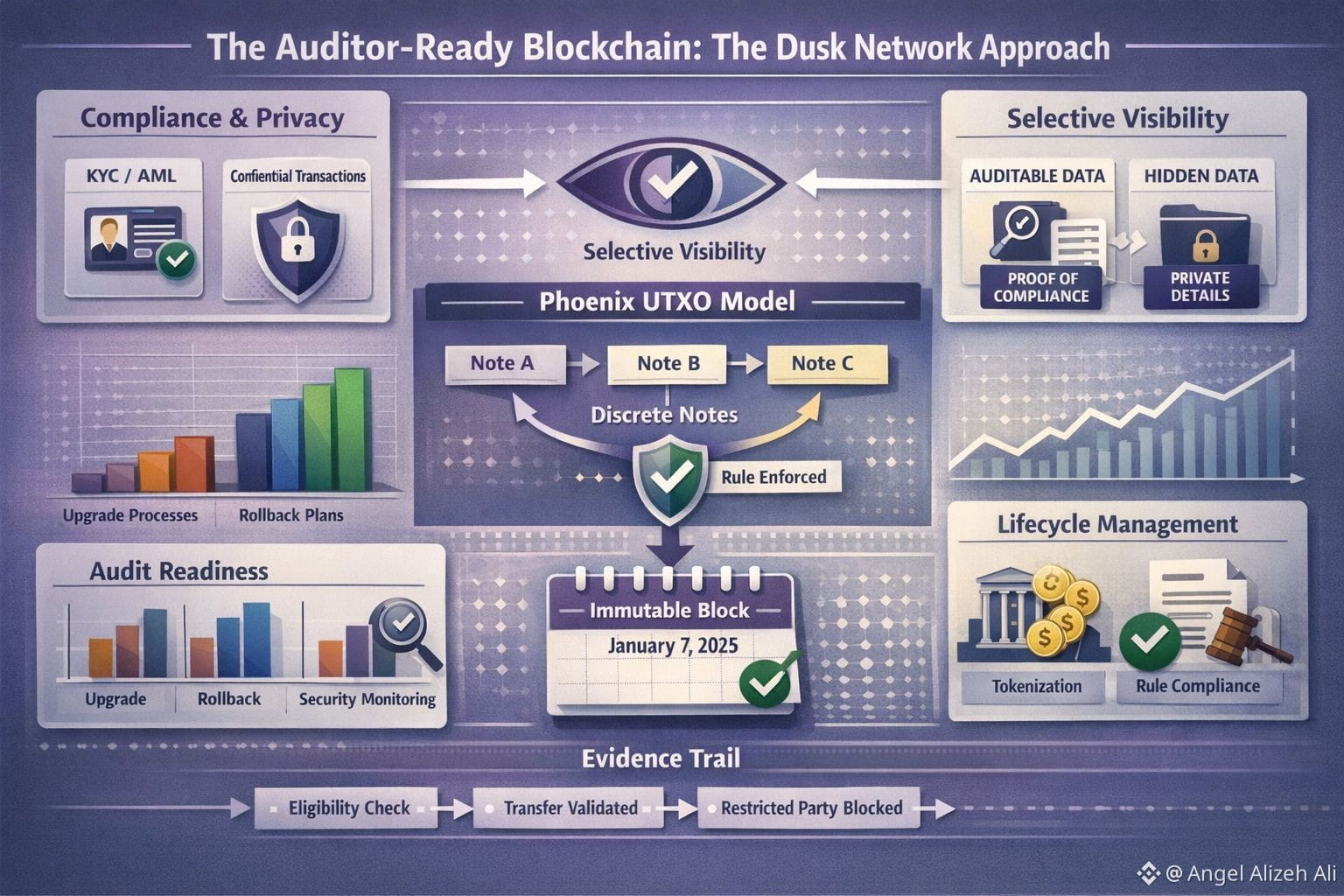
That shift is why Dusk Network feels genuinely relevant right now, not just “something to watch.” Most chains still talk like the main goal is speed or fees. Dusk keeps coming back to a different question: can regulated finance actually use a public network without exposing everyone’s business to the world? In its own words, it’s aiming for institutions to issue and manage financial instruments on-chain while building in disclosure, KYC/AML, and reporting rules at the protocol level. That’s not a promise that everything magically becomes compliant, but it’s an honest declaration of priorities. If you’re building for regulated markets, those priorities matter more than clever throughput claims.
A lot of projects still equate “auditability” with “make everything public.” That’s a developer’s answer, not an operator’s. In a real institution, full transparency can be a liability: it exposes counterparties, positions, and customer relationships. Yet full secrecy doesn’t work either, because an audit is controlled scrutiny. The practical target is selective visibility—what needs to be seen can be seen, and what doesn’t need to be seen stays out of the daylight. Dusk’s relevance lives in that middle space, because it’s designed around confidential transactions and smart contracts while still treating rule-following as a first-class requirement rather than a bolt-on.
The tricky bit is doing selective visibility without turning the chain into a surveillance machine. Dusk’s bet is that you can hide sensitive details and still prove the rules were followed, using zero-knowledge techniques to separate “what happened” from “how to verify it.” In plain terms, the chain should let you prove a claim—“this transfer met the eligibility rule,” “this instrument wasn’t sent to a restricted party,” “this limit wasn’t breached”—without broadcasting the underlying business data to everyone with a block explorer. Dusk’s older technical materials explicitly position its architecture around privacy plus compliance needs in tokenization and lifecycle management, which is exactly the stuff auditors end up caring about when real assets, not just memes, are involved.
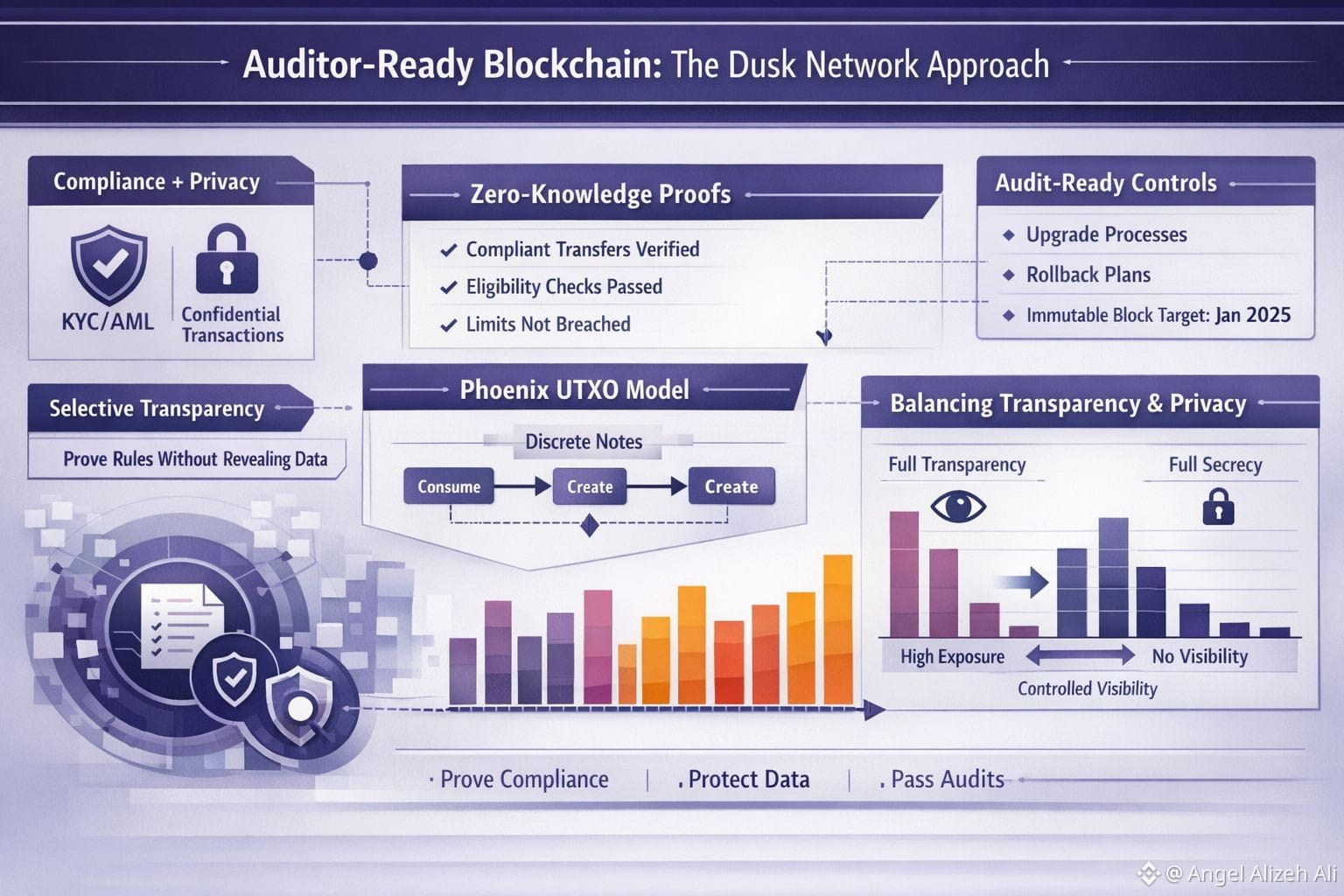
Under the hood, Dusk makes design choices that support that stance. Its Phoenix transaction model uses a UTXO-style approach where funds exist as discrete “notes,” and transactions consume and create notes rather than constantly rewriting one running balance. That matters because long account histories can turn into a permanent dossier: one address becomes “one life story.” A note-based model gives you cleaner units for evidence. You can prove properties about a note, or a set of notes, without publishing every detail that made that proof possible. It’s not automatically simpler—privacy systems rarely are—but it’s a structure that can be argued about in concrete, testable terms, which is what audits thrive on.
Dusk’s relevance also shows up in its execution details, not just its theory. Audits don’t stop at cryptography. They touch upgrade processes, rollback plans, and whether a network’s behavior is predictable across time. Dusk’s mainnet communications read like staged operations rather than a single big-bang announcement, including a schedule for producing its first immutable block on January 7, 2025. That kind of sequencing is unsexy, but it signals an awareness that “going live” is an operational event with consequences, not a banner moment for social media.
There’s a final reason Dusk keeps popping up in conversations about institutional crypto: it’s trying to make selective disclosure a normal workflow rather than an emergency exception. In my view, that’s the difference between a chain that merely tolerates audits and one that is built to survive them. “Auditor-ready” starts to look less like a slogan and more like a set of habits: predictable controls, explainable outcomes, and privacy that protects legitimate business data without blocking legitimate oversight. If the industry really is moving from “can we do it?” to “can we defend it?”, Dusk’s approach feels relevant because it treats that second question as the main design brief, not an afterthought.