
In 2018, when the blockchain world was drunk on noise, speed, and spectacle, Dusk Network was born almost in defiance of the moment. While others screamed about revolution, Dusk spoke softly about responsibility. While markets chased radical transparency, Dusk asked an unsettling question that few wanted to confront: what happens to human dignity when every financial move becomes public forever?
Because money is not neutral. It carries fear, hope, survival, shame, ambition, and legacy. It pays for a child’s education. It settles a worker’s retirement. It keeps a company alive through a hard winter. And yet, most blockchains treated money like content—something to be broadcast, scraped, analyzed, and exposed. Wallets turned into identities. Transactions into trails. Privacy into suspicion.
Dusk emerged from the realization that finance without privacy is not freedom—it is vulnerability.
Imagine a founder raising capital, knowing competitors can map every move. Imagine an investor whose net worth becomes a public breadcrumb trail. Imagine regulated institutions legally bound to confidentiality trying to operate on ledgers that never forget and never forgive. For them, transparency wasn’t empowering. It was dangerous. And Dusk listened to that discomfort instead of dismissing it.
What makes Dusk emotionally different is not just what it built, but why it built it. It did not start from ideology. It started from empathy. From the understanding that trust in finance is fragile, earned slowly, and shattered easily. That privacy is not secrecy for criminals—it is protection for ordinary people trying to live ordinary lives under extraordinary systems.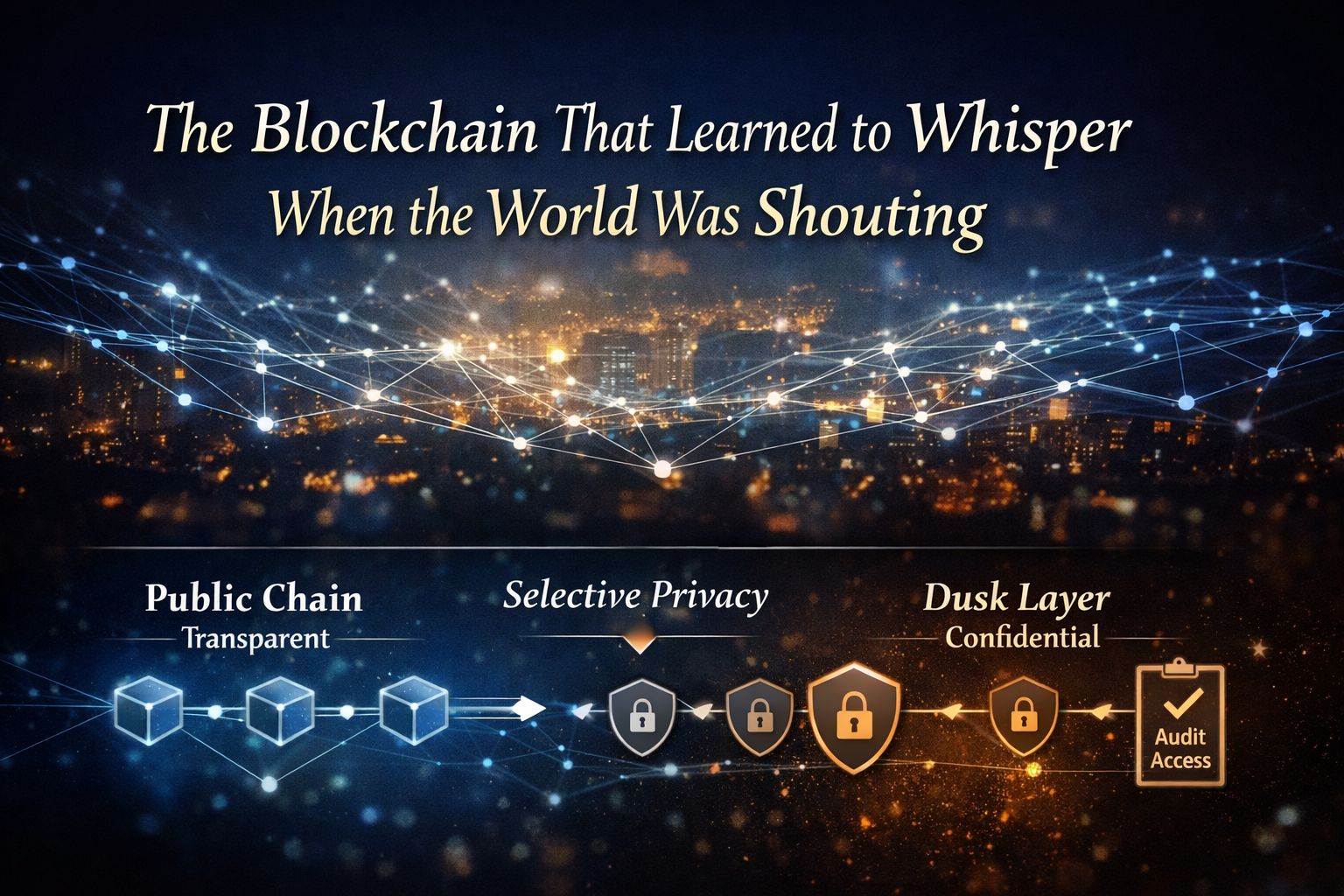
So Dusk chose a harder path.
Instead of chasing attention, it chose architecture. Instead of promising disruption, it promised discretion. Its Layer-1 design embeds privacy and compliance together, not as enemies forced to coexist, but as partners. Confidential smart contracts allow financial agreements to exist on-chain without exposing the people behind them. Transactions can be verified without being revealed. Obligations can be proven without being paraded.
This is not hiding. This is respect.
There is something deeply human about selective transparency—the idea that you should only have to reveal what is necessary, when it is necessary, and to those who are entitled to see it. That principle exists in law, medicine, and relationships. Dusk translated it into cryptography.
The emotional gravity of this choice becomes clearer when you step away from code and look at consequences. In a fully transparent system, power shifts to those who can analyze data at scale. Hedge funds, surveillance firms, bad actors. Privacy becomes a luxury the wealthy can simulate and the vulnerable cannot escape. Dusk pushes back against that imbalance. It says privacy should be structural, not optional. Built-in, not bolted-on.
Even its approach to regulation feels human. Instead of treating regulators as adversaries, Dusk treats them as part of reality. Because rules exist not to suffocate markets, but to protect people from collapse, fraud, and chaos. By aligning its design with real regulatory frameworks and working with licensed financial venues, Dusk acknowledges a truth many projects avoid: lasting systems don’t live outside society—they integrate with it.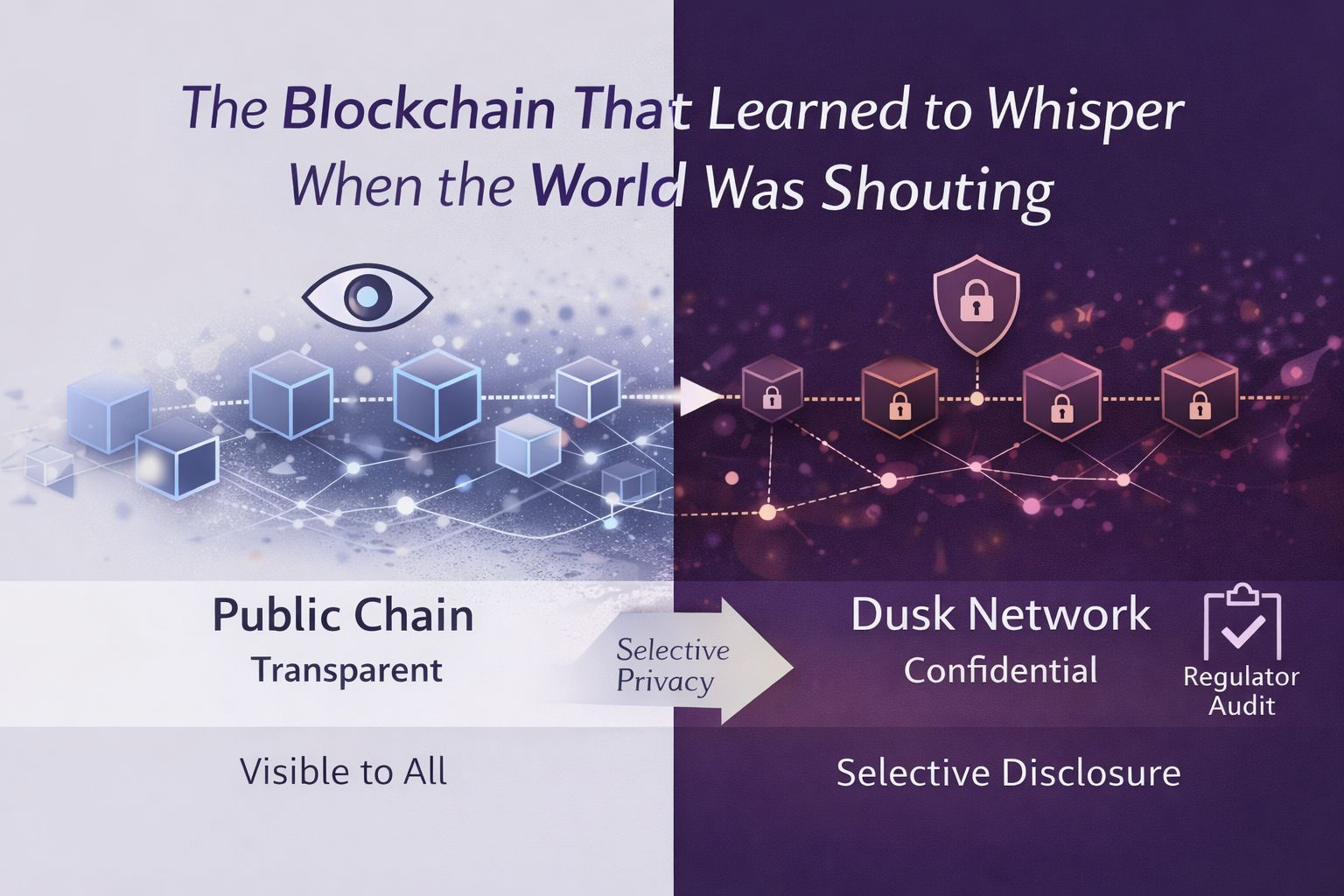
This makes Dusk slower. Quieter. Less flashy.
But slowness, in finance, is often a form of care.
There is an emotional maturity in choosing pilots over promises, audits over applause, and legal clarity over viral growth. It reflects an understanding that institutional trust is not won through charisma but through consistency. Through showing up again and again without breaking what you touched.
Behind all of this is a simple but powerful emotional thread: people deserve financial systems that do not exploit their exposure. Systems that allow them to participate without fear of being watched, targeted, or judged. Systems that understand that privacy is not about having something to hide—it’s about having something to protect.
Dusk does not claim to solve everything. It does not pretend that cryptography alone can answer moral questions. It knows that governance, law, and human judgment still matter. What it offers is something more honest: tools that allow nuance instead of extremes. Proof instead of performance. Accountability without humiliation.
In an ecosystem obsessed with being seen, Dusk dares to be trusted.
Its story is still unfolding. Adoption will test it. Markets will challenge it. Time will judge it. But even now, Dusk stands as a reminder that the future of finance does not have to be loud to be meaningful. That progress does not always arrive as a revolution—sometimes it arrives as a correction. A recalibration. A quiet refusal to treat people like data exhaust.
And maybe that is what makes Dusk resonate on a deeper level. It does not ask you to believe in a utopia. It asks you to believe that technology can grow up. That it can learn restraint. That it can carry value without stripping away humanity.
In a world where everything is exposed, Dusk is building a place where trust can finally breathe.
