
There’s a particular kind of anxiety that only money can create. It sits low in the chest. It shows up when you press “send” and hesitate, wondering if the transfer will fail, if the fee will spike, if you forgot some invisible prerequisite you were never taught to care about. It’s the feeling of needing something essential to work—and knowing it might not.
For years, that feeling has haunted digital money.
Stablecoins promised relief. They promised a dollar that didn’t shake, a unit of value that didn’t demand belief—only use. And people listened. Workers sent wages home across borders. Merchants priced goods in digital dollars. Families relied on them when banks were too slow, too expensive, or simply unavailable. Stablecoins didn’t spread because of ideology. They spread because they helped people survive.
But the systems carrying them never quite caught up.
They asked too much. They demanded extra tokens just to move money. They paused at the worst moments. They made ordinary people learn words like “gas,” “nonce,” and “finality” when all they wanted was certainty. The technology worked, technically—but emotionally, it failed far too often.
Plasma feels like it was built by people who noticed that failure and took it personally.
Not as a grand rebellion. Not as a flashy rewrite of finance. But as a quiet refusal to accept that money should feel this fragile.
What Plasma understands—deeply, almost tenderly—is that money is not just a system. It’s a relationship. Between effort and reward. Between trust and time. Between one human being and another. When money misbehaves, it doesn’t just cause inconvenience. It causes shame, stress, and fear. It turns simple moments into negotiations with uncertainty.
So Plasma starts from a different emotional center: what if money could move without asking for permission from complexity?
Gasless stablecoin transfers aren’t just a technical feature. They’re a release of tension. They mean you don’t have to hold something volatile just to send something stable. They mean you don’t have to explain to your mother, your employee, or your customer why “the dollar didn’t go through.” They mean fewer apologies. Fewer second guesses. Fewer moments where technology reminds you that it was not built with you in mind.
And when Plasma lets stablecoins themselves pay for transactions—or removes the cost altogether—it does something rare in this industry: it aligns incentives with dignity. It acknowledges that for many people, even small fees are not abstract. They are meals. They are phone data. They are time.
Under the surface, Plasma doesn’t chase chaos. It chooses familiarity. Full compatibility with the Ethereum ecosystem means developers aren’t forced to abandon the tools and instincts they’ve spent years building. That choice carries empathy too—respect for the human cost of learning curves, rewrites, and fractured ecosystems. Progress doesn’t always require reinvention. Sometimes it requires continuity.
Speed, here, is not about dominance. Sub-second finality is not a flex; it’s a courtesy. It’s the difference between a moment that flows and a moment that stalls. Between a customer who smiles and one who waits. Plasma treats finality the way the real world treats promises: either it’s fast enough to trust, or it isn’t good enough yet.
And then there’s Bitcoin—standing quietly in the background, like an old, weathered foundation no one bothers to decorate anymore because it doesn’t need decoration.
By anchoring itself to Bitcoin’s security, Plasma makes a statement that feels almost emotional in its restraint. It says: we don’t need to be the loudest to be credible. We don’t need to invent neutrality—we can inherit it. In a world where censorship, capture, and sudden rule changes are real fears, that anchor matters. It’s reassurance without marketing language. Stability without slogans.
This is why Plasma speaks to two very different groups at once.
To everyday users in places where stablecoins are already lifelines, Plasma offers something priceless: calm. Fewer steps. Fewer surprises. A sense that the system is not waiting for them to make a mistake. To institutions, it offers seriousness. Predictability. A settlement layer that doesn’t feel experimental or ideological, but operational—something you could trust with real volume, real responsibility, real consequences.
Bridging those worlds is not easy. One is built on lived necessity. The other on risk models and compliance checklists. Plasma’s quiet ambition is to let stablecoins be the common language—to prove that the same rails can serve both without betraying either.
None of this guarantees success. No infrastructure earns trust by claiming it deserves it. Gas sponsorship raises hard questions about sustainability. Anchoring to Bitcoin doesn’t erase governance challenges. Compatibility brings inherited risks. Plasma is not pretending otherwise.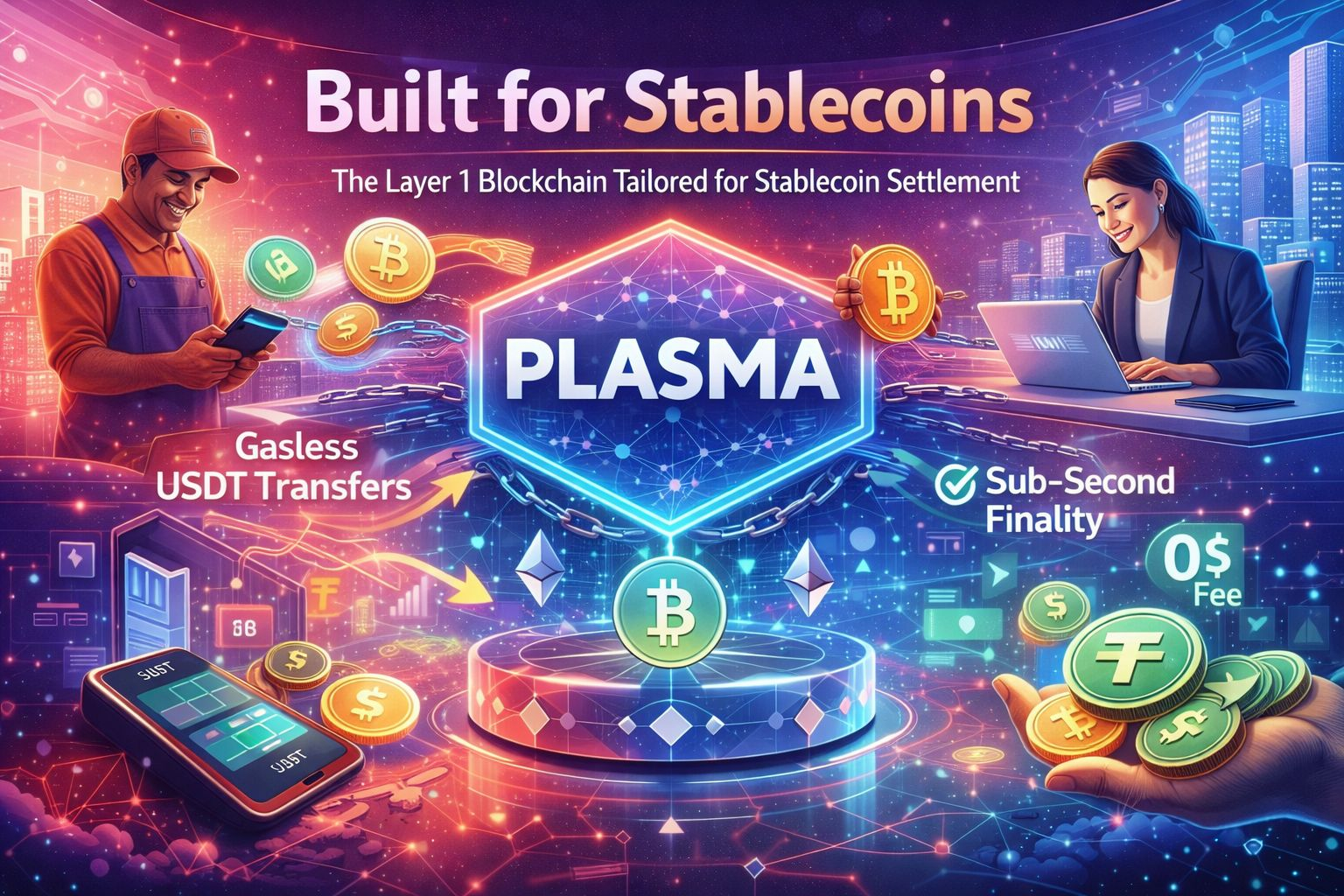
What sets it apart is that it doesn’t feel intoxicated by its own cleverness.
It feels grounded. Almost sober.
It feels like something built by people who are tired of watching good ideas fail the moment they touch real lives.
If Plasma succeeds, it won’t be celebrated the way other blockchains are. There won’t be dramatic narratives or cultish devotion. There will be something quieter—and far more meaningful. People will stop talking about it at all. Payments will just work. Money will arrive when it’s supposed to. The fear will slowly drain out of the act of sending value.
And if it fails, it will still have pointed to something important: that the future of finance is not about spectacle. It’s about relief.
Because the real promise of digital money was never freedom from banks or states or systems. It was freedom from that tight feeling in the chest when you press “send” and hope.
Plasma is, at its core, an attempt to let go of that breath—and finally exhale.

