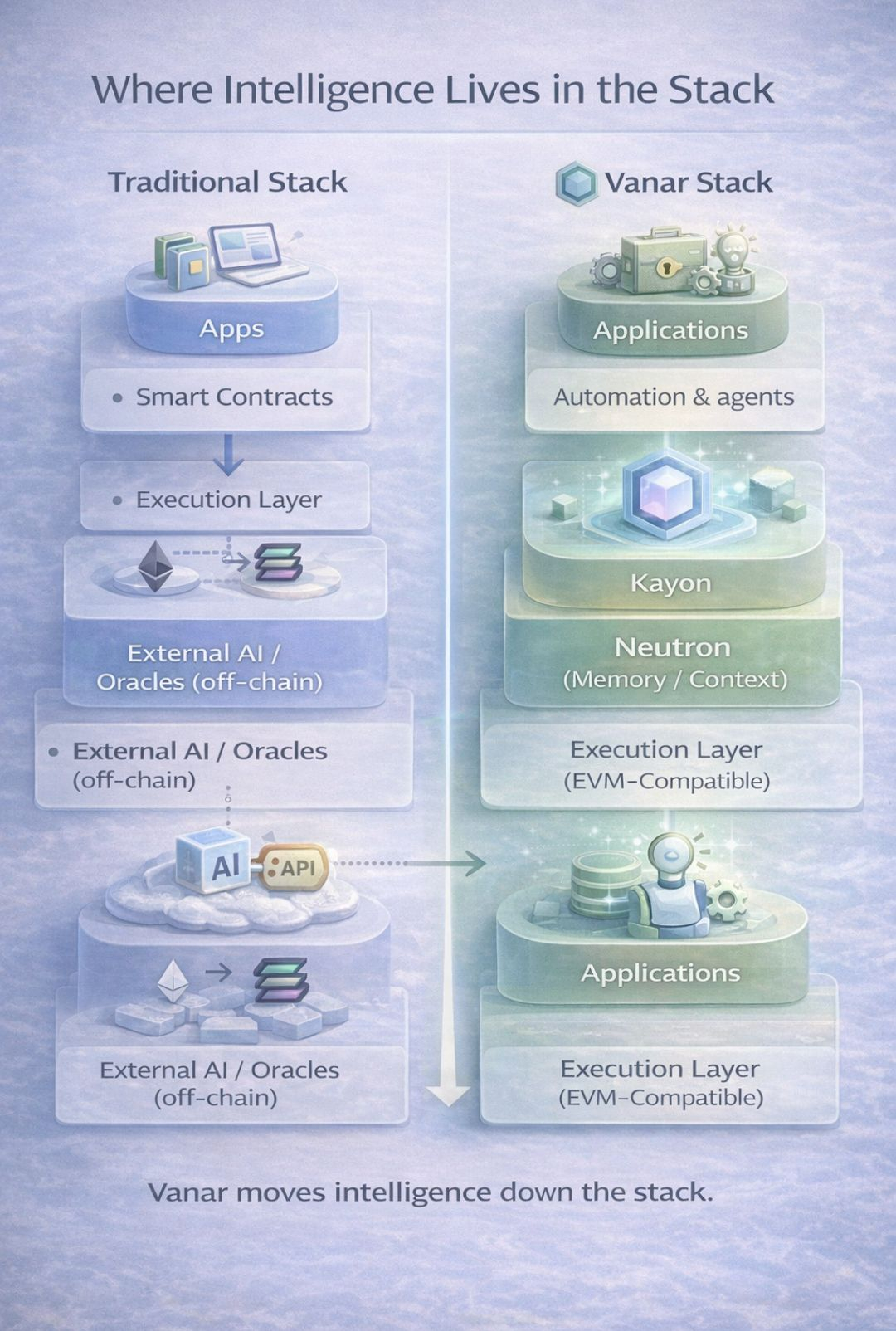
I’ve noticed that whenever AI and blockchains come up in the same sentence, the conversation usually jumps straight to buzzwords. Oracles. Plug-ins. Off-chain models. Big promises about intelligence layered on top of systems that were never designed for it. On paper, it sounds fine. In practice, it often feels patched together.
That’s why Vanar caught my attention in the first place.
Most chains were built to execute instructions, not to understand context. They’re excellent at saying “this happened,” but pretty weak at answering “why it happened” or “what should logically follow.” Developers end up compensating by building complex off-chain stacks: databases for memory, scripts for reasoning, services to glue everything together. It works, but it’s fragile. Every extra layer adds another place where things can drift, desync, or quietly break.
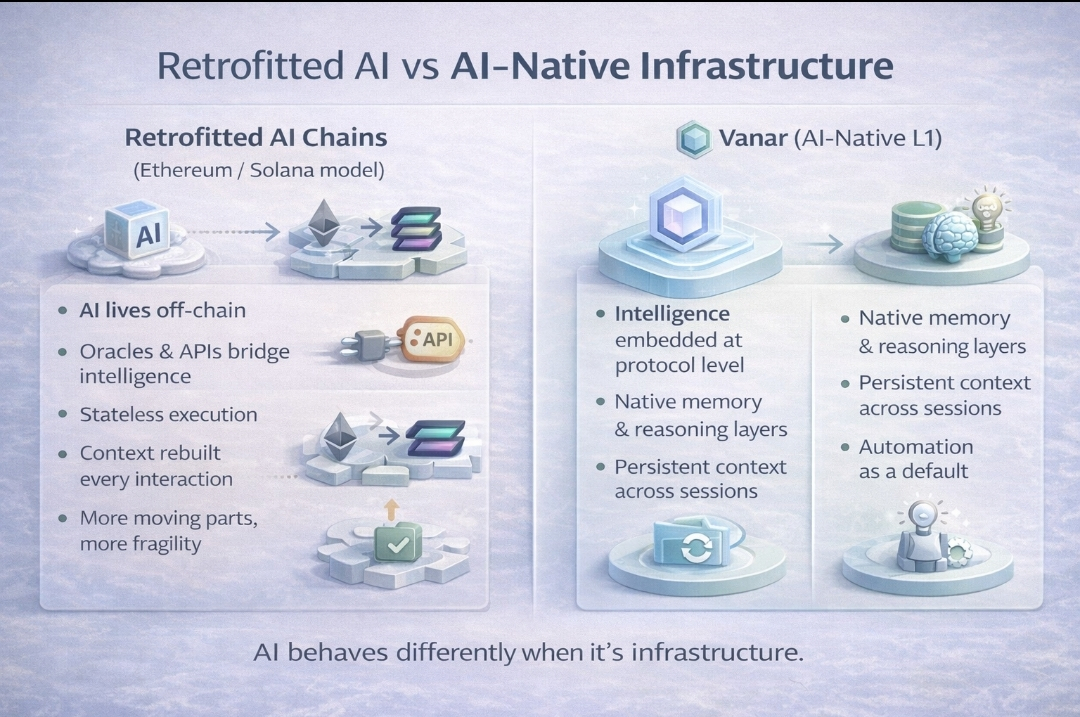
Vanar feels like it starts from a different assumption.
Instead of treating intelligence as an add-on, it treats it as part of the base environment. The idea isn’t that the chain becomes “smart” in a flashy way. It’s that applications don’t have to constantly reinvent memory, context, and decision logic outside the system. Those pieces are expected to exist, not bolted on later.
That difference matters if you’ve ever tried to build anything long-lived. Autonomous agents don’t behave well if they forget everything between interactions. Payment systems can’t rely on manual intervention forever. Tokenized real-world assets don’t work if rules need to be enforced socially instead of structurally. These are slow, unglamorous problems, but they’re the ones that decide whether a product survives beyond a demo.
What I find telling is how quiet Vanar is about all this. There’s no sense of racing for attention or trying to out-market older chains. It feels more like an engineering mindset than a narrative one. Build the environment first. Let developers discover what it enables.
Even the role of $VANRY fits that tone. It’s there to secure the network, coordinate incentives, and keep things running. It doesn’t demand constant focus from users, which is usually a sign that a system wants to fade into the background and do its job.
Vanar isn’t trying to prove that other chains are obsolete. Ethereum and Solana make sense for what they were designed to do. Vanar seems aimed at a different future, one where applications are persistent, adaptive, and increasingly autonomous.
If that future arrives, the chains that planned for intelligence early won’t need to shout about it. They’ll already be in use.