
@Vanarchain enters the blockchain space at a moment when the industry is slowly moving away from experiments and toward responsibility. Early Web3 cycles were driven by speed, speculation, and hype. Long term adoption was rarely part of the conversation. Today the focus has shifted toward infrastructure that can survive regulation, scale sustainably, and support real economic activity.
Many blockchains were designed for ideal conditions. They assumed frictionless environments with little oversight and unlimited tolerance for risk. That assumption no longer holds. Governments, enterprises, and institutions are now actively engaging with blockchain technology. This new phase requires systems that can operate within real world constraints without losing their core principles.
Vanar Chain is built with this reality in mind. Its architecture reflects a belief that adoption does not come from shortcuts but from discipline. Instead of chasing rapid growth metrics, it focuses on building a foundation that can endure market cycles and regulatory shifts.
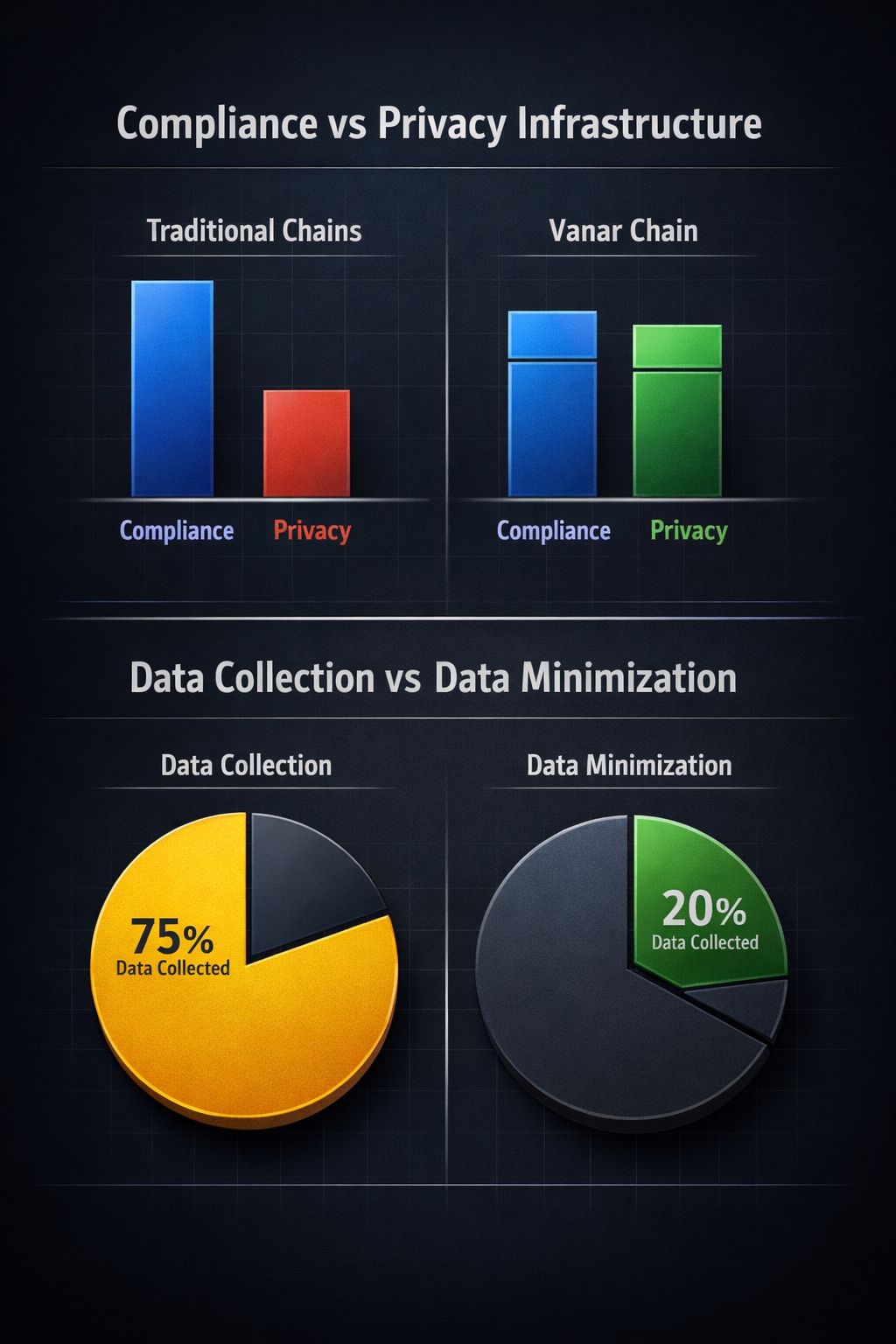
One of the biggest barriers to long term blockchain adoption has been the tension between compliance and decentralization. Many networks treat compliance as an afterthought or a threat. Others sacrifice decentralization entirely in pursuit of regulatory approval. Neither approach creates a sustainable outcome.
Vanar Chain takes a more measured path. It recognizes that compliance and decentralization are not mutually exclusive when infrastructure is designed thoughtfully. Rather than embedding heavy surveillance or unrestricted anonymity, the network emphasizes structured privacy and compliance awareness at the protocol level.
This approach matters because institutions require predictability. They need assurance that a network can adapt to regulatory frameworks without constant redesign. Vanar Chain addresses this by building flexibility into its core rather than layering solutions on top later.
Another major challenge for adoption is excessive data collection. Many blockchain systems record far more information than necessary. Over time this creates privacy risks, storage inefficiencies, and legal complications. Data permanence becomes a liability instead of a strength.
Vanar Chain is aligned with the principle of data minimization. It prioritizes collecting only what is required for functionality and security. This philosophy reduces exposure while improving scalability and long term maintainability.
Data minimization also builds trust with users. As awareness around digital privacy grows, people are becoming more cautious about how their information is handled. Networks that respect this shift are better positioned to attract long term participants rather than short term users.
Scalability is another area where long term thinking separates durable networks from temporary ones. Many blockchains achieve speed by compromising decentralization or security. These tradeoffs often surface later when usage grows and vulnerabilities appear.
Vanar Chain approaches scalability as an engineering problem rather than a marketing feature. The focus is on stable throughput, predictable performance, and infrastructure that can support consistent demand. This type of scalability does not generate headlines but it enables real adoption.
Developers play a critical role in determining whether a blockchain survives beyond its early years. Complex systems with unstable tooling discourage serious builders. Over time, developer fatigue leads to stagnation.
Vanar Chain aims to reduce this friction by offering a clear and structured environment for development. The goal is to make building sustainable applications easier rather than more experimental. This attracts developers who are interested in longevity rather than quick exits.
Long term adoption also depends on economic design. Token systems that rely purely on speculation tend to collapse once attention fades. Sustainable networks align incentives with usage, security, and contribution.
Vanar Chain places emphasis on economic models that reward participation aligned with network health. This encourages behavior that strengthens the ecosystem over time rather than draining value during market peaks.
Security is often discussed in technical terms, but its long term impact is psychological. Users and institutions need confidence that a network will not expose them to sudden failures or governance chaos. Repeated incidents erode trust faster than any marketing campaign can rebuild it.
By prioritizing disciplined infrastructure and controlled evolution, Vanar Chain positions itself as a network that values stability. This does not mean resisting innovation but introducing it carefully and deliberately.
Another factor influencing adoption is interoperability. Isolated ecosystems struggle to remain relevant as the broader Web3 environment matures. Networks must be able to interact without compromising their principles.
Vanar Chain approaches interoperability with caution and intent. Integration is treated as a strategic decision rather than a default feature. This prevents unnecessary complexity while allowing meaningful connections where they add real value.
Regulatory alignment is often misunderstood as surrendering decentralization. In practice, it is about acknowledging that technology operates within societies, not outside them. Networks that ignore this reality eventually face resistance or irrelevance.
Vanar Chain acknowledges regulatory trends without hardcoding itself to any single jurisdiction. This adaptability allows it to evolve alongside global frameworks rather than being disrupted by them.
Trust is the quiet driver of adoption. Users may arrive for incentives, but they stay for reliability. Enterprises may experiment for innovation, but they commit for stability. Trust is built slowly through consistent behavior and clear design choices.
Vanar Chain builds trust by being predictable. Its philosophy emphasizes transparency in direction, restraint in expansion, and accountability in development. These traits are rarely celebrated during bull markets but they define survival during downturns.
The blockchain industry is gradually maturing. The next wave of adoption will not come from novelty but from integration into existing systems. Payments, identity, data verification, and digital ownership all require infrastructure that can function quietly and reliably.
Vanar Chain positions itself for this phase. It is not designed to replace everything overnight. It is designed to fit into the world as it is and grow alongside it.
Long term adoption also depends on community expectations. Networks that promise unrealistic outcomes often disappoint their own supporters. Managing expectations is part of sustainable growth.
Vanar Chain communicates through design rather than slogans. Its priorities are reflected in how the network is built, not how it is advertised. This attracts participants who value substance over spectacle.
As Web3 continues to evolve, the gap between experimental chains and infrastructure chains will widen. Experimental chains explore what is possible. Infrastructure chains support what is practical.
Vanar Chain belongs firmly in the second category. It is built to last, not to impress temporarily. Its focus on compliance awareness, data minimization, scalability, and disciplined development aligns with the realities of long term adoption.
In an industry learning from its own excesses, this approach feels timely. Adoption does not happen because a network is loud. It happens because a network is reliable, adaptable, and trusted.
Vanar Chain is built with that understanding at its core.
