
In today’s rapidly evolving digital economy, moving money across borders efficiently remains a persistent challenge. Traditional blockchains were built to handle diverse applications, from smart contracts to NFTs, but they often fall short when it comes to high-volume stablecoin transactions. Delays, high fees, and the need to manage native gas tokens create friction for both everyday users and institutions. Plasma enters this space as a purpose-built Layer 1 blockchain, designed specifically for stablecoin settlement. It combines cutting-edge performance, seamless usability, and robust security, addressing a critical gap in the financial infrastructure.
Plasma’s core innovation lies in optimizing blockchain design for stablecoins. USDT and other dollar-pegged tokens dominate on-chain value transfers, yet moving them efficiently has remained a challenge. Plasma tackles this by integrating stablecoin-first features directly into its architecture. The network is fully compatible with Ethereum smart contracts through Reth, a Rust-based EVM client. Developers can deploy existing Ethereum applications without modification, simplifying adoption and encouraging ecosystem growth. At the same time, PlasmaBFT, a Byzantine Fault Tolerant consensus mechanism, enables sub-second transaction finality and high throughput, ensuring rapid settlement that traditional chains struggle to deliver.
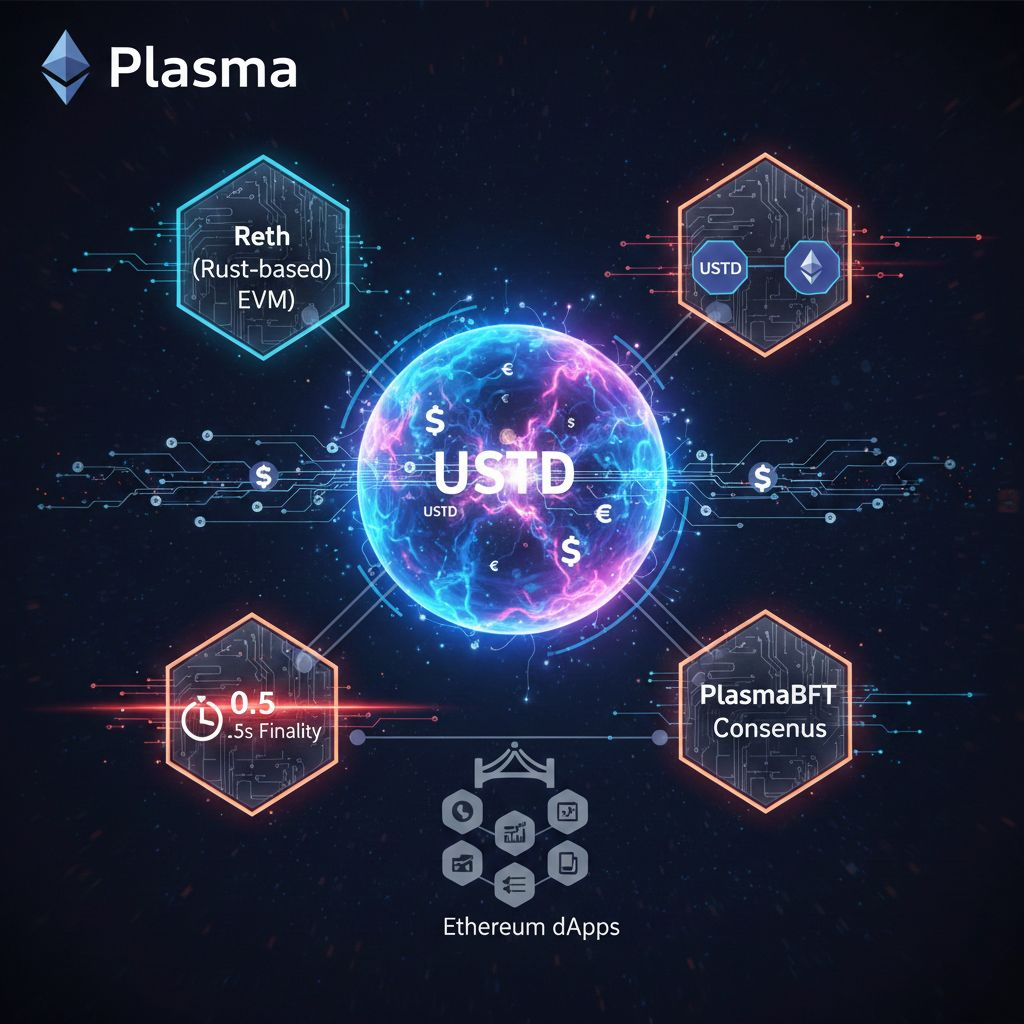
One of Plasma’s most notable advantages is its stablecoin-centric functionality. Users can transfer USDT without paying network fees, turning stablecoins into frictionless digital cash. This is made possible through a protocol-level paymaster system that covers transaction costs for basic stablecoin payments. Additionally, the network allows transaction fees to be paid in stablecoins or Bitcoin, reducing reliance on volatile native tokens and improving accessibility for both retail and institutional users.
Security is a central pillar of Plasma’s design. The network periodically anchors its state to Bitcoin, leveraging the security of the most decentralized blockchain in existence. This approach increases neutrality and censorship resistance, providing a trustworthy foundation for both individuals and institutions handling large-scale transactions. By combining strong validator incentives with a Bitcoin-anchored security model, Plasma aligns network sustainability with long-term reliability.
The Plasma ecosystem also benefits from a carefully designed economic model. Its native token, XPL, underpins validator participation and staking rewards, ensuring robust network security while everyday users enjoy low-friction stablecoin transfers. This separation of utility between security participants and transaction users creates a sustainable framework that supports growth without compromising usability.
When compared to existing solutions, Plasma stands out for its combination of speed, security, and stablecoin-first orientation. General-purpose networks like Ethereum offer flexibility but suffer from high fees and slower finality. High-speed chains such as Solana improve throughput but do not prioritize stablecoin usability. Dedicated payment-focused blockchains may reduce friction, but few combine EVM compatibility, stablecoin-native gas, and Bitcoin-anchored security. Plasma occupies a unique position by focusing precisely on the needs of digital payments and settlements.
The real-world applications for Plasma are extensive. Retail users benefit from instant, fee-free transfers, making stablecoins practical for everyday purchases and remittances. Merchants and financial service providers gain a scalable settlement solution that reduces costs and latency. Institutions can leverage Plasma for programmable payouts, cross-border settlements, and other financial workflows, all while enjoying predictable performance and strong security guarantees.
Looking ahead, Plasma’s continued development and adoption will be key to its impact on global finance. As more stablecoin issuers, fintech companies, and payment networks integrate with the platform, Plasma could emerge as a central infrastructure layer for digital value transfer. Its combination of speed, usability, and secure design positions it as a serious contender in the next generation of blockchain networks, offering a vision of stablecoins as seamless digital cash for a connected global economy.