
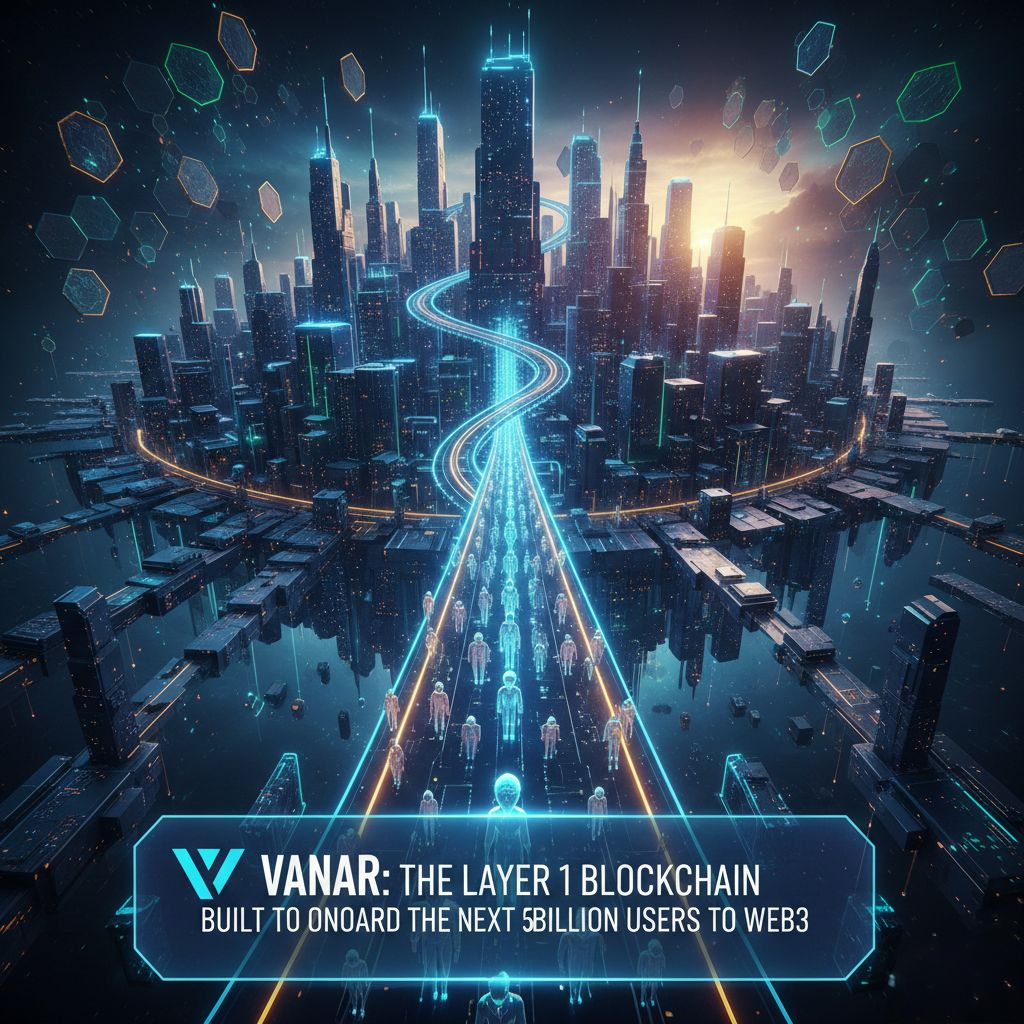
Blockchain technology has advanced rapidly over the past decade, yet true mass adoption remains limited. While decentralized finance, NFTs, and token ecosystems have generated waves of interest, the average consumer still finds Web3 complex, fragmented, and often speculative. High fees, scalability constraints, and difficult onboarding processes have slowed the transition from early adopters to mainstream users. For blockchain to reach billions of people, it must integrate naturally into industries that users already engage with, such as gaming, entertainment, digital brands, and emerging AI platforms. Vanar enters this landscape as a Layer 1 blockchain designed specifically to solve this adoption gap.
Vanar is built from the ground up with real world usage in mind. Rather than positioning itself solely as infrastructure for financial experimentation, it focuses on consumer driven sectors that already attract global audiences. The team behind Vanar brings experience across gaming, entertainment, and brand development, shaping a strategy centered on usability and integration. The core philosophy is straightforward: blockchain technology should enhance digital experiences without overwhelming users with technical complexity. This practical mindset influences both the network architecture and the surrounding ecosystem of products.
At a technical level, Vanar operates as a high performance Layer 1 blockchain optimized for scalability, low transaction costs, and efficient processing. The network supports smart contract deployment and decentralized validation while maintaining throughput suitable for consumer facing applications. Gaming platforms and metaverse environments require frequent microtransactions, asset transfers, and real time interaction. Vanar’s infrastructure is calibrated to support these high frequency demands, distinguishing it from general purpose chains that often struggle under entertainment scale workloads. The architecture is engineered to balance decentralization, speed, and stability in a way that supports long term consumer adoption.
One of Vanar’s defining strengths is its integrated product ecosystem. The Virtua Metaverse serves as a flagship initiative, offering immersive digital spaces where users can interact, own digital assets, and participate in branded experiences. Unlike isolated NFT marketplaces or standalone virtual worlds, Virtua operates natively within Vanar’s blockchain framework. This integration ensures secure ownership, efficient transactions, and a seamless user experience. Alongside this, the VGN Games Network provides infrastructure for developers to launch Web3 enabled games with built in token mechanics and digital ownership structures. By embedding blockchain directly into game development pipelines, Vanar lowers barriers for studios exploring decentralized models.
Vanar’s ecosystem also extends into artificial intelligence, sustainability focused initiatives, and enterprise brand solutions. The inclusion of AI reflects a forward thinking recognition that blockchain and intelligent systems are increasingly interconnected. Secure digital identity, asset ownership, and decentralized infrastructure can enhance AI driven platforms, creating new forms of value exchange. For brands, Vanar offers tokenized engagement tools that enable secure digital experiences for customers. This multi vertical approach spreads opportunity across sectors rather than relying on a single trend, strengthening the network’s resilience.
At the center of the ecosystem is the VANRY token, which serves as the network’s native utility asset. VANRY is used for transaction fees, staking, validator incentives, and ecosystem participation. Validators secure the network through staking mechanisms, aligning economic rewards with network integrity. As more applications deploy and user activity grows, demand for VANRY is tied directly to network usage. The token supply structure is capped, with allocations supporting validator rewards, ecosystem growth, and long term sustainability. This utility driven model seeks to anchor value in real transactional demand rather than short term speculation.
When compared to other Layer 1 blockchains, Vanar differentiates itself through its consumer focused positioning. Many networks emphasize technical benchmarks such as maximum throughput or theoretical scalability. While these metrics are important, they do not automatically translate into mainstream adoption. Vanar’s strategy centers on integrating blockchain into digital experiences people already value. By prioritizing gaming networks, immersive environments, and brand collaborations, it mirrors successful Web2 growth strategies where user engagement precedes ecosystem expansion.
Recent progress within the Vanar ecosystem reflects steady infrastructure development and community building. Expansion of the VGN Games Network, continued evolution of the Virtua Metaverse, and broader exchange availability for VANRY contribute to ecosystem maturity. Rather than relying on short lived hype cycles, the project’s trajectory appears focused on sustainable growth through product deployment and partnership development aligned with its core adoption thesis.
Scalability remains a crucial factor in Vanar’s long term trajectory. Consumer scale applications require networks that can handle large volumes of transactions without compromising performance or security. Vanar’s architecture is specifically tuned for this environment, but continued growth will test its ability to maintain efficiency under increasing demand. Security and decentralization must remain strong as validator participation expands. Achieving this balance will be central to its credibility as a long term Layer 1 solution.
Looking ahead, Vanar’s future potential depends on converting product engagement into sustained network activity. If gaming ecosystems, metaverse platforms, AI integrations, and brand partnerships continue to expand within its infrastructure, Vanar could serve as an accessible entry point for millions of users unfamiliar with crypto native environments. By abstracting complexity and embedding blockchain functionality into everyday digital experiences, it addresses one of Web3’s most significant challenges: usability.
In a blockchain industry transitioning from experimentation to practical implementation, Vanar represents a focused and application driven evolution. Its emphasis on scalable Layer 1 infrastructure combined with real world consumer verticals creates a credible pathway toward mainstream adoption. While execution and ecosystem growth will ultimately determine its impact, Vanar’s foundation reflects a clear understanding that the future of Web3 depends not only on technology, but on meaningful integration into how people already interact with the digital world.