
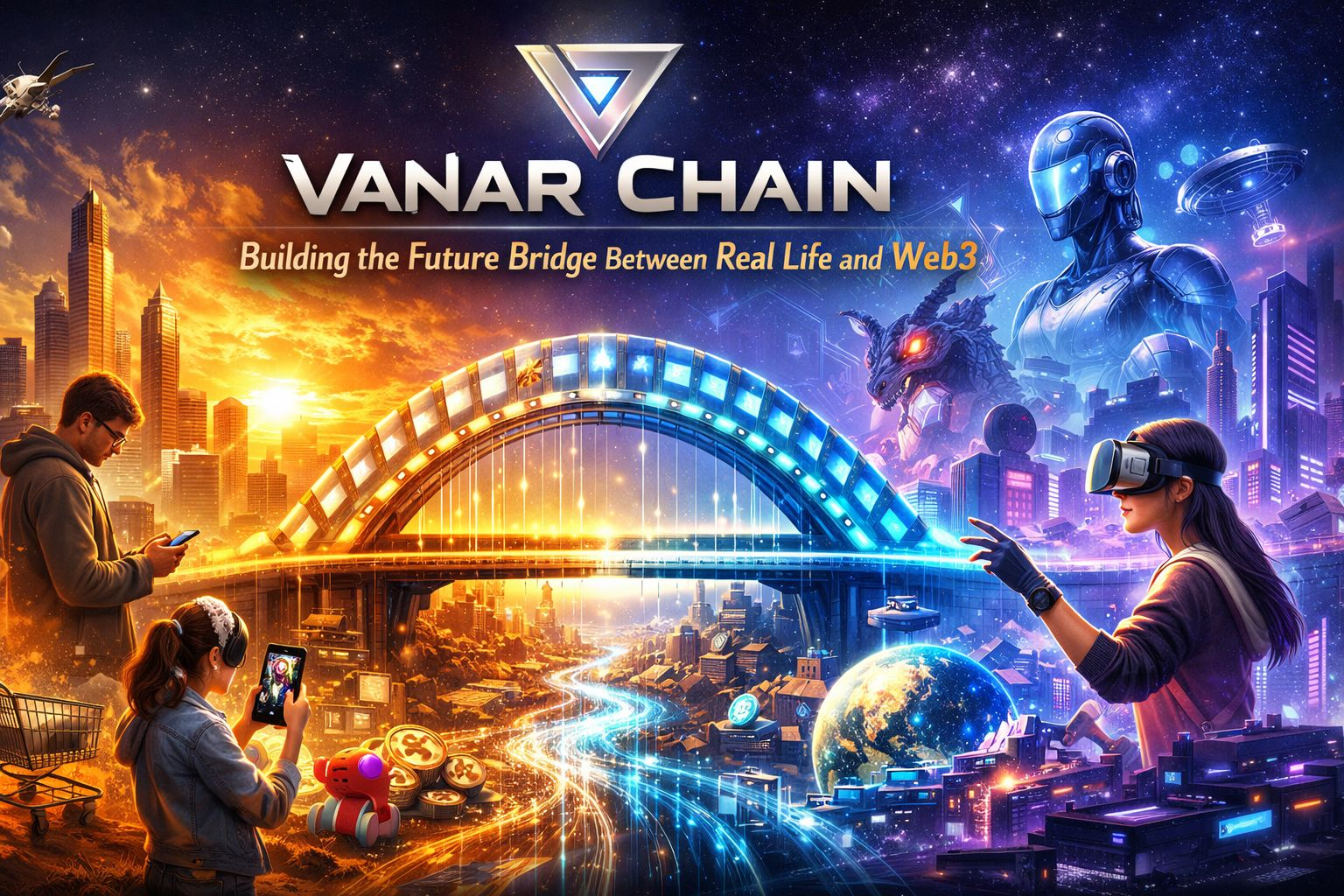
 The story of Vanar Chain begins during a period when blockchain technology was powerful but disconnected from ordinary life, when transaction fees fluctuated unpredictably and user interfaces felt like developer tools instead of consumer products, and the founding vision was shaped around the idea that decentralized infrastructure would only matter if it quietly blended into everyday experiences such as gaming, digital ownership, brand loyalty systems, and AI-driven applications used by normal people rather than crypto specialists. The project’s early conceptual phase emerged around 2022 with the release of technical documentation and early network experiments, followed by testnet deployment and eventually public network launch phases through 2022 and 2023, with token distribution models designed to create broad ecosystem participation rather than concentrating power among early insiders, while later development cycles focused on expanding real consumer-facing products such as metaverse platforms and gaming networks to stress-test adoption at scale rather than relying purely on theoretical throughput benchmarks.
The deeper purpose behind the ecosystem is rooted in solving the psychological and economic barriers that prevented mainstream adoption of decentralized systems, because historically blockchain technology forced users to think about wallets, gas fees, bridges, and network congestion, whereas this architecture was designed around the belief that people should interact with digital ownership, identity, and payments in ways that feel invisible and predictable, especially across entertainment, gaming, artificial intelligence, and brand interaction ecosystems where user experience determines success more than raw technical purity. The ecosystem positioning emphasizes bridging Web2 and Web3 by making blockchain functionality behave like background infrastructure while still preserving verifiable ownership and decentralization, with strong focus on consumer industries that naturally generate massive digital interaction volume such as virtual worlds, creator economies, and interactive entertainment experiences that demand microtransactions, persistent identity, and cross-platform digital assets.
The technical design philosophy combines multiple architectural layers and consensus concepts to create both performance and trust without sacrificing accessibility for developers, including EVM compatibility to allow smart contract portability, proof-of-stake or hybrid reputation-based validation systems to maintain energy efficiency and security, and specialized modules designed for AI computation, semantic data storage, and structured on-chain content so applications can embed logic and media without relying entirely on external servers or centralized APIs. This layered approach aims to support thousands of transactions per second while maintaining predictable fee structures suitable for consumer applications, while token economics are structured to reward validators over long emission schedules while maintaining sustainability through gradual supply release and incentive alignment across developers, validators, and community governance structures.
The operational mechanism of the network is designed around the idea that blockchain should act as a programmable economic and computational substrate rather than just a payment rail, meaning the native token fuels transaction execution, secures the network through staking incentives, and is expected to evolve into governance influence over protocol upgrades, while the ecosystem layer builds real demand through products such as metaverse environments where users can trade digital goods, interact socially, and participate in game economies that operate continuously across virtual spaces and marketplaces. This demand-driven architecture is intended to create a feedback loop where real product usage drives token utility rather than speculative activity alone, which is why ecosystem integrations include gaming networks, AI analytics tools, digital identity systems, and brand engagement technologies designed to function simultaneously across entertainment and enterprise use cases.
Looking forward, future expansion plans revolve around deeper AI integration, broader enterprise partnerships, and infrastructure designed to connect traditional financial rails and mainstream consumer platforms directly into decentralized environments, with roadmap discussions often referencing collaboration with major technology ecosystems, expansion of AI-native applications, and continued scaling of gaming and metaverse ecosystems as onboarding channels for new users who may not even realize they are using blockchain technology. The long-term ambition is not simply to compete with other blockchains on speed metrics but to redefine how blockchain is consumed by making it invisible inside everyday digital products, allowing developers and brands to build experiences where ownership, payments, and identity become native features rather than external add-ons.
The risks surrounding the ecosystem reflect the same challenges faced by most emerging infrastructure platforms attempting to reach mainstream adoption, including early-stage user activity levels that may lag behind long-term projections, partial transparency around ecosystem governance or auditing depth compared with more mature networks, and the broader market risk that consumer adoption of blockchain-based entertainment and metaverse products may grow slower than expected due to regulatory, usability, or cultural resistance factors. Security verification depth, validator decentralization quality, and sustained developer ecosystem growth will ultimately determine long-term credibility, especially because consumer-focused blockchains must maintain both performance and trust simultaneously while competing with centralized platforms that already dominate gaming and digital media distribution.
The ultimate possibility surrounding the ecosystem lies in whether it can transform blockchain from a financial speculation tool into a foundational digital infrastructure layer similar to cloud computing or mobile operating systems, where users interact with decentralized ownership and programmable assets daily without consciously thinking about the technology, because if gaming economies, brand ecosystems, and AI-driven digital identity systems converge onto decentralized rails successfully, the network could become part of the invisible digital fabric supporting billions of interactions per day, but if adoption remains limited to niche crypto-native audiences, then even technically strong architecture may struggle to reach its intended scale, making execution, partnerships, and developer ecosystem growth the deciding factors that will shape whether the vision becomes global infrastructure or remains an ambitious technological experiment.
