


A few months ago, I noticed something strange in my own routine. For trading, I still opened centralized exchanges. For storage, I trusted my wallet. For DeFi, I hesitated. Not because I didn’t believe in decentralization — but because it was inconvenient.
Slow confirmations, unexpected fees, fragmented liquidity, interfaces that feel more like engineering panels than financial tools. All of this still pushes users away from DeFi.
CEX platforms solved these problems long ago. They offer instant execution, clear order books, and smooth UX. But they come at a price. You don’t really own your assets there. Withdrawals can be paused. Rules can change overnight.
So we live in a constant compromise: speed on CEX, control on DeFi — rarely both.
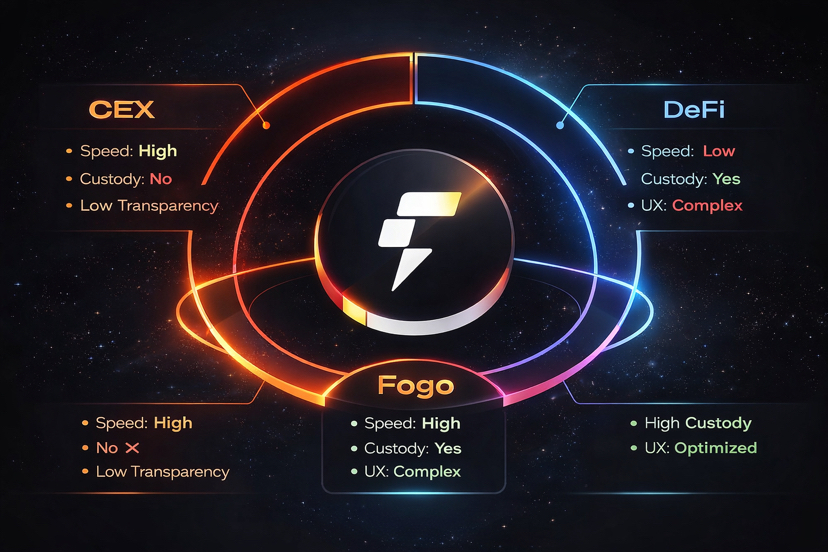
That’s the problem Fogo is trying to address.
Fogo is built as a Layer 1 focused on trading and financial applications from day one. Not as an “add-on later” solution, but as core infrastructure. Its idea is simple: performance should not require custody.
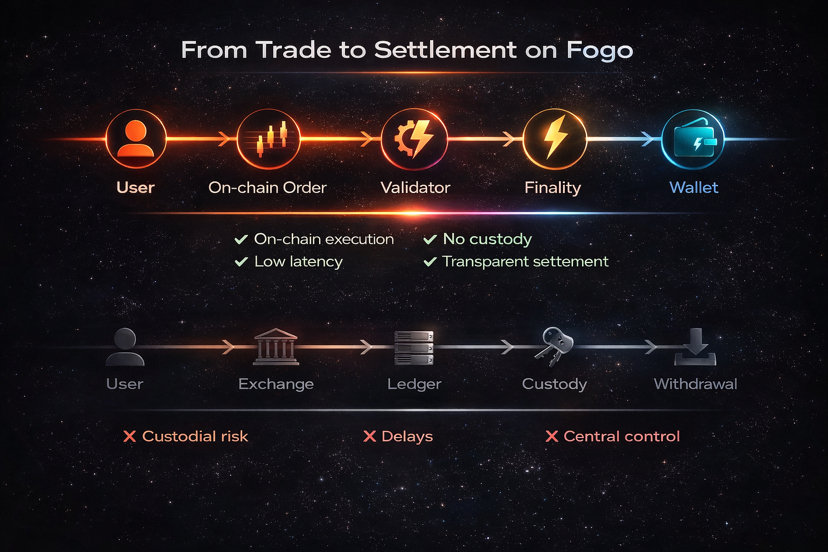
On Fogo, transactions are designed to be fast and predictable — something traders and payment systems actually need. At the same time, assets remain on-chain and under user control. No hidden intermediaries. No black boxes.
This approach reflects what Binance Academy often emphasizes: blockchains that survive long-term balance three things — scalability, security, and usability. Remove one, and adoption slows. Most networks pick only two. Fogo is trying to keep all three.
For developers, it means building financial products without worrying about congestion during market spikes. For users, it means interacting with markets without sacrificing ownership.
In practice, Fogo sits between two worlds. It doesn’t reject decentralization. It doesn’t imitate centralized exchanges. It rethinks how financial infrastructure should work in crypto.
$FOGO is not just a utility token. It represents this attempt to redesign speed, custody, and usability into one system.
I see this not as hype, but as a direction. And in the next phase of crypto, direction matters more than noise.