
When I first started looking closely at Vanar Chain what immediately came to mind was a familiar contradiction I have seen repeat itself across decentralized systems for years. So many platforms speak confidently about trustless execution and onchain transparency, yet when I look at how data is actually stored and accessed, it often ends up sitting somewhere centralized, fragile and quietly out of scope. That gap has always felt unresolved to me because decentralization loses its meaning the moment data ownership is treated as optional. If execution is decentralized but the data that gives it context can disappear or be controlled, then resilience becomes a promise with conditions. When I look at Vanar it becomes clear over time that this contradiction is something they are actively trying to confront rather than ignore.
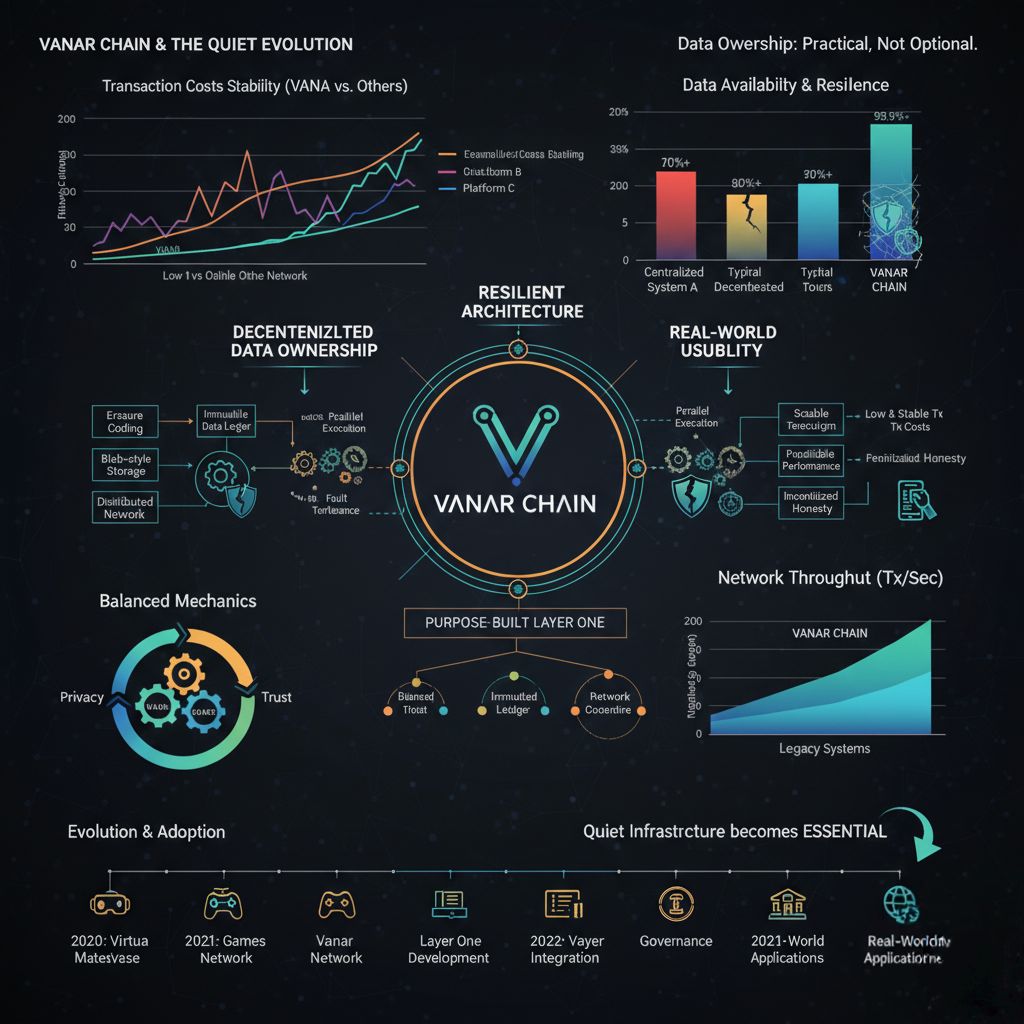
Vanar presents itself as a Layer One designed for real world usage, and what stands out to me is how intentional its architectural choices feel. This does not come across as a chain that happened to arrive at its design by chasing trends. Parallel execution and scalable throughput are not framed as performance bragging points but as necessities once you accept that meaningful applications generate real volumes of data. When systems are built with the assumption that everything will always work perfectly, they tend to fail the moment pressure arrives. Vanar seems to assume the opposite. It assumes components will fail sometimes and designs around that reality. Data is broken apart and distributed across the network using approaches like erasure coding and blob style storage so availability does not depend on a single point staying online. What matters here is not the mechanics themselves but the balance they create between privacy availability and trust. No single participant needs to be trusted with the whole picture and yet the system remains usable even when parts go missing.
As I think through adoption, ideology alone starts to feel insufficient. People do not adopt systems because they are philosophically elegant. They adopt them because costs are predictable performance is reliable and access to their data is not something that quietly expires. Vanar seems grounded in that reality. Low and stable transaction costs are treated as infrastructure rather than incentives and scalability is positioned as a prerequisite for long term use rather than a future upgrade. Incentives are structured so participants are rewarded for behaving honestly which reduces the need for blind trust and replaces it with alignment. That shift is subtle but important because trustless systems only work when honesty is the most rational option.
The native token VANRY enters the picture naturally as part of this coordination rather than as a spectacle. It underpins staking governance and participation in a way that creates a feedback loop where real usage strengthens the network itself. Governance here feels less like control and more like adaptation. It allows the system to evolve as conditions change without locking decisions into a static past. Over time that flexibility may matter more than any single feature.
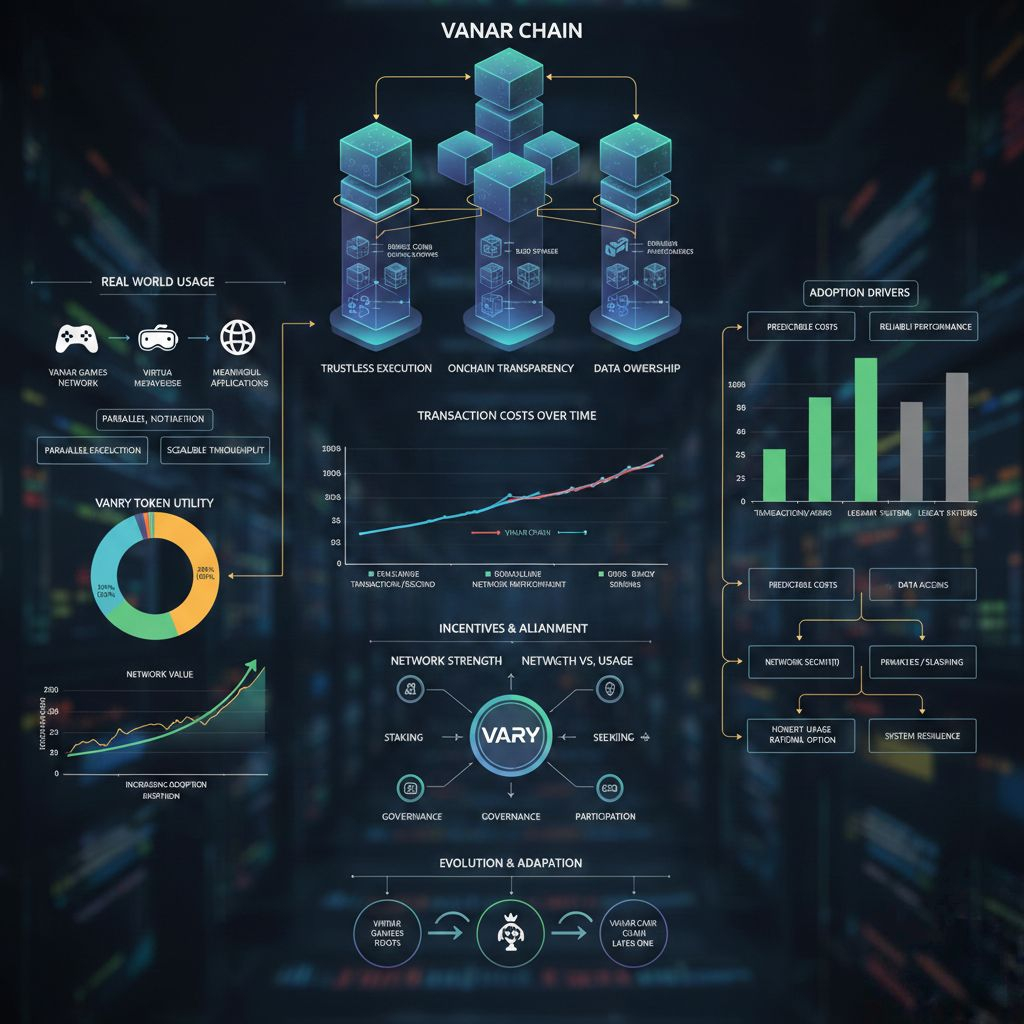
What also becomes clear is that Vanar did not emerge in isolation. Its roots in platforms like Virtua Metaverse and the Vanar Games Network reflect a longer attempt to understand how people actually interact with digital environments. These are not experiments designed to impress other builders. They are attempts to connect decentralized infrastructure to experiences people already understand and value.
Markets tend to reward what is loud visible and immediately exciting. Quiet infrastructure often goes unnoticed until it becomes essential. When I look at Vanar I do not see something optimized for attention today. I see a system that is trying to solve the less glamorous problems of data ownership resilience and long term usability. Those efforts rarely generate instant excitement but they shape the foundations of what comes next. If decentralized technology is going to matter beyond theory it will be because projects like this quietly made data ownership practical rather than optional.
