
Fogo is not positioning itself as a copy of anything. The real value in its choice to build around SVM is not a headline metric that people repeat on social media. What actually matters is the starting position it creates. Most new Layer 1 networks launch with a blank execution environment, unfamiliar assumptions for developers, and a long uncertain climb toward meaningful activity. I have watched many chains struggle through that phase. Fogo is approaching it differently by anchoring its Layer 1 around a production tested execution engine that has already shaped how serious builders think about performance, state design, concurrency, and composability. That decision does not automatically guarantee adoption, and I am not pretending it does, but it changes the early probabilities in a very real way. It lowers the friction for the first serious deployments in a way that most new chains simply cannot replicate.
SVM becomes meaningful when it is treated as a concrete execution model instead of a marketing phrase. It pushes developers toward parallel processing and performance discipline because the runtime rewards applications that avoid unnecessary contention and penalizes designs that fight against the system. Over time, this shapes a developer culture that focuses less on making something barely function and more on ensuring it can survive heavy usage. When Fogo adopts SVM as its execution layer, it is effectively importing that culture along with the tooling familiarity and the performance focused mindset that comes with it. At the same time, it still leaves room to differentiate in the areas that determine long term durability. I see the real differentiation happening at the base layer, where decisions about consensus behavior, latency stability, and transaction inclusion rules define how the network reacts when demand becomes chaotic rather than calm.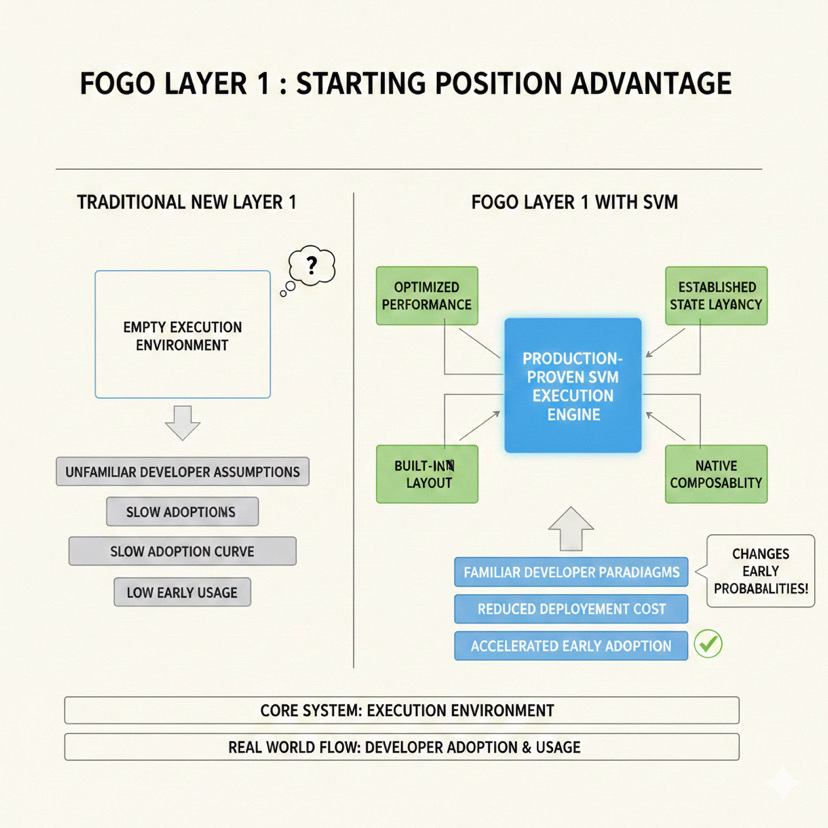
The quiet advantage starts with the cold start problem that quietly damages most new Layer 1 launches. Builders hesitate because there are no users. Users hesitate because there are no applications. Liquidity providers hesitate because volume is thin. Volume remains weak because liquidity is shallow. I have seen this loop repeat across cycles. It feeds on itself and makes even well engineered systems feel empty for longer than anyone expects. Fogo’s SVM foundation can compress that cycle because it lowers the barrier for developers who already understand the execution style and already know the patterns that hold up in high throughput environments. Even if code needs modification and even if deployments require careful testing, the biggest reusable asset is not copied contracts. It is developer instinct and architectural muscle memory. That is what allows a network to move from its first meaningful applications to its first real usage without wasting time relearning fundamentals.
Reuse should be viewed realistically. I think that honesty strengthens the case. What transfers smoothly is the mental framework of building for concurrency, the habit of designing around state access patterns, and the expectation that throughput and latency are product level features. What does not transfer automatically is liquidity and network effects. Liquidity does not migrate just because a bridge is available. Users do not move simply because an application is deployed. Trust has to be earned again. Market depth has to be rebuilt. Even subtle differences in networking behavior, validator incentives, or fee mechanics can change how an application behaves under stress. I believe this is where careful audits and operational discipline matter most, because small base layer variations can have outsized consequences during peak activity.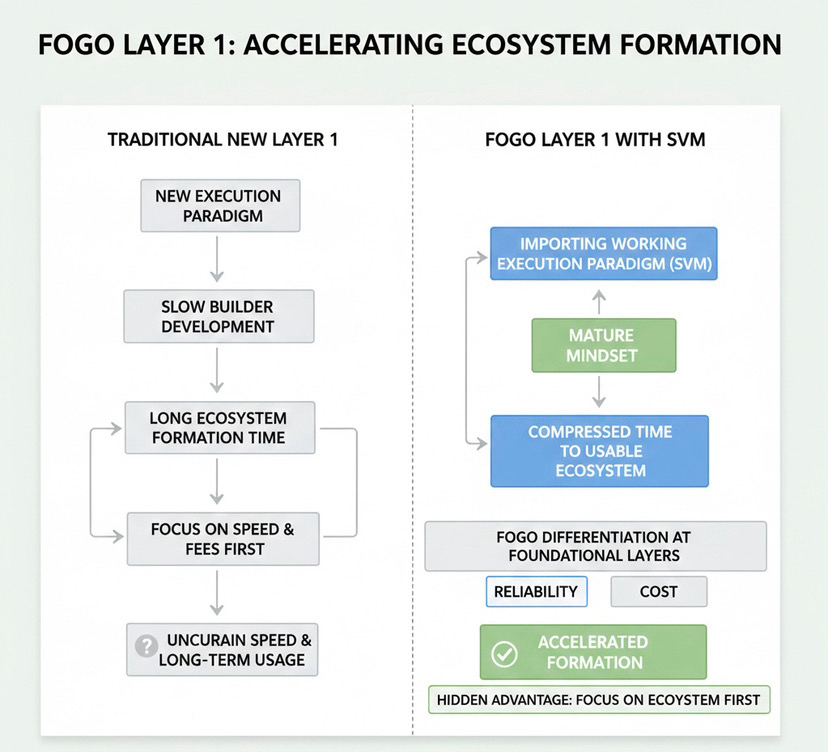
The idea of running SVM directly on a Layer 1 becomes powerful when ecosystem density begins to form. Dense ecosystems do not just appear busy. They behave differently in ways that traders and builders can feel. When multiple high throughput applications share the same execution environment, second order effects begin to compound. More venues and instruments create more routing options. More routing options tighten spreads. Tighter spreads attract greater trading volume. Higher volume draws in more liquidity providers. Deeper liquidity improves execution quality and makes the system feel stable rather than fragile. I find this compounding dynamic far more important than small differences in advertised transaction speed. Builders benefit because they can plug into an existing flow of activity instead of operating in isolation. Traders benefit because the number of pathways between assets and strategies increases, making markets more efficient.
The obvious question always follows. If it runs SVM, is it just another clone. I understand why people ask that. The grounded answer is that an execution engine is only one layer of a much larger system. Two networks can share the same execution framework while behaving very differently in practice. When demand surges and the network is forced to reveal its true character, base layer design choices become decisive. Consensus structure, validator incentives, networking model, and congestion handling policies determine whether performance remains consistent or becomes unstable. I look at it this way. If the engine is shared, the chassis defines how the vehicle handles real road conditions. The chain that makes the right chassis decisions is the one that retains users when stress arrives.
A simple mental model keeps the comparison clear without overcomplicating it. One ecosystem introduced a powerful execution engine to the industry. Fogo is building a new vehicle around that engine with different foundational decisions. The engine shapes developer ergonomics and performance characteristics. The structural framework determines stability, predictability, and how the network behaves when everyone shows up at once. This is why I do not see the SVM choice as merely a compatibility strategy. Compatibility is only the first layer of advantage. Time compression is the deeper layer. The ability to reach a usable ecosystem faster can change the trajectory of a Layer 1 more than incremental speed improvements ever could.
Recently, there has not been a wave of loud announcements or aggressive headline chasing around Fogo. I do not see that as a negative signal by default. Often, it means the project is focused on practical structural work rather than performative marketing. From what I can observe, the emphasis appears to be on strengthening the elements that make a network feel reliable to builders and users. That includes reducing onboarding friction, improving the consistency of core performance, and ensuring that the system remains steady as usage scales. When a network is trying to prove itself, the most meaningful progress often happens quietly. Stability under real conditions matters far more than temporary excitement.
The core takeaway remains simple. Running SVM on a Layer 1 is not just about supporting familiar programs. It is about shortening the journey from zero to a functional ecosystem by adopting an execution paradigm that already encourages disciplined architecture. At the same time, it leaves space for differentiation at the foundational layers that determine reliability and cost stability. I think many traders still focus first on speed and low fees, but ecosystem formation is what ultimately determines whether a network becomes a long term venue for building and trading.
If I were evaluating Fogo from here, I would focus less on how impressive a demo looks and more on how the network behaves when real weight is applied. I would watch whether developers treat it as a serious production environment instead of a temporary experiment. I would pay attention to whether the user experience feels consistent enough to build trust over time. I would monitor whether liquidity pathways deepen to the point where execution feels smooth and dependable. Most importantly, I would observe whether performance remains stable during periods of heavy demand rather than only during calm phases. When those elements begin to align, the strategic choice to combine SVM with deliberate base layer design stops being an abstract thesis and becomes visible onchain. That is the moment when a Layer 1 moves beyond narrative and starts to function as a genuine ecosystem.
