
This morning I stood in the kitchen staring at a leaking faucet I’d meant to fix for weeks. The vision was simple: a quick ten-minute job with the right tools. Reality was different—parts scattered across the counter, one wrong turn stripping a thread, the whole thing taking hours and leaving me frustrated at how the plan crumbled under execution.
That same quiet irritation carried over when I opened CreatorPad later in the day. The dashboard showed the latest campaign tasks in a plain list, and one title sat there without embellishment: “From Vision to Execution: The Strategic Role of Fogo in the Next Phase of Blockchain Infrastructure.” I clicked the card, the screen shifting to the empty response field, and the blunt pairing of those two words—vision on the left, execution on the right—stopped me cold.
It was that exact moment, cursor blinking in the submission box under the task header, that corrected an assumption I’d held without questioning. The idea that decentralization by itself is sufficient for the next phase of infrastructure suddenly felt incomplete, almost evasive. We treat it as an article of faith: the more open and permissionless, the more inevitable the progress. But the task forced a harder look. What if the real barrier isn’t lack of vision but the refusal to accept that execution sometimes requires deliberate, even uncomfortable, constraints?
Most of us in crypto have internalized the opposite lesson. Every new chain promises to out-decentralize the last one, as if adding more nodes and removing every rule will magically solve latency, congestion, and reliability. The result is familiar: grand whitepapers, testnets that never quite feel production-ready, and users who still route through centralized bridges when speed matters. The ideology becomes a shield. It lets teams avoid the messy work of prioritization, of saying “this use case first, everything else later.”
Yet infrastructure is not a democracy in the moment of transaction. When milliseconds decide whether a trade fills or slips, when order books must clear without jitter, the system that wins is the one engineered for that specific pressure, not the one most ideologically pure. This is where the discomfort lies. Suggesting that some curation—whether in validator geography, specialized consensus zones, or vertical integration of components—might be necessary for usable performance feels like heresy. It sounds like sneaking centralization through the back door. But watching the faucet drip while the instructions sat ignored, I saw the parallel: the plan only works when you accept the constraints of the materials in front of you.
Fogo illustrates the point without fanfare. It is built around a narrow mandate—real-time trading infrastructure—using an architecture that accepts certain design choices others treat as taboo. The focus is not on being all things to all users but on delivering deterministic speed where it is non-negotiable. That single-mindedness is what the task title made me notice: the strategic role emerges precisely because the project refuses to dilute execution for the sake of broader appeal. It is infrastructure that behaves like infrastructure, not another experiment in maximal openness.
None of this erases the value of permissionless systems. They remain essential for experimentation, for new applications, for the long tail of innovation. But the next phase—the one where blockchain actually competes with traditional market plumbing—may belong to layers that are willing to be less universal and more capable in their domain. We have spent years celebrating the absence of gatekeepers. Perhaps it is time to ask whether the absence of discipline has become its own kind of gate.
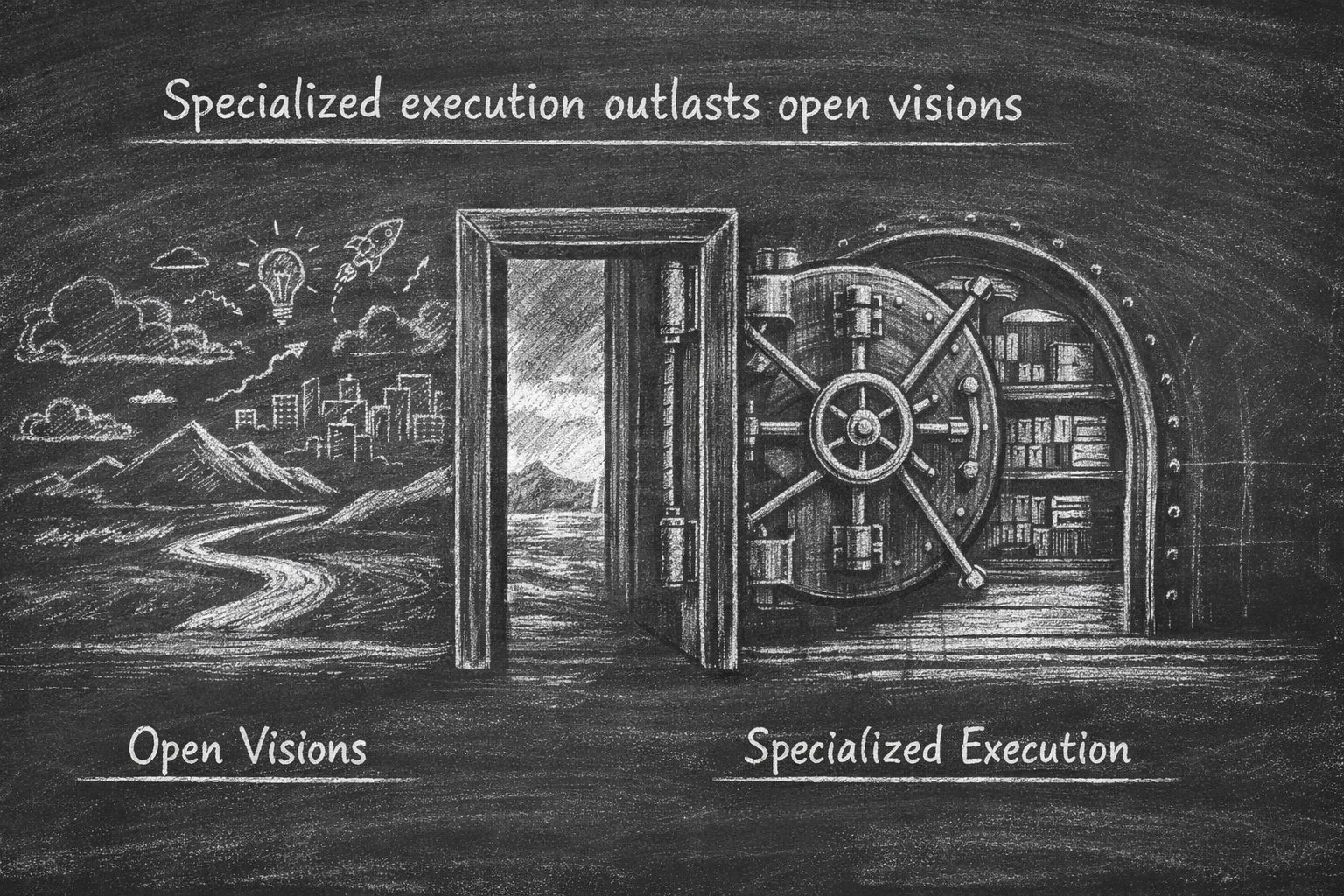
The question that stays with me is simple: how many more cycles will we watch visions stall before we admit that execution, not purity, is the scarcer resource?
@Fogo Official #fogo $FOGO