
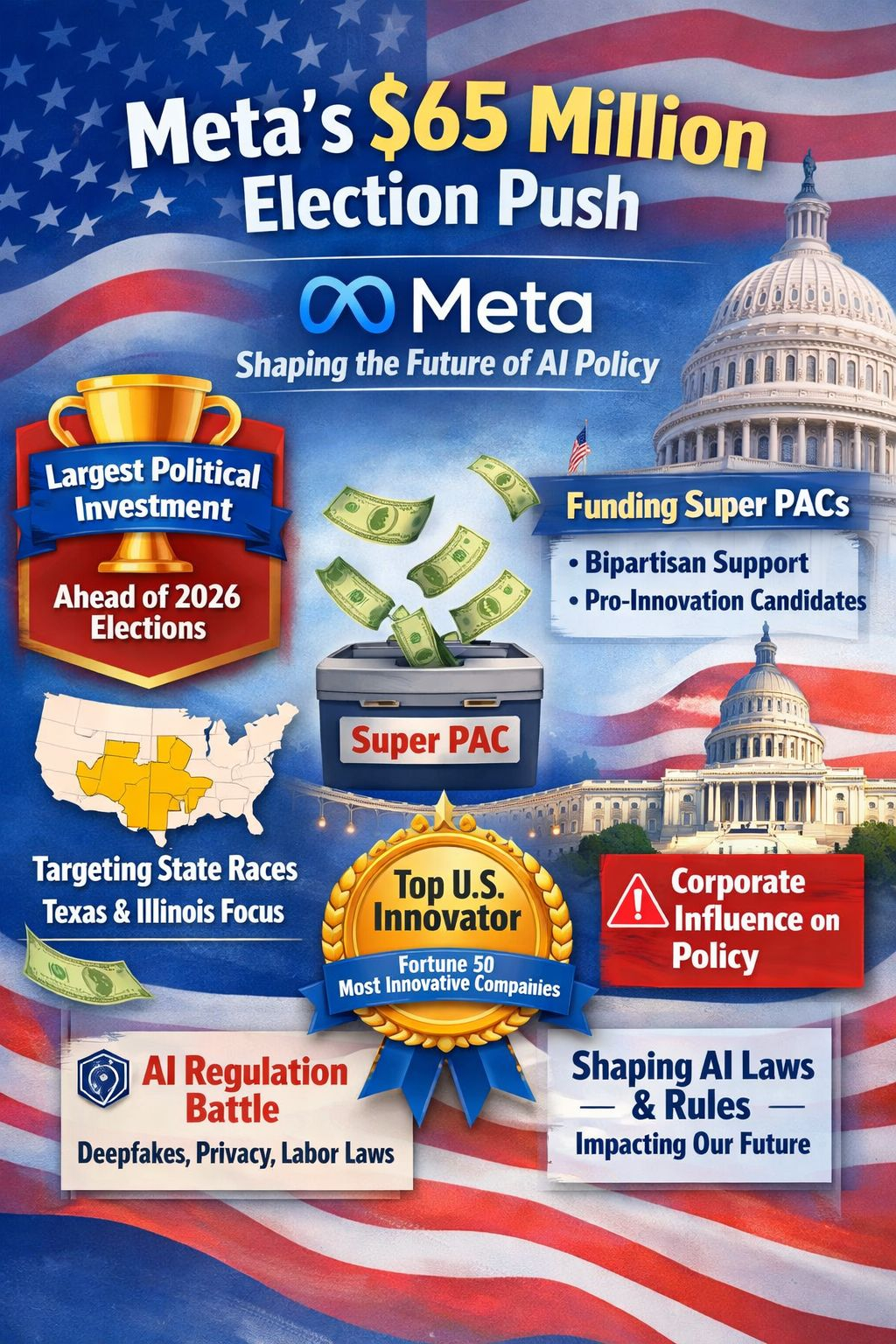
In early 2026, Meta $XRP quietly set the stage for one of its biggest political plays yet: a reported $65 million campaign spending push designed to help elect state-level candidates who take a “pro-innovation” stance on artificial intelligence. The effort is expected to start immediately in Texas and Illinois, signaling that Meta’s new priority isn’t Washington gridlock—it’s the faster-moving lawmaking engines in statehouses, where rules on deep fakes, data privacy, AI liability, online child safety, and even data-center construction can advance in weeks, not years.
The strategy reflects a basic political reality: states are writing the first real rulebook for AI. While Congress debates big frameworks, state legislatures have been introducing—and passing—large numbers of tech and AI bills, creating what companies describe as a “patchwork” of requirements. Axios previously reported Meta’s view that state proposals can be “poorly crafted” and numerous (Meta cited over 1,100 state tech policy proposals introduced in a year), and that this patchwork could slow U.S. competitiveness in the AI race.
To execute the plan, Meta’s approach leans on the political machinery that has become the default tool for modern influence: super PACs. Reporting tied to the NYT story indicates Meta is deploying the $65 million war $USDC chest through new committees aligned with both parties—one aimed at helping Democrats, another at helping Republicans—so the company can shape outcomes regardless of which party controls a chamber. Techmeme’s aggregation of reporting on the push describes two super PACs by name “Making Our Tomorrow” (Democratic-focused, launching in Illinois) and “Forge the Future Project” (Republican-focused, launching in Texas).
Why Texas and Illinois? The answer is less about ideology than leverage. Texas has become a central node in America’s compute boom: huge, power-hungry data centers, fights over permitting, and political debates over whether the grid can support massive AI infrastructure buildouts. Illinois, meanwhile, is a major Midwestern policy hub with high-stakes statewide contests and legislative influence that can ripple outward. Starting in these states signals that Meta’s political operation is tracking where AI rules—and AI infrastructure—are most likely to collide with voters and regulators first.
This isn’t Meta’s first step into state politics around AI. In 2025, Reuters reported Meta’s launch of a California-focused political group “Mobilizing Economic Transformation Across (Meta) California” built to back state candidates who favor lighter tech regulation, explicitly including AI. That earlier move read like a pilot project: test the messaging, learn which bills are popular or vulnerable, and build relationships with consultants and operatives who know state races. The 2026 $65 million push looks like the scaled-up version.
Meta’s public framing centers on “innovation,” U.S. leadership, and what it calls practical governance, supporting candidates who “embrace AI development” and “defend American tech leadership,” in Axios’s account of Meta’s political messaging. Critics argue that the same framing can mask something simpler: regulatory self-interest. When a company spends tens of millions to influence the lawmakers writing rules that govern its products, its data practices, its AI training pipelines, and its liability exposure, the line between “public policy” and “corporate strategy” becomes hard to see from the outside.
Meta’s bet also lands in the middle of a rapidly escalating AI election spending arms race. Reuters recently reported that Anthropic is donating $20 million to a political group supporting state-level AI regulation—explicitly positioning itself against efforts to weaken state authority over AI laws. That same Reuters report describes competing networks and super PAC activity around AI governance, showing the industry is no longer lobbying quietly; it’s funding electoral coalitions that can determine who writes the rules in the first place.
What happens next is likely to shape how AI feels in daily life: whether deepfake political ads face strict limits, whether AI-generated fraud triggers tougher liability, whether companies must disclose more about data use, and whether states impose new constraints on where and how AI infrastructure expands. The deeper story behind Meta’s $65 million push is that AI policy is becoming election policy—and the winners won’t just be candidates, but the future regulatory environment that defines how powerful AI systems can be built, deployed, and profited from in the United States.
#StrategyBTCPurchase #BTCVSGOLD #Xrp🔥🔥 #meta #MillionaireGoals