
Rethinking Validator Failure: How Fogo Reframes Blockchain Reliability
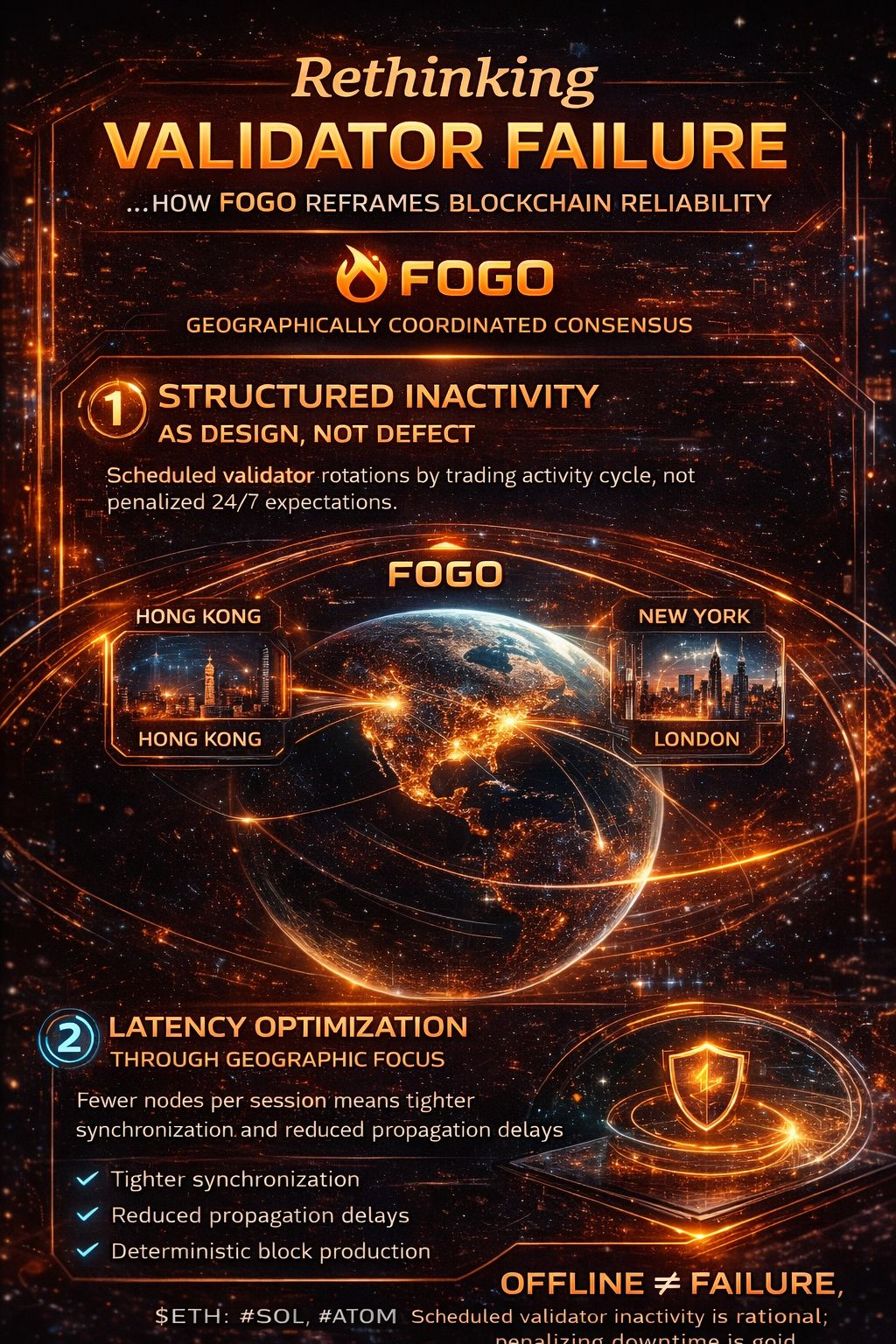
q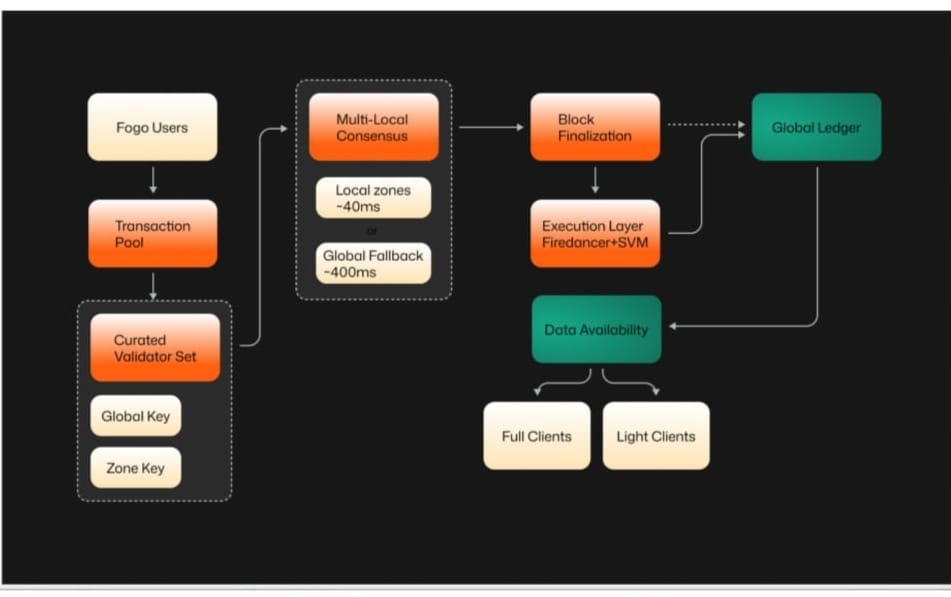 The original design by Satoshi Nakamoto treated offline nodes as natural but undesirable. Later networks hardened that assumption:
Ethereum introduced slashing.
Cosmos enforced validator jailing.
Polkadot applied era-based stake penalties.
The shared philosophy: an inactive validator equals failure.
Fogo challenges this premise.
1️⃣ Structured Inactivity as Design, Not Defect
Fogo’s “Follow the Sun” consensus reframes uptime expectations. Instead of forcing all validators to remain globally active 24/7, it organizes participation geographically by trading activity cycles:
Asia session → Singapore / Hong Kong
Europe session → London
U.S. session → New York
Validators vote on the active zone and prepare infrastructure accordingly. When a zone rotates out, validators in that region do not fail—they pause by protocol design.
This is not reduced reliability. It is coordinated specialization.
2️⃣ Latency Optimization Through Geographic Focus
Most discussions frame this as latency reduction—and it is.
But the deeper innovation lies in narrowing the validator set per session to:
Improve network determinism
Reduce cross-continental propagation delays
Maintain execution quality under peak order flow
Instead of chasing average performance benchmarks, Fogo optimizes for consistent block production during real trading spikes.
3️⃣ Antifragility Over Constant Uptime
Traditional infrastructure (power grids, telecom) prioritizes near-perfect uptime. Blockchain consensus systems inherited this mindset.
Fogo diverges.
If a selected validator zone unexpectedly fails or coordination breaks down, the protocol automatically shifts into a slower, global consensus fallback mode. Performance decreases—but liveness remains intact.
This layered model reflects Nassim Taleb’s concept of antifragility:
A system that anticipates stress and structures it becomes more resilient than one that tries to eliminate volatility entirely.
Predictable inactivity strengthens the system.
Unpredictable failure weakens it.
Fogo attempts to convert the former into protocol logic to reduce the latter.
4️⃣ Redefining “Reliable” in Distributed Systems
Reliability in distributed systems is not universal uptime—it is guaranteed progress under variable conditions.
Fogo’s architecture implies:
Reliability = structured validator rotation
Safety = fallback consensus
Performance = geographic concentration during demand
Rather than demanding that all nodes perform identically at all times, the network embraces temporal specialization.
Closing Perspective
If most blockchain systems treat validator absence as a fault condition, Fogo treats it as a schedulable variable.
That shift—from punishing downtime to engineering around it—may represent one of the more subtle but meaningful evolutions in consensus design.