
$WAL has been on my radar for a while, though not in the way a flashy token grabs attention. It’s more like noticing a piece of infrastructure quietly humming in the background—something engineers and developers start pointing to when the conversation shifts to efficiency and reliability. In Web3 circles that care about infrastructure rather than hype, that kind of subtle relevance is what gets people talking.
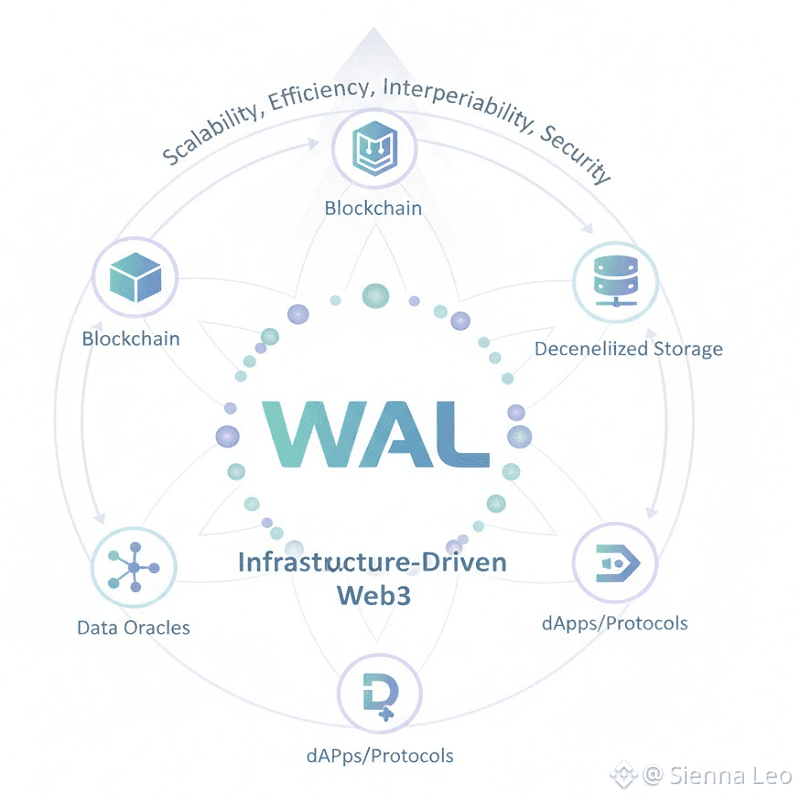
At its core, WAL is a protocol designed to handle decentralized state storage and transactional logging with a focus on modularity. The idea is straightforward: blockchains and decentralized apps are growing more complex, and the tools to manage data integrity and cross-chain operations are lagging behind. WAL was created to provide a more standardized, interoperable way to log changes in decentralized systems without forcing every project to reinvent the wheel. It started as an experimental framework by a small team of developers who had been frustrated with the redundancy and friction in maintaining ledger consistency across different chains.
What makes WAL interesting now is not its novelty, but its practical utility. Infrastructure teams in Web3 are always looking for systems that reduce operational overhead, especially in multi-chain deployments. WAL offers a pattern that’s surprisingly simple in principle: a consistent, verifiable log of state changes that any app can plug into. For projects experimenting with modular blockchains or sidechains, this kind of middleware can significantly lower the risk of desynchronization or data loss.
Thinking about it in real-life terms, it’s a bit like the difference between a city with roads that work only for one type of vehicle versus a network designed to accommodate buses, bikes, cars, and pedestrians without conflict. WAL is trying to create that sort of flexible roadway for decentralized applications. It doesn’t solve every problem—network latency, transaction fees, and adoption barriers still exist—but it provides a foundation that can scale without forcing radical changes to every connected system.
There are practical limits to what WAL can do. It is still a protocol at a stage where adoption matters more than speculation. Its effectiveness depends on integration: if only a handful of projects use it, its value remains mostly theoretical. Security is another consideration; while the design emphasizes verifiable logs, any middleware layer adds a potential point of failure. For teams thinking about implementing it, the question is whether the operational benefits outweigh the dependency on a relatively new and evolving standard.
Looking forward, WAL could find a quiet niche in infrastructure-focused projects. It might never be a household name among casual crypto users, but for developers orchestrating complex decentralized systems, it could become as indispensable as containerization tools are for cloud-native apps. Its trajectory will likely depend on demonstrable reliability, adoption by a few high-profile projects, and continued clarity in how it integrates with existing blockchain ecosystems.
The discussion around WAL is less about excitement and more about recognition—acknowledging a tool that addresses real pain points without needing fanfare. Observing it in practice feels a bit like noticing a bridge that everyone uses to get across a river: not glamorous, but quietly essential.