The Elephant in the Server Room: Why Decentralized Storage Was Failing Until Walrus Arrived
We talk a lot about "decentralization" in this industry. We celebrate when a new Layer-1 blockchain processes 10,000 transactions per second. We cheer when a DeFi protocol hits $1 billion in Total Value Locked. We pride ourselves on the idea that "code is law" and that no single entity controls our financial destiny.
But there is a dirty little secret in Web3 that, for a long time, nobody really wanted to talk about.
Where is the stuff actually stored?
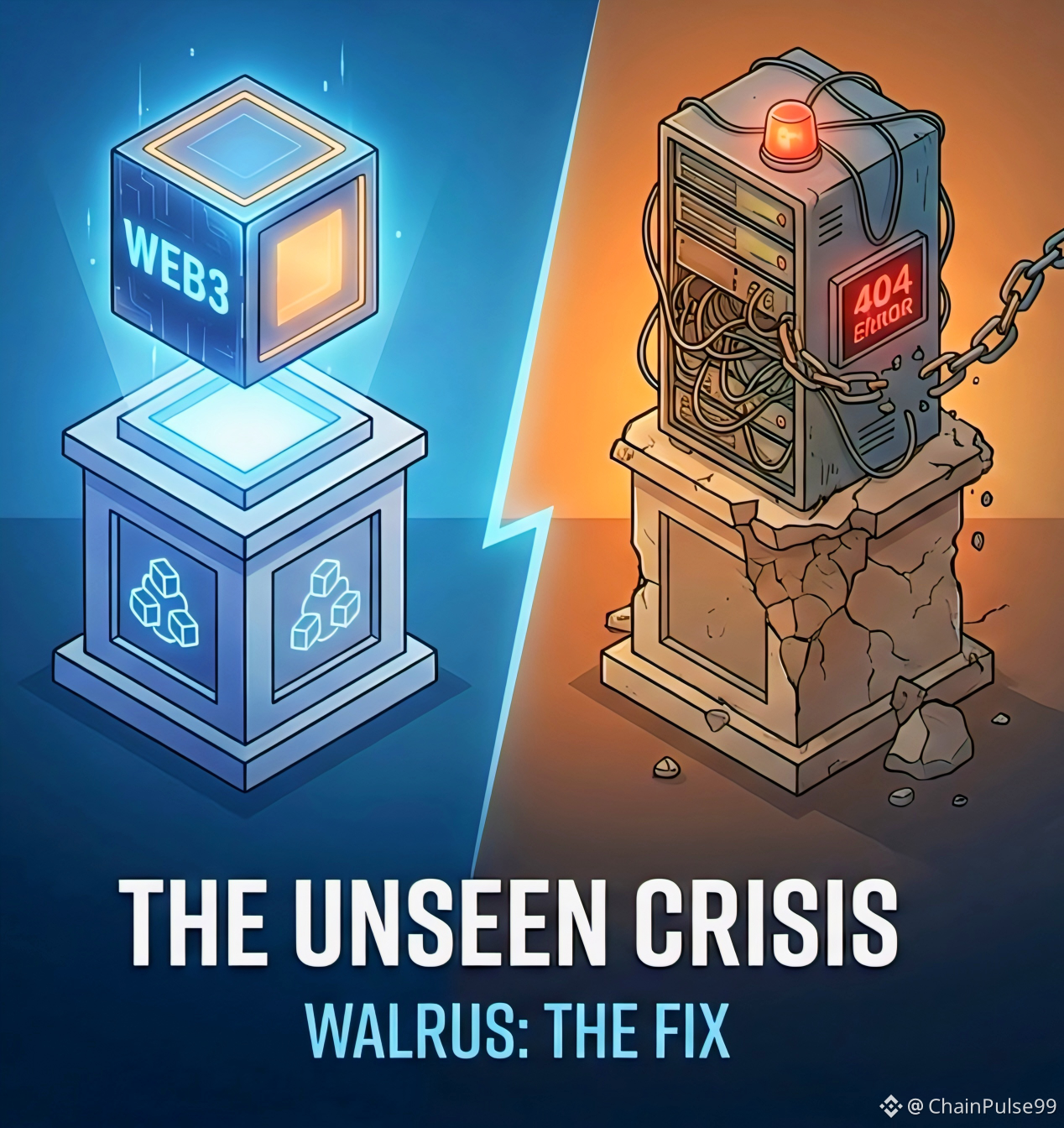
You buy an NFT of a digital artwork. The transaction record—the receipt that says "User X owns Token Y"—is immutable and lives on the blockchain. But the image itself? The high-resolution JPEG or the MP4 video file? In far too many cases, that file lives on a centralized server. It lives on Amazon Web Services (AWS). It lives on a Dropbox link. If that centralized server goes down, or if the company stops paying its hosting bill, your "immutable" asset becomes a 404 Error. You own the receipt, but the goods are gone.
This is the "Data Availability" crisis. For years, solving it was too expensive, too slow, or too complex. Early pioneers like Filecoin and Arweave broke important ground, but they often struggled with the "impossible triangle" of storage: keeping it cheap, keeping it fast, and keeping it decentralized all at the same time.
Enter Walrus.
Not Just Another Dropbox Clone
Walrus isn't just trying to be a "crypto Dropbox." It is building the missing hard drive for the decentralized internet.
Developed by Mysten Labs—the same heavy-hitters who built the Sui network—Walrus was born from a frustration with the status quo. The team realized that as blockchains got faster (thanks to networks like Sui and Solana), the storage layer was lagging behind. You could execute a trade in 400 milliseconds, but retrieving the metadata for that trade might take seconds or cost a fortune to store permanently.
Walrus changes the math. It is a decentralized storage network designed specifically for "blobs"—large, unstructured pieces of data like video, audio, AI datasets, and dApp front-ends.
But the real magic isn't what it stores; it's how it stores it.
The Philosophy of "Red Stuff"
At the heart of Walrus is a technological breakthrough with a surprisingly playful name: "Red Stuff."
To understand why this matters, think about how traditional cloud storage works. If Google wants to make sure your file is safe, they usually just make copies. They might keep three full copies of your file on three different servers. If one breaks, they use the others. It’s effective, but it’s expensive. You are paying for 3x the storage you actually need.
In the crypto world, this "replication" model is even more costly because every node in the network needs to be paid.
Walrus creates a paradigm shift using "Erasure Coding." Instead of copying your file, "Red Stuff" breaks your file into mathematical fragments (shards). It then scatters these shards across the network.
Here is the "human" part of the equation: You don't need all the shards to get your file back. You only need a fraction of them.
Imagine you shred a document into 100 pieces. In a normal world, you’d need to tape all 100 back together to read it. With Walrus’s math, you might only need any 30 pieces to perfectly reconstruct the original document. This means the network is incredibly resilient. A large chunk of the storage nodes could go offline, get hacked, or vanish, and your data would still be instantly recoverable.
Why This Matters for You (Even if You Aren't a Dev)
You might be thinking, "I'm an investor, not a coder. Why do I care about erasure coding?"
You care because it drives the cost down to a level where decentralized storage finally makes business sense.
Before Walrus, storing terabytes of data on-chain was a luxury. It was cheaper to just use AWS and hope for the best. With Walrus, the cost of decentralized storage drops significantly, making it competitive with the centralized giants.
This opens the floodgates for real-world use cases:
Uncensorable Social Media: Imagine a Twitter alternative where your posts and videos aren't stored on a corporate server that can ban you, but on a decentralized web that no single CEO controls.
AI Training Data: As AI grows, we need verifiable, public datasets. Walrus provides a cheap, permanent home for the massive libraries of data needed to train the next ChatGPT, without relying on Microsoft or Google to host it
True NFT Ownership: Finally, your expensive digital collectibles can live entirely on-chain.
The Human Element of Stability
What stands out most about the Walrus project is the team’s focus on usability. They didn't just build a complex math problem; they built a product. They understood that for this to work, it had to be easy for developers to plug into.
By leveraging the Sui network for coordination, Walrus offers something rare in crypto: speed. Sui handles the "management" logic (who pays whom, who stores what) with lightning-fast consensus, while Walrus handles the heavy lifting of the data.
It is a symbiotic relationship that feels less like a science experiment and more like a finished product.
In the end, Walrus is trying to make the "decentralized cloud" boring. And that is the highest compliment you can pay infrastructure. You shouldn't have to think about where your water comes from; you just want it to flow when you turn the tap. For years, the "water" of Web3 (data) has been unreliable. Walrus is finally fixing the plumbing.