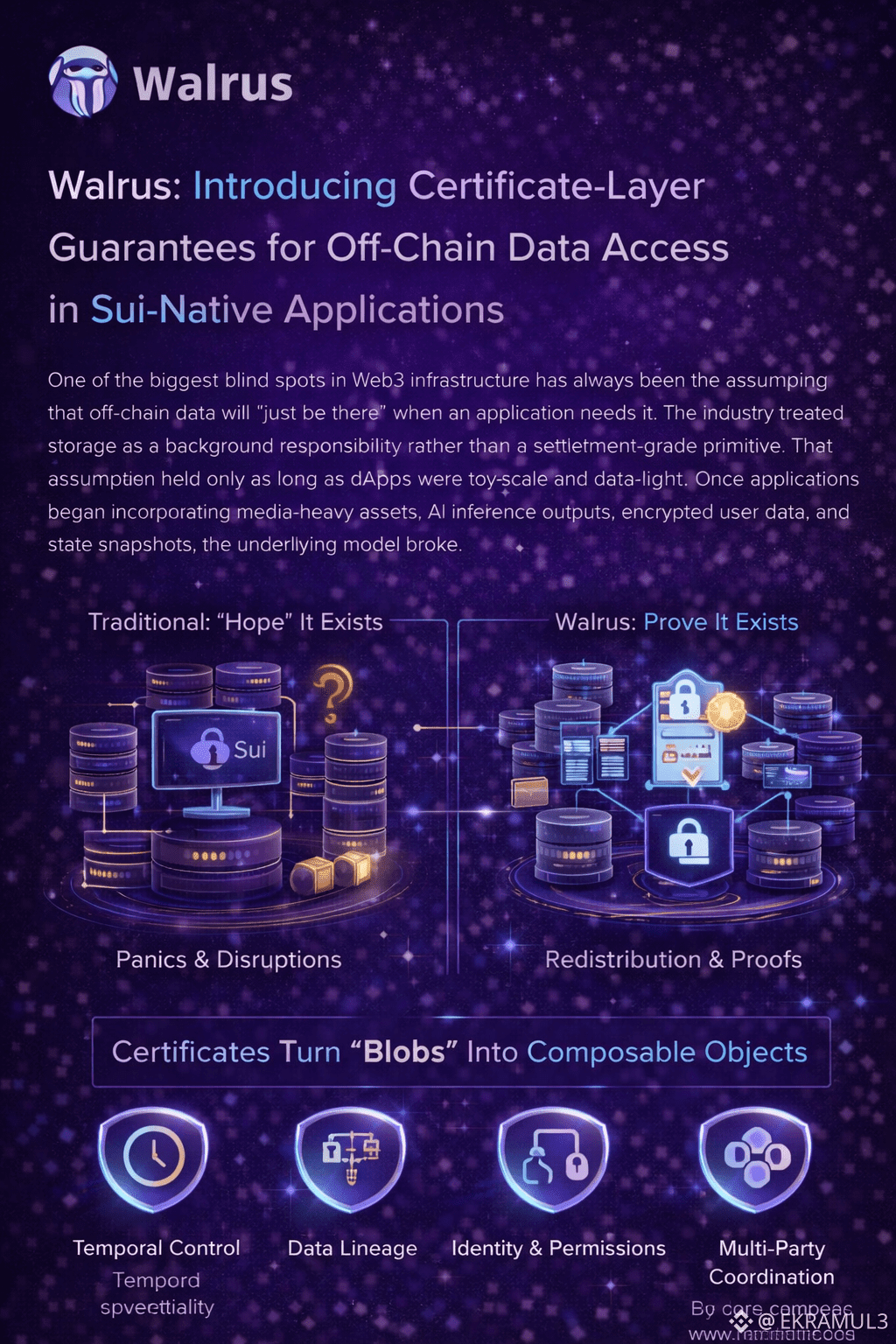
 One of the biggest blind spots in Web3 infrastructure has always been the assumption that off-chain data will “just be there” when an application needs it. The industry treated storage as a background responsibility rather than a settlement-grade primitive. That assumption held only as long as dApps were toy-scale and data-light. Once applications began incorporating media-heavy assets, AI inference outputs, encrypted user data, and state snapshots, the underlying model broke.
Walrus introduces a correction to that assumption by turning off-chain blob availability into a verifiable, certificate-backed process that integrates directly with Sui’s execution layer. Instead of hoping that data is retrievable, Walrus makes retrievability something that can be proven, settled, and referenced by smart contracts.
The Core Innovation: From Probabilistic Availability to Certificate-Verified Access
Traditional decentralized storage networks provide availability through probability:
“If the network is functioning normally, someone will still have the file.”
Walrus replaces probabilistic guarantees with explicit proofs:
“The file exists, is encoded, is stored, and here is the certificate that attests to it.”
This certificate is not decorative. It becomes an object that Sui applications can consume, reason about, and compose with. As a result, blob storage stops being a peripheral service and becomes a first-class resource primitive inside the execution model.
Why Sui Benefits From a Certificate Layer Instead of Trust-Based Storage
Sui was engineered for parallel execution and fast settlement; it was never intended to act as a global storage bucket. That separation is intentional. However, without a storage layer that provides verifiable persistence, Sui applications inherit a hidden risk:
Execution state becomes decoupled from data state.
The certificate layer steps in to close the gap, setting up a clear, step-by-step process:
First comes execution it commits to storing the data.
Next, the certificate shows proof that storage actually happened.
Finally, retrieval relies on that certificate as solid evidence.
No need for a central authority. No blind trust, either.
This design lets Sui handle workflows like:
✔ encrypted messaging
✔ AI output streaming
✔ social graph persistence
✔ audit log retention
✔ enterprise document coordination
all without turning the blockchain into a storage warehouse.
Certificates Turn Blobs Into Composable Objects
Before Walrus, blob-level data in Web3 was effectively unaddressable it could be referenced via a URL/IPFS hash, but it could not be verified, renewed, expired, billed, or governed through protocol logic.
Certificates unlock new composition patterns:
1. Temporal control
Applications can enforce expiration and renewal cycles.
2. Identity and permissions
Access control can be applied cryptographically rather than contractually.
3. Data lineage
Historical snapshots can be referenced without duplicating data.
4. Multi-party coordination
Enterprises and DAOs can collaborate on shared datasets without copying them.
For decentralized AI workloads, this matters even more. Model inputs and outputs become persistent data artifacts rather than ephemeral byproducts.
Economic Implications: Availability Becomes Metered, Not Assumed
Cloud storage charges for bytes at rest and bytes in motion.
Blockchains charge for execution and state.
Walrus introduces a third category:
Protocol-priced persistence
Developers pay for the continued life of their data, not for arbitrary replication. Node operators earn for maintaining verifiable availability, not just for storing bytes.
This is economically healthier than both extremes:
🚫 Cloud-style “pay forever for storage even if unused”
🚫 Arweave-style “pay once, store forever even if nobody accesses it”
Walrus aligns incentives with application reality:
Data that matters stays funded
Data that doesn’t dies gracefully
Retrieval remains cryptographically accountable
Storage remains decentralized
This is how infrastructure survives long after hype cycles end.
Why This Matters for Sui’s Application Layer
Sui is entering a market phase where applications are no longer financial toys they are becoming data-rich systems with parallel state, private user contexts, and off-chain execution traces.
Without a persistence layer, those applications either:
➤ centralize to cloud providers (breaking decentralization), or
➤ constrain themselves to low-data workloads (breaking usability)
Walrus gives Sui a third option:
Decentralized persistence with verifiable access
That is the missing ingredient required for Sui to support:
🧩 decentralized AI models
🧩 crypto-native social networks
🧩 privacy-preserving collaboration tools
🧩 game state that persists across sessions
🧩 enterprise data workflows
🧩 compliance-grade audit systems
None of these categories scale on execution alone.
They require memory.
The Quiet Insight Behind Walrus
The strongest infrastructure products in crypto don’t announce themselves with noise. They integrate deeply and then become invisible. Walrus seems to be tracking toward that category.
It is not competing for speculative attention.
It is competing for relevance in how applications are built.
When a Web3 application requires:
✔ reliable storage
✔ privacy
✔ verifiable reads
✔ time-bound persistence
✔ composable data references
it stops being optional infrastructure it becomes indispensable.