

Most blockchain conversations still treat data availability as a secondary concern, something that sits quietly beneath execution and consensus. It is mentioned briefly in technical discussions, then overshadowed by narratives around throughput or applications. Walrus Protocol starts from a different assumption: if data is not reliably available, nothing built on top of it actually matters.
Blockchains do not fail because transactions cannot be executed. They fail when data cannot be accessed, verified, or reconstructed when needed. Execution without data availability is an illusion of finality. Walrus was designed around this reality, positioning data availability as a foundational layer rather than an optimization problem.
What makes Walrus distinct is its focus on decentralizing data availability without compromising reliability. Instead of relying on a small set of trusted actors or monolithic storage systems, Walrus distributes data across a network in a way that preserves accessibility even under adverse conditions. This is not about storage for its own sake. It is about guaranteeing that the data required to verify state, reconstruct history, and validate execution is always reachable.
In many blockchain systems, data availability assumptions are implicit. Users are expected to trust that data will be there when needed, often because a limited number of nodes or providers are responsible for serving it. This model introduces fragility. If those providers fail, censor, or disappear, verification becomes impossible. Walrus removes that dependency by making availability a protocol-level guarantee.
Recent development around Walrus continues to reinforce this direction. The protocol is increasingly framed as infrastructure for rollups, modular chains, and execution environments that do not want to inherit centralized data risks. By separating execution from data availability, Walrus allows chains to scale without concentrating trust in a single layer.
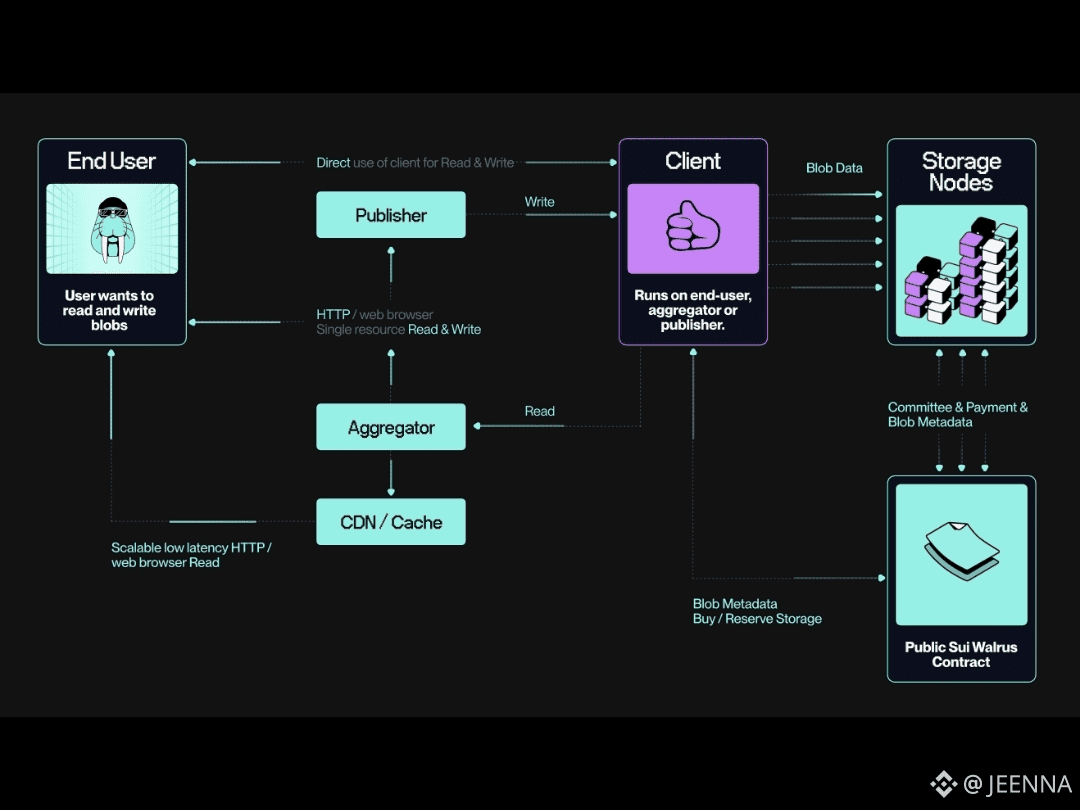
Another important aspect of Walrus is its alignment with long-term decentralization rather than short-term performance metrics. High throughput means little if data cannot be independently retrieved and verified. Walrus optimizes for durability and recoverability, ensuring that data remains accessible even as networks grow and participants change.
This approach also has implications for security. Data availability attacks are subtle but devastating. If data is withheld, users cannot verify state transitions, and the system’s guarantees collapse silently. Walrus addresses this risk directly by designing availability as an explicit, enforceable property of the network rather than an assumption.
There is a tendency in the market to undervalue this kind of infrastructure because it operates in the background. Users interact with applications, not availability layers. But applications only remain trustworthy if the data beneath them is accessible. Walrus focuses on that invisible layer because it understands where real systemic risk lives.
Walrus Protocol does not position itself as a competitor to execution environments. It positions itself as the layer that makes them credible. By ensuring that data remains available, verifiable, and decentralized, Walrus strengthens the entire stack above it.
As blockchain systems continue to modularize, data availability will no longer be optional. It will be a requirement. Walrus is building for that future by treating data availability not as a feature to advertise, but as infrastructure to depend on.

