Crypto has spent years debating transparency as if it were a moral absolute. Either everything should be visible or nothing should be. This debate made sense when blockchains were mostly places for experimentation. It matters far less now, as the industry moves closer to real financial infrastructure. Dusk exists because finance does not operate on absolutes. It operates on boundaries.
What sets Dusk apart from many layer 1 blockchains is not performance or programmability but a more practical observation. Financial systems are built around controlled disclosure. Privacy is not optional, yet opacity is unacceptable. Most blockchains choose one side and justify the consequences. Dusk starts from the belief that both sides are necessary and that reconciling them is the real challenge.
This viewpoint influences everything about the network.
Transparency was never designed for markets
Public blockchains made one bold choice early on. They treated transparency as a virtue in itself. Every transaction, balance, and interaction was visible by default. This created trust in a trustless environment, but it also caused behaviors that traditional markets typically avoid.
Front running, copy trading, strategy leakage, and adversarial surveillance are not flaws in transparent systems. They are natural outcomes. For retail experimentation, that trade-off was acceptable. For regulated finance, it was a deal-breaker.
Markets rely on asymmetry. Timing, information, and discretion are competitive advantages. Institutions protect these advantages not to deceive regulators but to function effectively. Dusk understands that transparency in the wrong context does not create fairness; it creates fragility.
Why private chains were not the answer either
When public blockchains proved too exposed, the industry swung in the opposite direction. Permissioned and private chains promised confidentiality and control. However, they sacrificed neutrality.
Private chains brought back trusted operators, governance bottlenecks, and limited composability. They seemed familiar to enterprises but felt strange to crypto. They addressed privacy by discarding openness.
Dusk occupies a middle ground. It maintains a public, decentralized network while allowing transaction-level privacy and selective disclosure. This balance is not superficial. It determines whether a network can host markets rather than demos.
Financial infrastructure is judged by auditors, not users
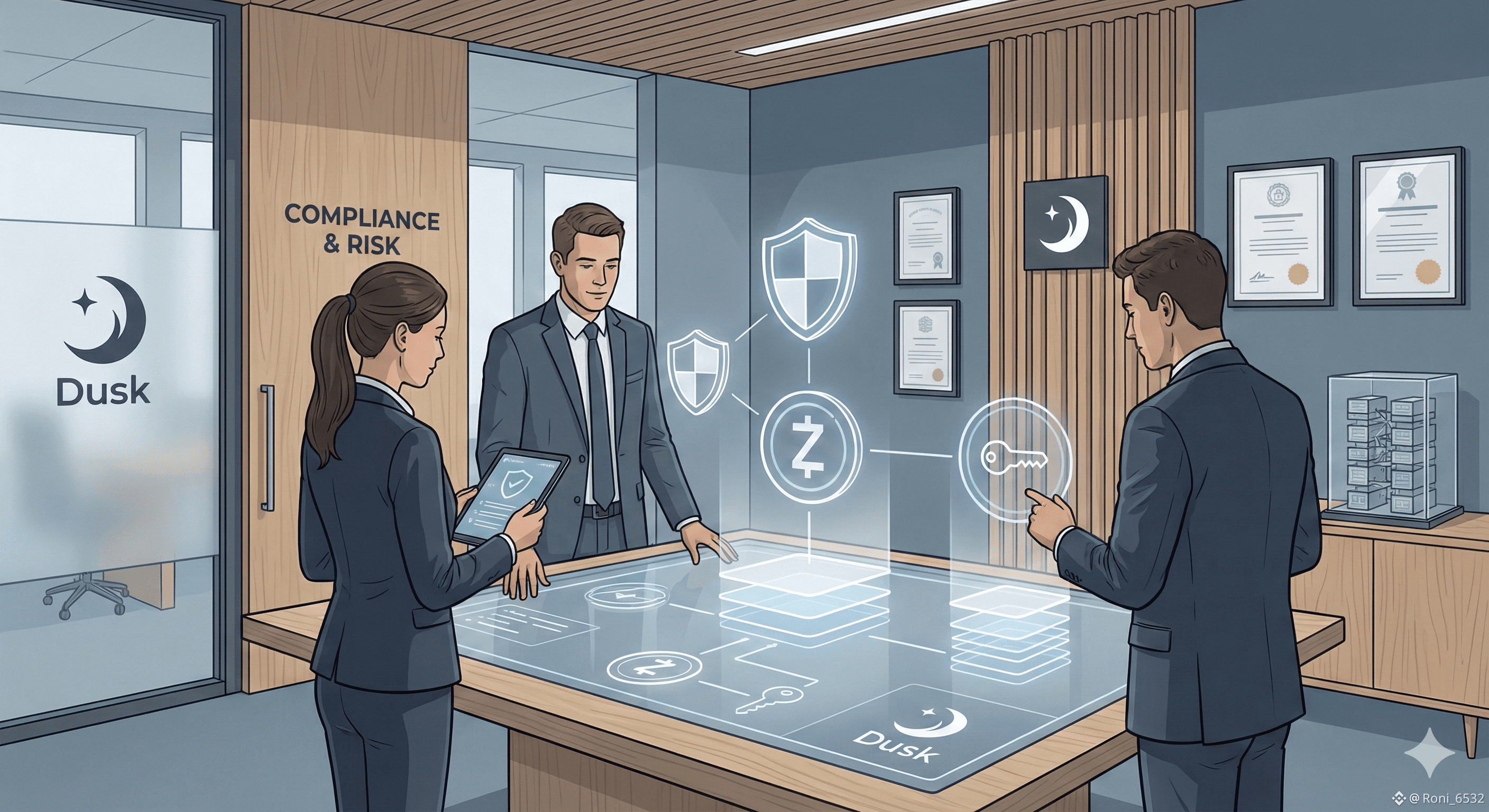
One reason people often misunderstand Dusk is that it is designed for a different audience. Many blockchains focus on developers or traders. Dusk focuses on auditors, compliance officers, and risk committees.
These stakeholders do not care about narratives. They care about provability, enforceability, and legal defensibility. They ask questions that most protocols were not designed to answer.
Can transactions be proven compliant without revealing counterparties?
Can historical activity be audited without exposing unrelated data?
Can access be granted selectively without undermining decentralization?
Dusk’s architecture exists because these questions matter long before liquidity arrives.
Zero knowledge as a governance tool
Zero knowledge proofs are often seen as privacy tools. In Dusk’s context, they serve more as governance mechanisms.
They allow participants to prove that rules were followed without disclosing sensitive inputs. This shifts compliance from trust-based reporting to cryptographic verification. Regulators do not need to assume honesty; they can verify it.
This is a subtle but significant shift. It reframes regulation as something enforceable on-chain rather than imposed from the outside. This alignment reduces friction for everyone involved.
Modularity reflects regulatory reality
Regulation is not uniform. What is acceptable in one jurisdiction may be restricted in another. Static protocols struggle in this environment. Modular systems can adapt.
Dusk’s modular design allows applications to adjust compliance rules without rewriting the entire system. Privacy constraints, disclosure requirements, and verification needs can evolve as laws change.
This flexibility is not just about convenience; it is about survival. Financial infrastructure that cannot adapt becomes obsolete, regardless of its past elegance.
Builders are designing for scrutiny, not scale
An interesting shift is taking place among builders drawn to Dusk. They care less about rapid user growth and more about regulatory viability.
These builders assume scrutiny is inevitable. They design systems that can withstand it rather than hoping to avoid it. This approach leads to different product choices, slower launches, and fewer public promises.
It also results in applications that appear dull until they suddenly become relevant.
Why tokenized assets change the equation
The rise of tokenized real-world assets forces the industry to confront its own limitations. Securities, funds, and regulated instruments cannot exist in environments without compliance guarantees.
Dusk’s relevance increases as these assets move on chain. It creates a setting where ownership, transfer, and compliance can coexist without exposing sensitive financial data to the public.
This is not just theoretical alignment; it is practical compatibility.
Markets reward reliability over novelty
Crypto culture often celebrates novelty, while finance rewards reliability.
Protocols that can show consistent behavior under regulatory pressure become trusted infrastructure. Trust builds slowly, but once established, it is hard to displace.
Dusk’s approach trades short-term excitement for long-term credibility. That trade-off may not appeal to everyone but is attractive to institutions deciding where to start experimenting and where to scale up later.
The quiet role of foundations
Projects like $Dusk are often shaped more by their foundations than by market sentiment. @dusk_foundation operates less like a marketing engine and more like a steward of protocol integrity.
This matters because institutional adoption relies on relationships. It depends on consistency, clarity, and the absence of surprises. Foundations that grasp this dynamic tend to outlast more vocal competitors.
Why this design philosophy matters now
The crypto ecosystem is maturing unevenly. Some areas are consolidating while others are fragmenting. What remains constant is the need for infrastructure that regulators can engage with without compromising core blockchain values.
Dusk does not promise to revolutionize finance overnight. It offers something more practical: a place where financial activity can occur on-chain without violating the assumptions that finance is built upon.
Having witnessed multiple cycles of ambition meet reality, this feels less like a bold claim and more like a necessary adjustment.
The future of blockchain in finance will not belong to the loudest protocol. It will belong to the one that makes itself usable under real-world constraints. That is the lane Dusk has chosen, and it is a path that seems increasingly unavoidable.