
What’s good, Binance Square!
After spending a good amount of time comparing storage solutions—both traditional cloud systems and blockchain-based networks—Walrus Protocol stands out as an interesting middle ground. It isn’t trying to replicate everything centralized providers do, nor is it copying earlier decentralized storage models. Instead, Walrus focuses on a specific niche: programmable, verifiable storage designed for modern Web3 and AI-driven applications, built natively on the Sui Network.
Below is a structured comparison of how Walrus stacks up against both centralized giants and decentralized peers—purely from a technology and design perspective.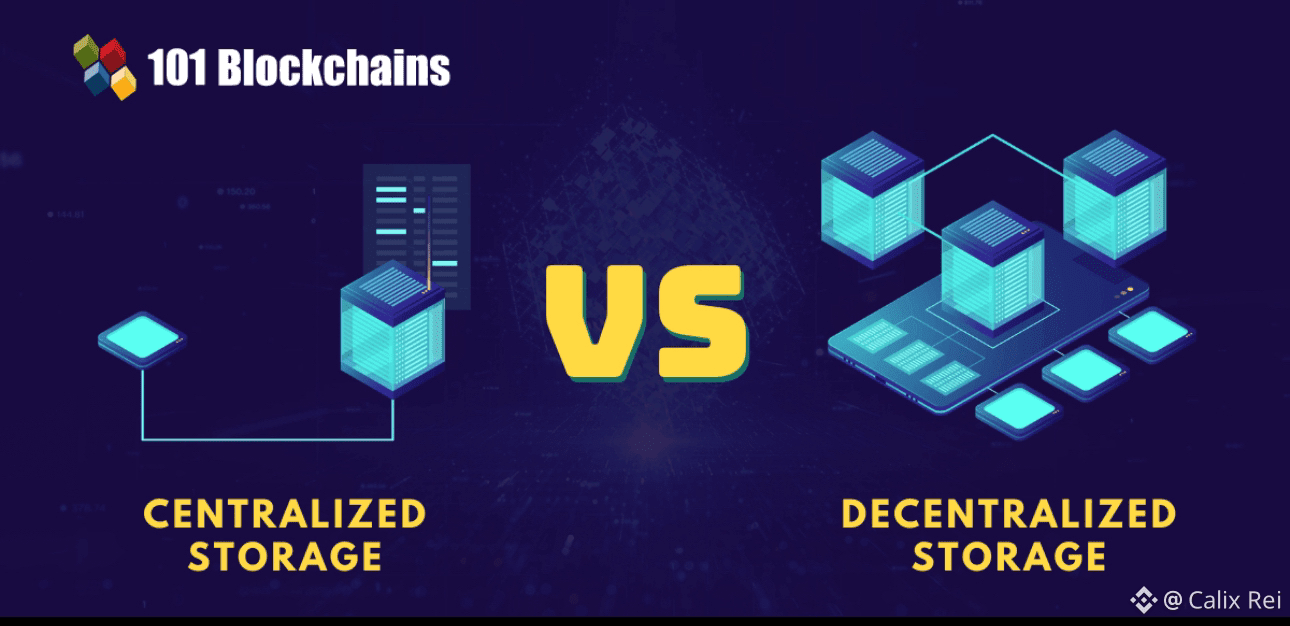
Walrus vs. Centralized Cloud Storage
Traditional cloud services such as Amazon Web Services or Google Cloud are proven, fast, and widely adopted. They excel at low-latency access and mature developer tooling. However, they operate as centralized systems where users rely on a single provider for data availability, policy enforcement, and long-term access.
Walrus approaches storage from a different angle:
Decentralization: Data is distributed across independent nodes rather than hosted by a single operator.
Verifiability: Applications can cryptographically verify that data exists and remains accessible.
Programmability: Storage logic can be integrated directly into smart contracts instead of managed externally.
While centralized clouds still lead in raw performance and enterprise integrations, Walrus offers stronger guarantees around transparency and composability—qualities that are increasingly relevant for decentralized applications and on-chain systems.
Walrus vs. Filecoin
Among decentralized competitors, Filecoin is often the first comparison point. Filecoin has established itself as a large-scale decentralized storage marketplace, particularly suited for archival and long-term storage.
Walrus differs in a few key ways:
Integration: Walrus is deeply integrated into the Sui ecosystem, allowing stored data to be referenced directly in on-chain logic.
Programmable blobs: Instead of storage deals with fixed parameters, Walrus treats data as composable objects that applications can manage dynamically.
Access patterns: Walrus emphasizes frequent access and interaction, whereas Filecoin is often optimized for longer-term storage commitments.
Both models are valid, but they target different developer needs.
Walrus vs. Arweave
Arweave is known for its “store once, access forever” philosophy. This makes it ideal for immutable content such as historical records or static NFT metadata.
Walrus, by contrast, is designed for mutable and evolving data. Applications that require updates, renewals, or conditional access benefit more from Walrus’s renewable storage model. For AI workflows or dynamic applications, this flexibility is often more important than permanence.
Walrus vs. IPFS and Storj
IPFS pioneered content-addressed storage, but persistence depends heavily on external pinning services. Walrus adds economic incentives and protocol-level guarantees to ensure data remains available.
Compared to enterprise-focused decentralized solutions like Storj, Walrus places less emphasis on mimicking traditional cloud features and more on on-chain composability and verifiability, which are crucial for Web3-native applications.
Performance and Architecture Considerations
Walrus benefits from Sui’s parallel execution model, which allows storage-related operations to scale alongside application demand. Instead of forcing all activity through a single execution path, independent objects can be processed concurrently. This architectural choice reduces congestion and improves responsiveness for data-heavy dApps.
While decentralized systems naturally face trade-offs compared to centralized infrastructure, Walrus is optimized for environments where trust minimization and composability are more important than ultra-low latency.
Use Case Comparison
AI & Data Infrastructure: Walrus supports verifiable datasets and transparent data pipelines, which are valuable for decentralized AI workflows.
Gaming: Persistent assets and user-generated content can be stored without relying on centralized servers.
DeFi & DataFi: Applications can reference datasets directly, enabling new forms of data-backed logic.
Rather than competing across every category, Walrus focuses on scenarios where active, programmable data is essential.
Limitations and Trade-offs
As a newer network, Walrus is still growing its node base and developer ecosystem. Tooling and documentation continue to evolve, and broader adoption will depend on how easily builders can integrate storage into real-world applications.
That said, its focused scope and clear design goals reduce complexity and make it easier to reason about long-term sustainability.
Final Perspective
Walrus Protocol isn’t trying to replace centralized cloud providers or every decentralized storage network. Its strength lies in specialization: verifiable, programmable storage built for Web3 and AI-native use cases.
In a future where decentralized applications rely more heavily on data integrity and transparency, Walrus could become a foundational layer—quietly enabling systems that demand more than traditional storage can offer.
Curious to hear your thoughts: which storage model do you think will matter most as Web3 matures—centralized efficiency or decentralized verifiability?