

Walrus is the first to integrate quantal-resistant decentralized storage with lattice-based cryptography, protecting the blob integrity against future attacks of harvest-now-decrypt-later attacks characteristic of the elliptic curve based schemes. Storage node (onboarding) generation Only post-quantum keypairs are created at the start of epochs, the slivers are encrypted using Kyber-1024 variants, and the forward secrecy of the resulting encrypted value is maintained. This defensive hardening makes Walrus the longevity protocol (protocol) to use on institutional datasets over decades, in which data permanence has to outlast a change in computation paradigm.
Post quantum Hardening Encoding.
The Red Stuff encoding can be easily modified to quantum threats by nesting lattices commitments inside sliver header - each fragment contains Dilithium signature verifiable over the NIST PQC with, and can be used to obtain reconstruction proofs which are resistant to superposition attacks. Walrus makes signing keys quantum-safe and rotate between epochs, threshold cryptography documents the existence of secret masters to many nodes to ensure no a single node is compromised bringing forward the complete corpora. To execute recovery auctions, requiring PQC compliant bids, slashing operators can pass quantum hardened availability tests generated on randomized circuits.
Blob organization on Sui registers Kyber public keys as metadata of objects, which allows dApps to encrypt the payload details on the client before posting them - decryption keys can only be recovered through quorum-signed slivers, which removes reliance on trusted third-party keys. This architecture facilitates classical-quantum transitions, and the existing ECDSA proofs can be moved into Falcon-512 on network upgrades without re-freezing overhead with zero compatibility to existing 4.5 million blobs.
Zero-Knowledge Data Provenance Circuits.
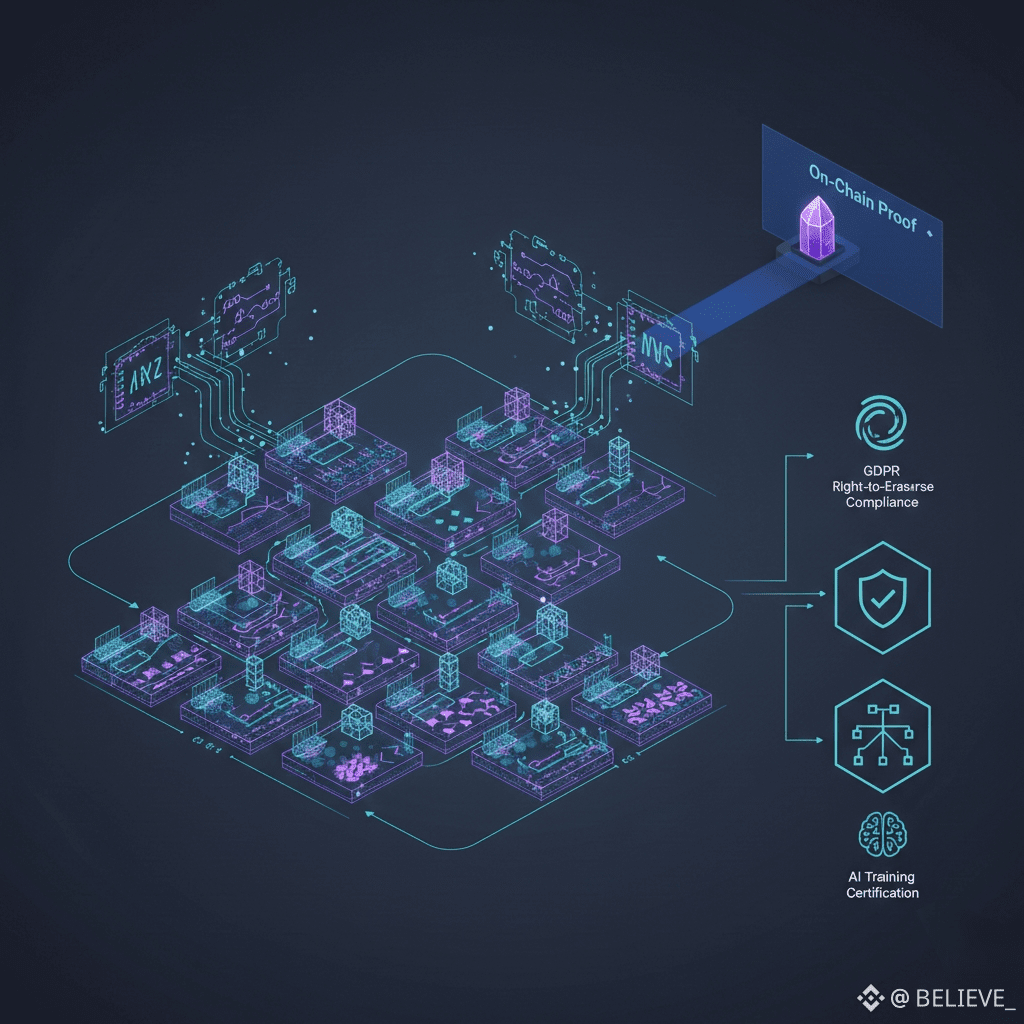
Walrus uses zk-SNARKs built to provide storage proofs which produce succinct attestations, effectively complying with enterprise compliance models such as SOC 2 Type II or if a table of view of contests - such as GDPR Article 17 - without disclosing the contents. Quantum-resistant circuits demonstrate sliver allocation freireign jurisdictions at quality of right-to-erasure procedures filled by on-chain key epochs without destruction of audit trails by regulators. These circuits are queried by AI governance platforms to certify training data lineage which is blocked by mathematical poisoning of datasets prior to deploying the model.
Groth16 aggregators consolidate the thousands of PoA checks into single proofs which are published to Sui, reducing gas expenses 95x on high-velocity streams such as real-time feeds of fraud detections. Walrus generalizes this to recursive composition, zk-proofs on zk-proofs care about nested hierarchies of datasets, which are essential to regulatory sandboxes based on AI risk models using historical financial corpora without privacy leakage.
Temporal Consistency similar to the consistency of time series.
Walrus introduces a concept of temporal consistency unlike the statistically permanent protocols: unlike business-time timelines, Walrus will strictly follow verifiable delay functions persistently included in the timelines of the blobs it is storing (Walrus), which points to a lack of retroactive sliver injections with false signatures in the history. In verifiably delay-randomized client-side uploads, causes may be determined causally, and reordering does not mount a threat. Storage contracts prescribe durability SLAs, which are supported by bonded $WAL collateral and have automatic payouts when freshness proofs are missed - enterprise grade guarantees which are not found on peer networks.
With the Mysticeti consensus of Sui, epoch-finality coordination guarantees atomic transitions of the Bobs state on over-the-world (across-network) committees and long-lived network partitions, beyond 72 hours due to sliver gossip coordination. This reliability is also applicable in the archival modes where the cold blobs are free to move to the special nodes with a 100-year retention rate at a 1/10th of the active rate, wherein space agencies of satellites storing telescope data or governments storing elections would benefit.
Primitives of regulatory compliance.
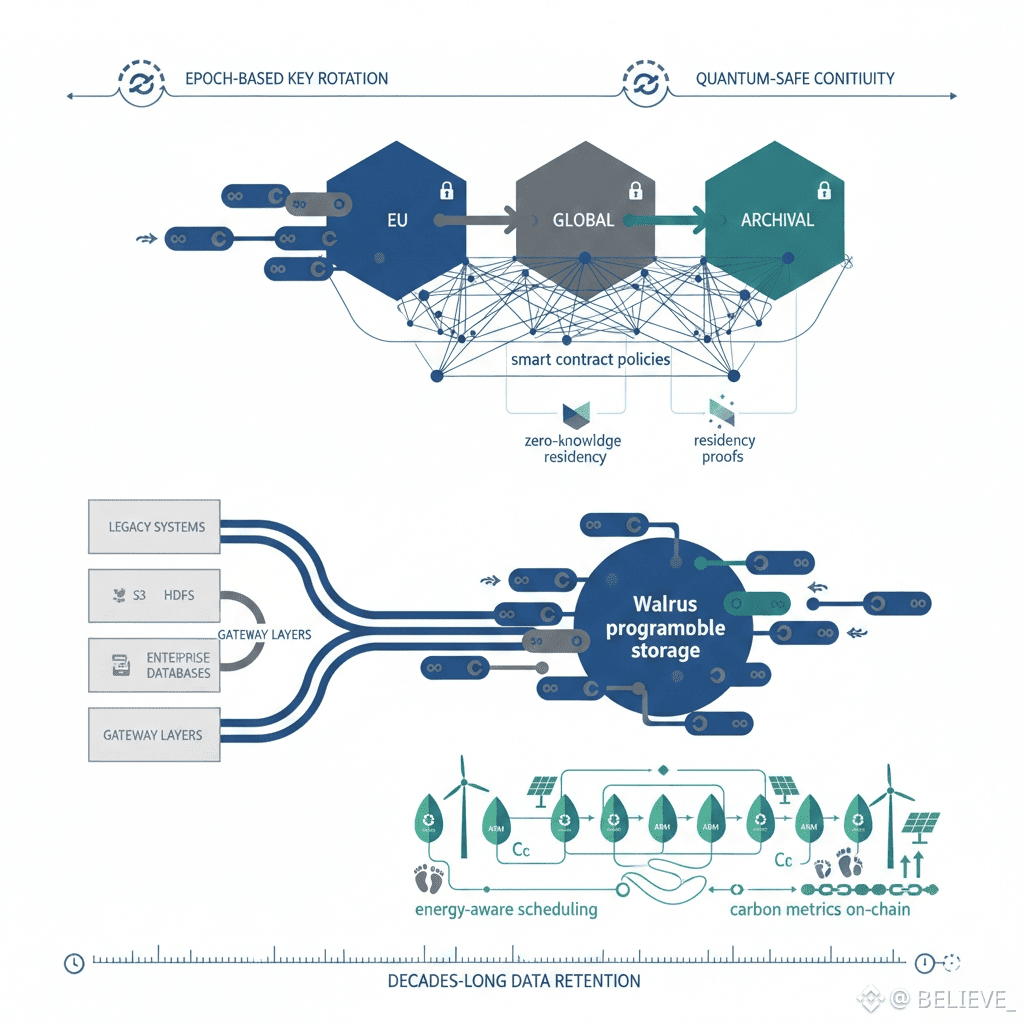
Walrus creates compliance-as-code primitives embedded in blob policies, and Jurisdictional storage routing--slivers give preference to GDPR-compliant operators on EU payloads Jurisdictional file attestation- Kotter duties are automatic, as well. Smart contracts with data localization through geofensed node selection with zk-proofs to attest residency but not metadata. This is used in MiFID II transaction reporting by financial institutions which hold order book reconstructions in terabytes that can be verified by an array of regulators at the same time.
Multi- tenant isolation ensures cross-tenant inference attacks by ensuring that the parameters of the domain-separated encoding are distinct in which each client has sub-slivers with distinct coefficient polynomials that can never be rebuilt algebraically. Board-reporting reality Audit dashboards reveal live compliance statistics, such as percentage of blobs passing 11/11 SOC controls, median of time-to-erase after request, and give financial officers the ability to be satisfied with board-level risk reporting with no manual evidence gathering.
Green Storage Optimization
Walrus optimizes the ARM-based edge node proof computation on node types commonly found in renewable-powered data centers, to be 60x lower in carbon intensity than competitors using the more power-intensive GPUs by using lattice operations with low-precision arithmetic. Sliver builds upon the existing entropy model training frameworks that learn transformation models using the training of the distribution of blobs and encode the payload in a way that adverbently scales with content type genomic sequences compress 8.2x, while video is aided by the neural codecs that achieve 4.1x compression on content. Energy-aware scheduling radios proofs to clusters control it by solar power when the energy generation is optimal to balance between latency and sustainability metrics recorded on-chain.
The node nodes are green certified, and the emission grants to carbon-negative operators in governance systems increase the delegation preference of the node operator in governance. This makes Walrus aligned to the ESG-oriented institutional requirements, in which contracts of storage outline high limits of CO2 quantities known with the help of oracle feeds of sustainability strategies.
Legacy Systems Interoperability.
Walrus gateways reform consistent formats of the enterprise HDFS directories, S3 buckets, Azure blobs, into programmable formats without disrupting the workflow, with POSIX semantics using FUSE mounts as directories exposing Sui objects as filesystems. Chain-of-Custody reports are produced by compliance adapters that are tailored to various validators of SAP, Oracle EBS, or Salesforce, and connect Web3 storage to trillion-dollar ERP systems. Multi-cloud egress policies facilitates the use of hybrid architectures with Walrus supporting hot data and the cold layers gradually descending to archives in the form of tapes.
REST endpoints are mapped to Sui transactions by API compatibility layers which are configured to support OAuth2 enterprise auth flows over wallet signatures. This frictionless onboarding benches legacy finance usage, in which banks transfer petabytes of license checks content without forklift discusses to principle-safe perpetuity.
Walrus is a quantum-secure, regulation-native storage data structure that combines post-quantum cryptography with primitives of visibility-free compliance. Time guarantees decade longevity. Green optimizations meet ESG requirements. Enterprise gateways save investment. The protocol becomes the unquestionable base of data of institutional blockchain, as computation attacks and regulatory complexity give way to mathematically sound engineering.