
When I first came across the Walrus project, I honestly did not expect to spend so much time reading about storage. Most of us in this space talk about tokens, charts, or execution speed. Storage usually gets ignored until something breaks. But the more I looked into Walrus, the more it became clear that big data in Web3 is heading toward a massive bottleneck, and Walrus is one of the few projects actually trying to solve it instead of pretending the problem does not exist.
The idea behind Walrus is pretty simple to understand. As decentralized apps grow and NFTs become more complex and artificial intelligence tools need constant access to large datasets, traditional storage models just do not keep up anymore. They are slow, expensive, and rely way too much on centralized servers. Walrus approaches the issue by treating storage like a core infrastructure layer instead of a side service.
The entire system is built around storing huge blobs of data across a decentralized network. I like how they do not hide the complexity. They openly say that files get encrypted, split into smaller parts, and then scattered across many nodes. If a group of nodes fails, the data is still accessible because no single machine holds the original file. From a reliability standpoint, that is huge. It means no single point of failure, no forced trust in a hosting provider, and no downtime because someone forgot to renew a subscription.
Walrus also runs on the $SUI blockchain, which I find really smart. Instead of being a separate storage network with a slow bridge, Walrus plugs directly into smart contracts on Sui. Developers can use programmable storage that interacts with apps in real time. That is a big step forward from other solutions that sit outside the blockchain and only communicate through added layers.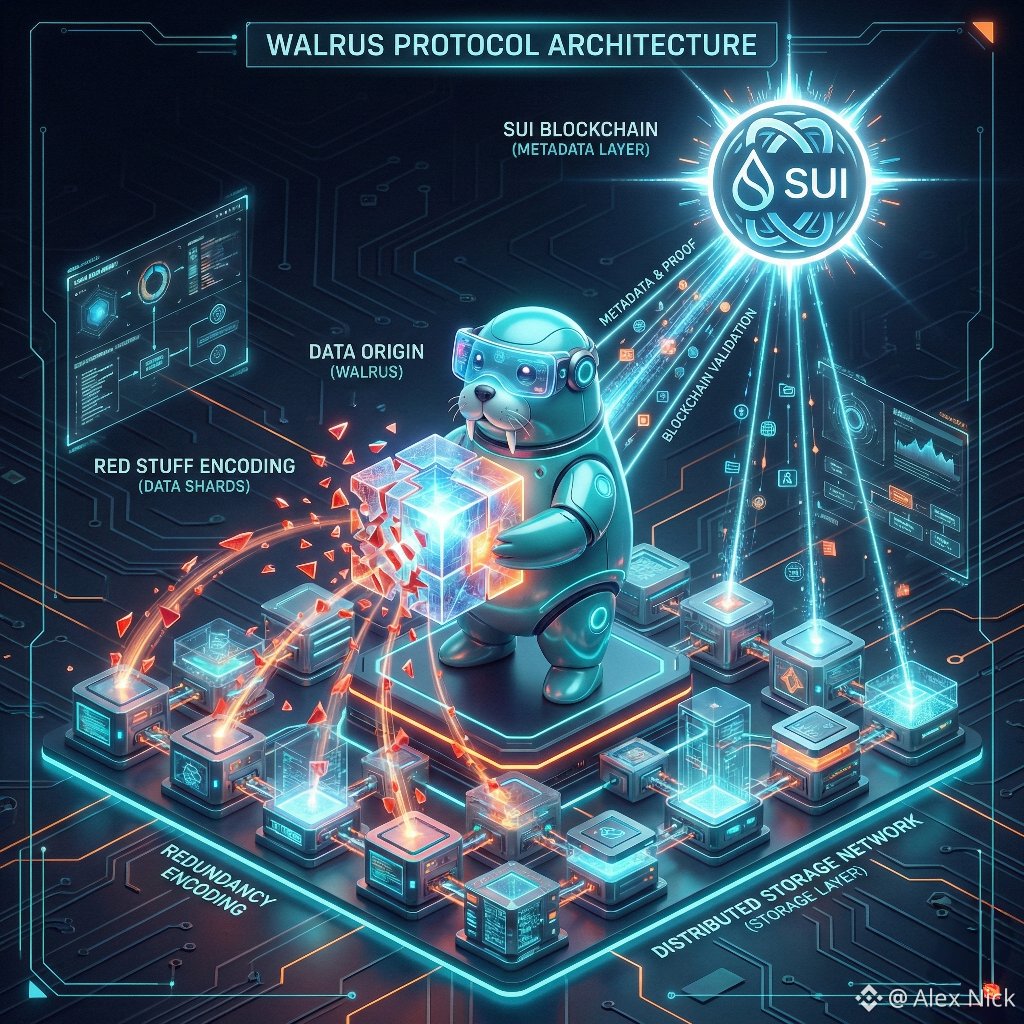
The part that really caught my attention is the Red Stuff Encoding system. Instead of copying entire datasets multiple times, Walrus uses a two dimensional serial encoding method that drastically reduces redundancy. With this method, storage costs drop a lot while still keeping the data recoverable. Even if many nodes disappear, the system can rebuild the data. I personally think this is the kind of innovation decentralized storage needs because raw replication simply does not scale.
Performance is another area where Walrus stands out. The read and write speed is designed for constant interaction with large datasets. That makes it attractive for AI projects, gaming engines, analytic platforms, and any app that cannot afford slow storage calls. Most decentralized storage networks struggle with speed. Walrus is trying to fix that directly in the design.
The WAL token ties everything together. It is used for payments, node incentives, security through staking, and governance voting. There are five billion tokens in total supply, which signals a system designed for massive ecosystem growth rather than a short term pump. I like that it encourages long term participation instead of temporary liquidity mining.
With the combination of new storage tech, deep chain integration, and a token model aimed at real use rather than speculation, Walrus puts itself in a strong position. If developers start adopting it, and if big projects begin storing their heavy data on this network, Walrus could easily become one of the core building blocks of Web3 infrastructure. I could see it powering AI models, game worlds, NFT platforms, and enterprise data systems once the ecosystem matures.
In my view, Walrus is still early, but it is solving a problem that is becoming impossible to ignore. If it delivers on its vision, it could reshape how decentralized applications handle storage for years to come.

