
Every discussion of blockchain performance obsesses over the engine: consensus algorithms, virtual machines, cryptographic proofs. We benchmark TPS, finality times, and gas costs. Yet, we consistently ignore the network layer the actual system of roads, traffic lights, and delivery vans that must carry every transaction, vote, and block between these powerful engines. A Formula 1 car is useless if it's forced to drive on a dirt track.
This is the silent crisis of high-performance blockchains. Innovations like Dusk's Succinct Attestation (SA) promise finality in seconds. But if consensus messages are propagated using the digital equivalent of a gossip-based "telephone game" where each node shouts to all its neighbors latency balloons, messages collide, and the entire system bottlenecks not on computation, but on chaotic communication.
Dusk's solution to this foundational problem is Kadcast. It’s not just a peer-to-peer (P2P) network upgrade; it’s a strategic architectural choice that transforms the network from a liability into a strategic asset. While SA is the brain making fast decisions, Kadcast is the central nervous system transmitting those decisions at the speed of light, with precision and efficiency. For a blockchain built for high-frequency finance, this isn't an optimization it's a prerequisite for existence.
I. The Gossip Bottleneck: Why Traditional P2P Fails Finance
Most blockchains (Bitcoin, Ethereum, Solana) rely on unstructured gossip protocols. The logic is simple: when a node learns something new (a transaction, a block), it immediately broadcasts it to all its directly connected peers ("neighbors"). Those peers do the same. Like a rumor spreading in a crowd, it eventually reaches everyone.
For a slow-moving, high-value settlement layer like Bitcoin, this is adequate. For a chain aiming to be a financial transaction processor, it's disastrous. Let's diagnose the disease:
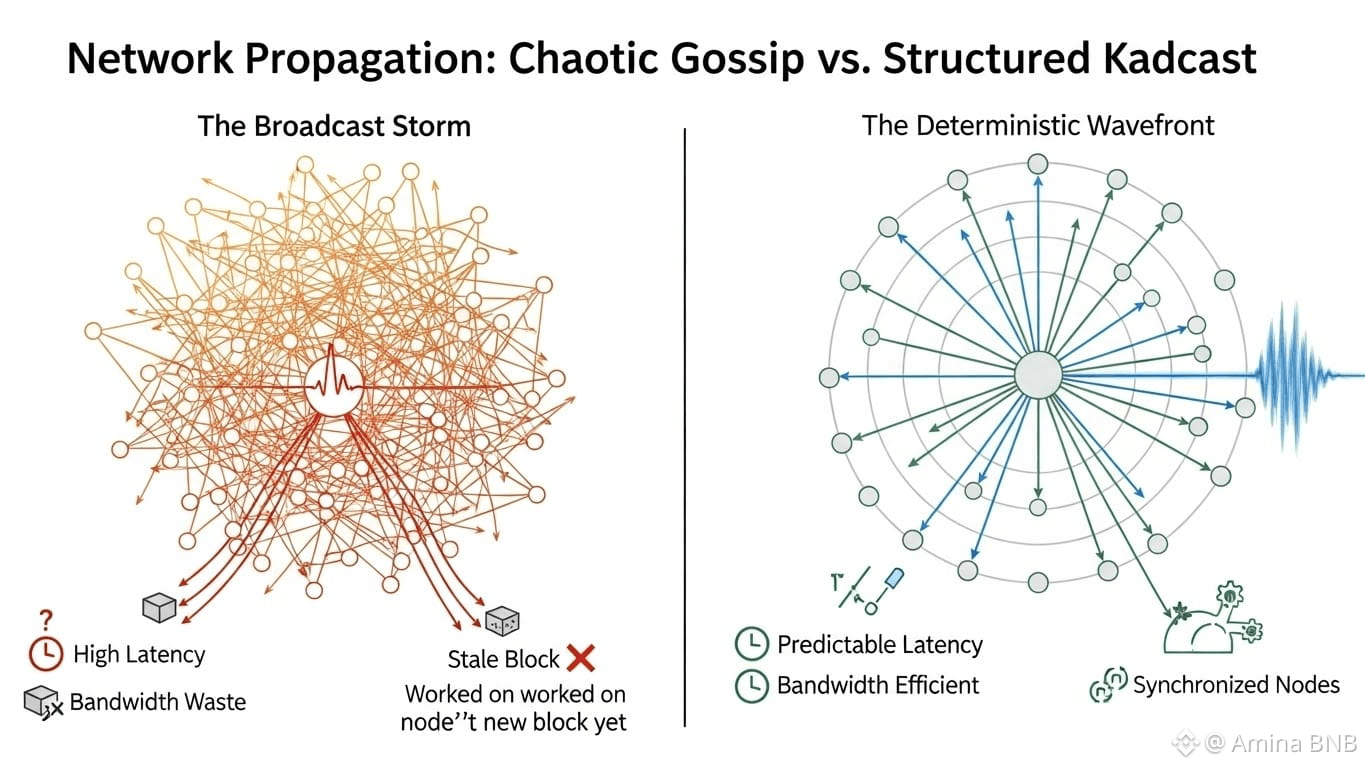
The Broadcast Storm Problem: Every node re-broadcasts every message to all neighbors. This creates exponential redundancy. A message might be sent dozens of times over the same network link, wasting precious bandwidth the scarcest resource in global decentralized networks.
Unpredictable & High Latency: The "gossip" path is random. A message's travel time from one side of the network to the other is a function of random connections and opportunistic forwarding. This leads to high variance in message delivery times (jitter), which is poison for the synchronized, timed steps of consensus protocols like SA.
The Stale Block Epidemic: In fast blockchains, this is fatal. If block propagation is slow and chaotic, many nodes will receive and start building on Block N+1 before they've even heard of Block N. They waste resources on a stale block that will be orphaned. Research indicates gossip protocols can have stale block rates of 10-30% in high-throughput settings, directly capping effective throughput and burning energy on useless work.
Poor Anonymity: In a gossip network, your immediate neighbors know you sent them a message first. While not directly identifying, this weakens the privacy guarantees that protocols like Dusk's Phoenix seek to provide at the application layer.
Kadcast is engineered to surgically remove these pathologies by replacing chaotic gossip with structured, deterministic routing.
II. Kadcast Demystified: From Town Criers to a Postal Network
Kadcast's core insight is profound: To broadcast efficiently, you must first understand the topology of your network. It builds this understanding by layering a broadcast protocol on top of a Distributed Hash Table (DHT), specifically Kademlia the same system underpinning BitTorrent and early versions of Ethereum's discovery.
Here’s how it transforms communication:
The Foundation: The Kademlia DHT "Address Book"
Every Dusk node has a NodeID (a cryptographic hash). The Kademlia protocol organizes all nodes in a virtual, logarithmic space based on the XOR distance between their IDs.
Each node maintains a routing table of other peers, sorted into "buckets" by their XOR distance.
This isn't social; it's geometric. A node knows a few peers that are "close" to it, a few that are "medium" distance, and a few that are "far" away.
The Kadcast Innovation: Structured Broadcast along Distance Rings
When a node needs to broadcast a block (a critical, time-sensitive message), it doesn't scream to all neighbors. It performs a targeted, multi-step transmission:
Step 1 - Inner Ring: It sends the block to all peers in its closest distance bucket (e.g., the 10 peers with the smallest XOR distance to itself).
Step 2 - Middle Ring: Each of those peers, upon receiving the block, forwards it to their closest peers that are farther away from the original sender than they are. This creates an expanding wavefront.
Step 3 - Outer Ring: The process continues, with each wave of nodes forwarding to peers at increasing XOR distances from the origin.
The result is a controlled, non-redundant flood. The message ripples outwards in concentric "distance rings" from the source. Crucially, a node only forwards a message once, and only along the vector away from the source. This eliminates the broadcast storm.
Analogy: Gossip is like shouting in a square. Kadcast is like a hierarchical postal service: the origin post office (node) sends bundles to regional hubs (close peers), which then send sorted mail to local post offices (farther peers), ensuring every address gets the mail exactly once via the most efficient route.
III. The Quantifiable Edge: Why Kadcast is Non-Negotiable for Dusk
The academic research behind Kadcast quantifies advantages that read like a checklist for a financial blockchain's networking requirements.
Bandwidth Reduction: 25-50% Less Traffic. By eliminating redundant transmissions, Kadcast drastically reduces the total bytes transmitted across the network. This isn't just about cost; it's about scalability. Lower bandwidth per node means more nodes can participate on consumer-grade connections, enhancing decentralization without degrading performance.
Stale Block Rate Reduction: 10-30% Fewer Orphans. Faster, more deterministic propagation ensures the valid chain tip is known globally more quickly. In tests simulating Ethereum-like block times, Kadcast significantly reduced the rate at which nodes wastefully build on stale predecessors. For Dusk's SA consensus, this means fewer wasted validation and ratification efforts on competing chains, directly increasing network throughput and provisioner reward efficiency.
Predictable Low Latency & Improved Finality. The structured propagation provides a reliable upper bound on message travel time. This allows the SA protocol to use aggressive, short timeouts in its proposal, validation, and ratification steps. Committees can be confident that if a message hasn't arrived within a known window, it's not coming they can safely vote NoCandidate or NoQuorum and move to the next iteration. This predictability is the glue that allows "finality in seconds" to be a reliable guarantee, not a best-case scenario.
Enhanced Network-Layer Privacy. Because messages are forwarded along a path of increasing XOR distance, it becomes cryptographically hard for an observer to trace a message back to its true origin. The origin is obfuscated within the first "ring" of peers. This fortifies the privacy guarantees built into Phoenix transactions at a foundational level.
Inherent Fault Tolerance. Kademlia routing tables are constantly updated. If a peer in a forwarding path fails, the sender has alternative peers at a similar distance to use. The structure is maintained dynamically, making the broadcast resilient to node churn a constant reality in global P2P networks.
IV. Kadcast in Action: Accelerating the Succinct Attestation Heartbeat
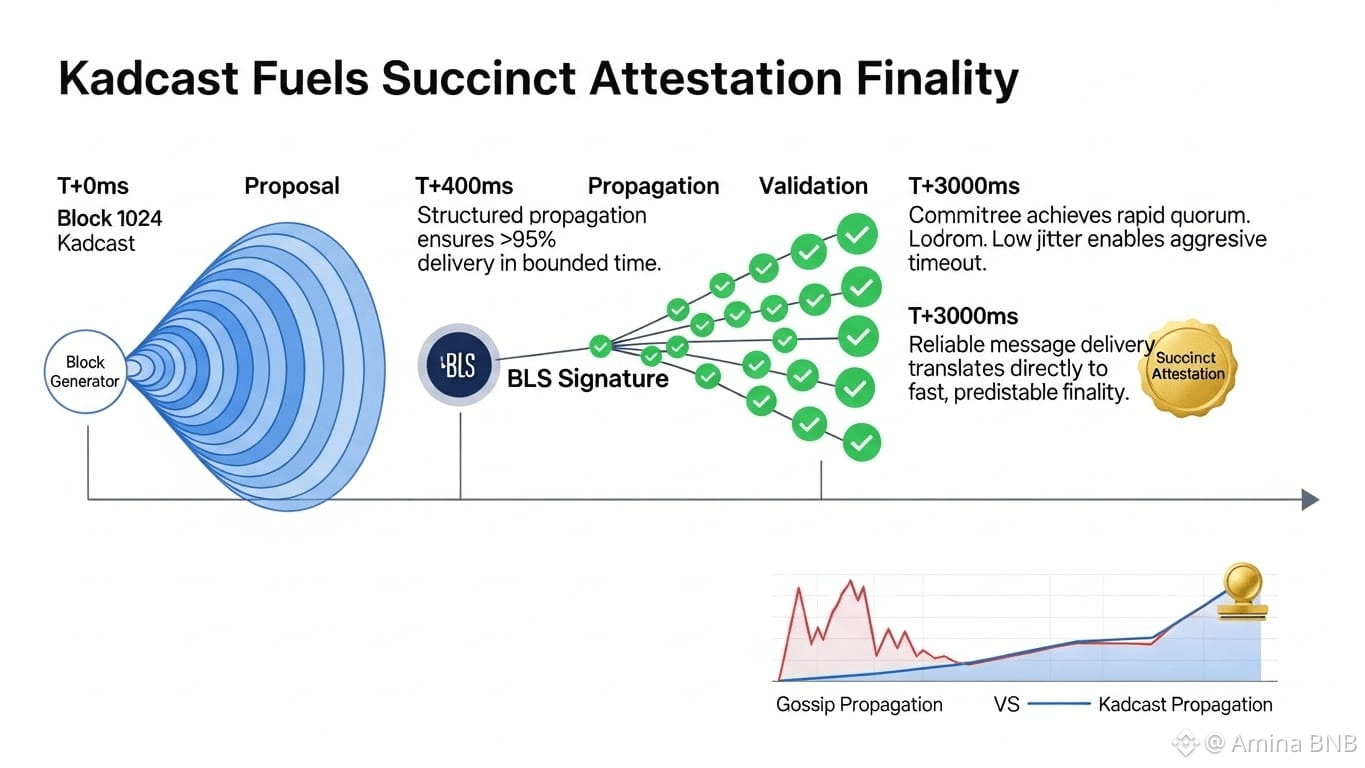
Let's witness the synergy. A Dusk Provisioner is selected as the Block Generator for round 1,024.
Proposal Step (T+0ms): The generator produces Block_1024 and immediately invokes Kadcast.
Propagation (T+0ms to T+800ms): Block_1024 ripples through the network in a structured wave. Within a few hundred milliseconds a time bound the protocol knows it has reached over 95% of the Validation Committee members.
Validation Step (T+1000ms): The validation timeout fires. Because of Kadcast's predictable latency, almost every committee member has received the block. They perform rapid BLS signature aggregation on their Valid votes. A Kadcast broadcast of the aggregated signature is also efficient, ensuring quick quorum detection.
Ratification & Finality (T+3000ms): The same efficient process repeats for the Ratification Committee. The Succinct Attestation is formed and Kadcast to the entire network as the proof of finality.
Contrast this with a gossip network: The block and subsequent votes experience random delays. Some committee members vote late, causing timeouts and forcing the round into a second, costly iteration. Finality is delayed from seconds to potentially tens of seconds. The "high-frequency" promise evaporates.
Kadcast ensures the consensus protocol operates in a synchronized, low-jitter environment, allowing its theoretical speed to become practical reality.
V. The Strategic Imperative: Network as a Competitive Moat
For most blockchain projects, the P2P layer is a commodity an off-the-shelf tool. For Dusk, Kadcast is a core, defensible component of its value proposition.
It provides a competitive moat in the race for institutional adoption:
Performance Moat: It enables SA to deliver its unique combination of fast finality and high throughput reliably.
Decentralization Moat: By reducing bandwidth needs, it allows a more geographically and socioeconomically diverse set of participants to run Provisioner nodes, strengthening the network's censorship resistance.
Privacy Moat: It adds a layer of network obfuscation that complements application-layer privacy, creating a more robust overall privacy solution.
In the cathedral of high-finance blockchain infrastructure, if Succinct Attestation is the vault door and Phoenix is the silent transfer tunnel, Kadcast is the vibration-dampened, redundant, high-speed fiber optic network that connects it all. You don't see it, but without it, the entire system seizes up.
Conclusion
The evolution of blockchain is entering the infrastructure refinement phase. The next leaps in performance and usability won't come only from novel consensus or sharding, but from re-engineering the fundamental plumbing we've taken for granted.
Dusk Network's commitment to Kadcast signals a mature, full-stack engineering philosophy. It recognizes that to build a global financial settlement layer, you must excel not only in what you compute but in how you communicate. By mastering the network layer, Dusk ensures that its groundbreaking cryptographic and consensus innovations don't stall in transit, but are delivered with the speed, reliability, and efficiency that the world of finance demands. In the quest to put Wall Street on-chain, the most important breakthrough might just be the one that makes the network itself invisible.
